Question · Roof lanterns
Is a Roof Lantern Too Big for a Small Extension?
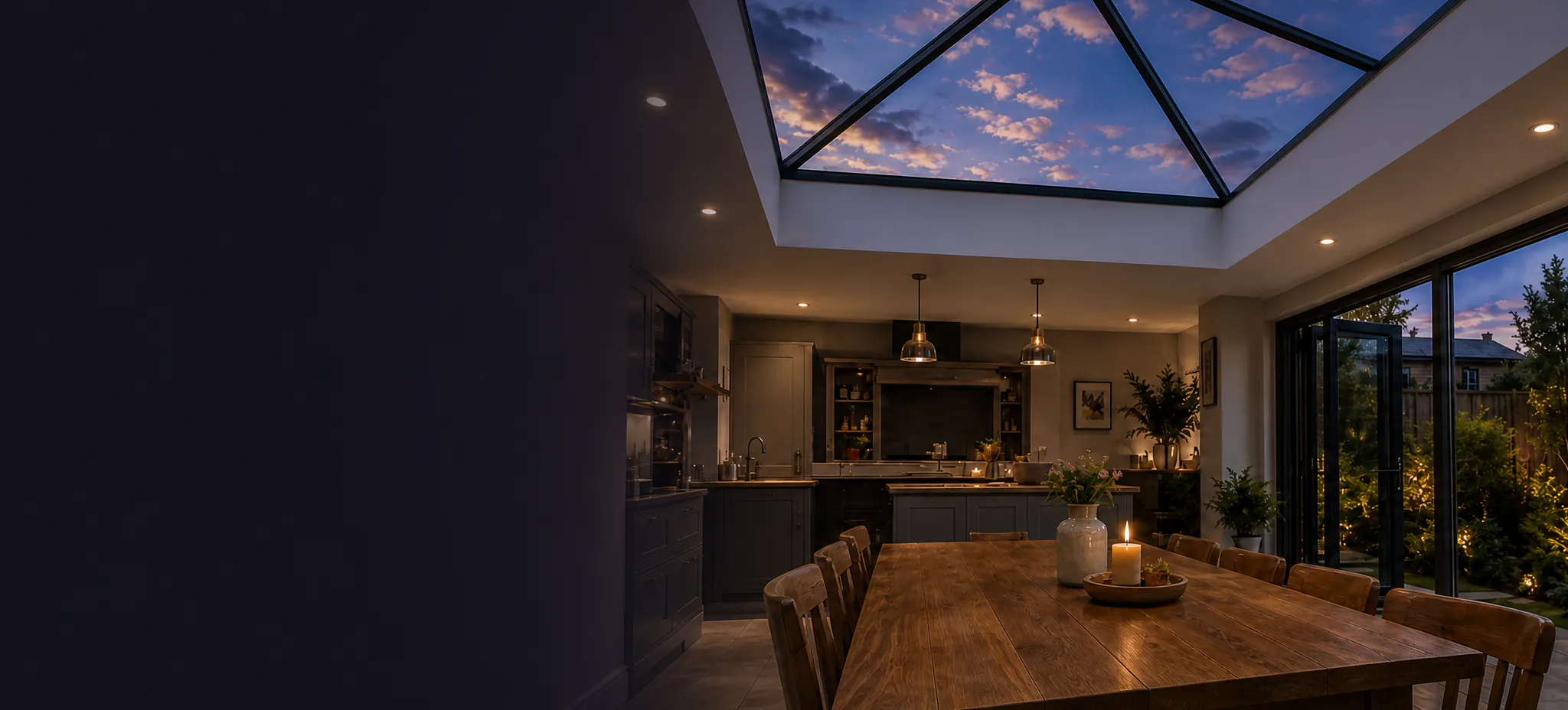
The ceiling that ends up doing all the work
A lantern too large for its room does not simply look big; it takes over the one surface in the extension that was meant to stay calm.
Push a lantern out towards the walls on both sides and the flat plaster ceiling that should frame it shrinks to a sliver, so the glazed box reads as the ceiling rather than a feature set into it. From a chair a few feet back, the ridge sits almost directly overhead, ceiling and sky start to look like one continuous bright volume, and there is nowhere for the eye to rest before the glass begins. That is the practical meaning of "too big": not the size on a brochure, but how much flat, ordinary ceiling is left once the lantern is in.
Why width brings more bar with it, not just more sky
A wider lantern is not simply a bigger version of a small one; the glass has to be split into more panes to stay within a manufacturer's span, so a larger unit carries more rafters, a taller ridge and, on many shapes, deeper hips.
From below, that extra structure sits closer to your line of sight precisely because the glass overhead has grown to fill more of a narrow room. A wide lantern crammed into a small extension often shows you more frame per square metre of ceiling than a modest one would, which runs against the usual assumption that bigger glass simply means more open sky. Our guide to roof lantern glazing bars and the view up sets out how bar count and spacing change what crosses the eyeline from a seat or a table, and aluminium roof lanterns and slim rafters covers how a slimmer profile claws some of that sky back without changing the lantern's footprint.
The width a small room can actually carry
Room width, not the size of the flat roof outside, is the first measure worth taking, because a lantern only reads as part of the ceiling when a clear band of plaster runs down both sides of it.
A useful starting point is a lantern between roughly a third and a half of the room's internal width, and a small extension sits nearer the lower end of that range rather than the upper one. Go past half the width and the ceiling margin either side thins to almost nothing, the lining runs close against the walls, and the lantern stops looking planned. A narrow galley-style kitchen extension, common behind Fletton brick terraces across the city, is exactly the shape where this bites hardest, since there is little spare width either side to give the glass room to breathe.
Our guide to sizing a roof lantern for your extension works through the room width, ceiling height and roof margin together in more detail; the point for a small room is simply that the safest size sits at the modest end of what the room could technically take, not the largest unit the flat roof will physically allow.
A shallow ceiling void makes a big lantern worse, not just tighter
Every lantern sits above a lined well running from the ceiling up to the top of the kerb, and the shallower that well is, the more a wide lantern crowds the view rather than opening it.
On a single storey extension with a modest roof build-up, the well is often no deeper than the joists, deck and insulation demand, which leaves little room for the lining to splay outward as it drops. A large lantern set into a shallow, square-cut well can put the far side of the lining directly in the sightline from a chair near the edge of the room, so part of what you paid for in glass is spent looking at plaster rather than sky. A smaller lantern, or the same lantern moved slightly and paired with a splayed reveal, keeps that same sightline reaching open glass instead.
Where a flat rooflight suits the room better
Once a lantern's width, ridge height and well depth all start working against a small room at the same time, a flat rooflight over the same opening is usually the better answer rather than a compromise.
A flat rooflight lies close to the roof deck with a single pane of glass and no ridge or hip bars, so a narrow extension gets a clean rectangle of sky with nothing dividing it, at a height that suits a lower ceiling void far more comfortably than a raised glazed box. Roof Lantern or Flat Rooflight for the View sets the two side by side room by room; for a small kitchen extension or a box room built over a flat roof, the flat rooflight's plain single view often reads calmer than a lantern working hard to earn its keep in too little space.
A flat rooflight is not the only fallback, either. A pyramid lantern, kept modest and centred rather than stretched wall to wall, can suit a small square extension better than a long hipped or rectangular shape asked to fill the same footprint; Pyramid, Double Hipped and Contemporary Lanterns compares how each shape behaves once the room is on the small side.
What the seating position tells you before a size is agreed
Where people actually sit or stand matters more to a small room than the lantern's overall size, since a modest lantern placed correctly over the table can outperform a large one placed by habit in the middle of the ceiling.
In a kitchen extension, that usually means keeping the glass over the table or island rather than a walkway, so the sightline from a seated position reaches straight glass rather than a hip bar or the far edge of the well. Our guide to planning a roof lantern over the kitchen works through that placement in detail, and the same reasoning holds whether the final choice is a lantern kept deliberately modest or a flat rooflight instead.
The rule that can settle the size on its own
Approved Document L limits how much glazing a small extension can carry, and on a genuinely small room that limit can decide the outcome before questions of proportion even come into it.
The guide sets total glazing, windows, doors and rooflights together, at 25 per cent of the extension's floor area, plus credit for any opening the extension has covered over. On a compact extension with a run of bifold doors already claiming much of that allowance, there is often less room left for the roof than the ceiling proportions alone would suggest, which naturally pushes the size down towards a smaller lantern or a single flat rooflight rather than a large glazed box. Roof Lantern Building Regulations covers what Building Control checks alongside that glazing limit, including structure, insulation and safety glass.
Every quote for a small extension starts with the room's own measurements rather than a preferred size, and a sightline sketch from the seat that matters shows what a given size actually gives back in sky before the roof is cut. The roof lantern installation page covers that process in full, and the costs page sets out what affects the price of a rooflight or lantern once a size is agreed.
Questions people also ask
Is there a minimum size below which a lantern stops working?
There is no fixed minimum, but below roughly a third of the room's width a lantern tends to read as an afterthought rather than a feature, and the sky is only really visible from directly underneath it. Below that point a single flat rooflight, or two smaller ones spaced apart, often gives a better view for the same glass area.
Does a smaller lantern let in noticeably less light than a bigger one?
A smaller lantern lets in less total light, but the view from a seat below it does not fall by the same proportion, since a well-placed modest lantern can still show a clean patch of open sky, while an oversized one over a small room sometimes shows more frame than a smaller one does.
Can a small extension take a lantern on one side and a flat rooflight elsewhere?
Yes, mixing a modest lantern over a table with a flat rooflight over a run of units or a walkway is a common way to keep both areas in proportion, so long as the combined glazing still sits within the room's structural and Building Regulations limits.
Does going smaller reduce how much the roof structure has to be altered?
Generally yes. A narrower opening trims fewer joists and needs lighter trimmers at each end, so a modest lantern or a single flat rooflight is often the simpler structural job as well as the better proportioned one on a small extension.
Book a home visit
Tell us which room
- No obligation
- Sightline sketch included
- 10-year guarantee
Or call 01733 736163