Question · Roof lanterns
Is a Roof Lantern Wasted on a North-Facing Extension?
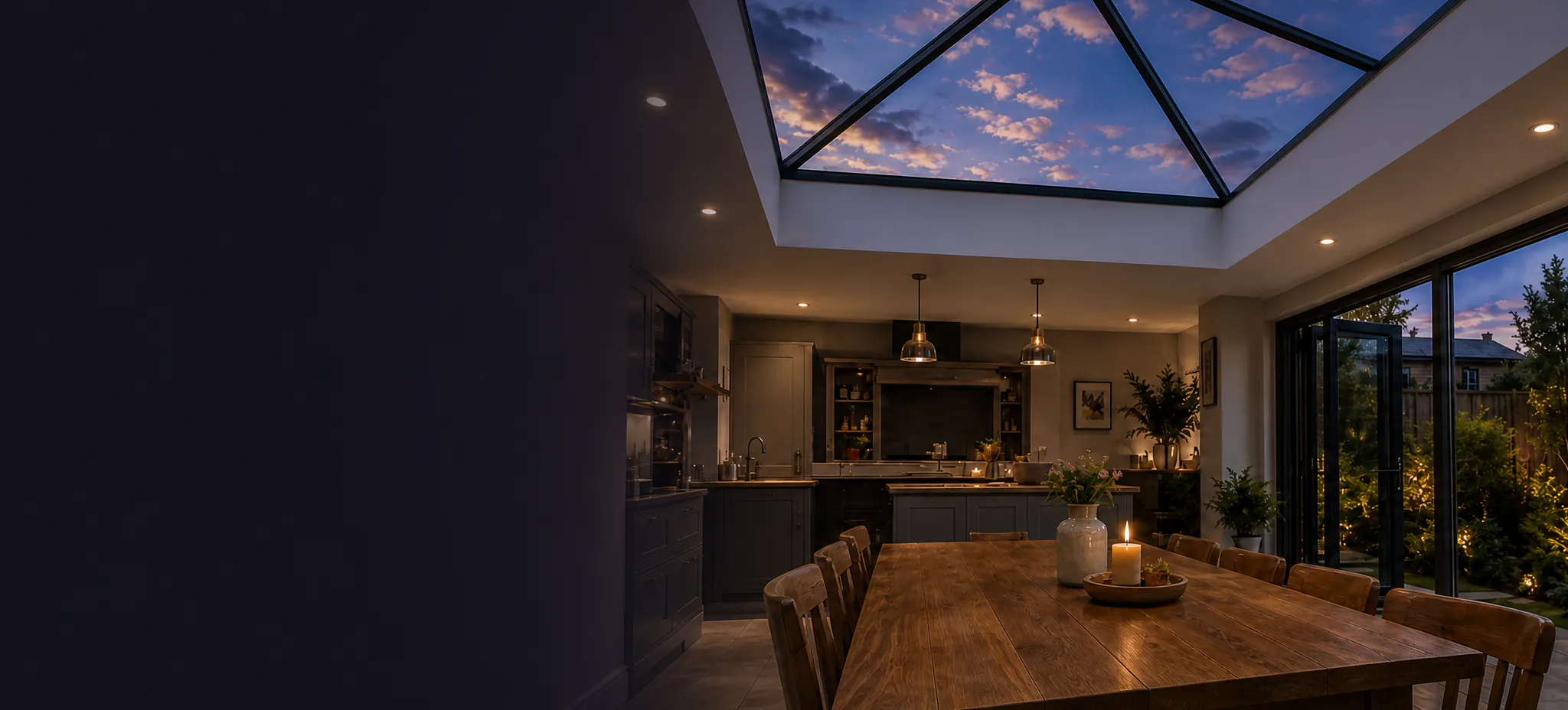
How north light behaves on a roof
Direct sun crosses a south or west lantern in a moving band, throwing a bright stripe across the ceiling and making the glass hard to look at for part of the day. A north-facing roof never gets that. The light comes from the whole dome of sky rather than the sun's disc, so it arrives as one steady wash rather than a hot patch that shifts with the clock.
That has a real effect on the view up. Where a south lantern can bleach the sky to white glare at midday, a north lantern keeps its colour: pale blue on a clear day, soft grey under cloud, without the squint. Sitting under it at a kitchen table, you see the sky itself rather than a glare source you have to look away from.
Where the light is genuinely lower
The difference is real, not imagined. A north roof gets less total daylight over a year than a south one, because it never has direct sun. In a Peterborough extension backing onto a taller part of the house or a boundary fence, that gap widens further, since a north wall is also the side most likely to sit in someone else's shadow.
The answer is rarely to abandon a lantern. It is closer to sizing it generously and choosing a shape that reads well against a flat, even sky rather than one built to filter hard sun. Sizing a lantern to the room covers how ceiling height and the flat roof around it set the right footprint. On a north extension there is little reason to hold a lantern back for fear of overheating, so the constraint is usually the roof and the room, not the compass point.
Glass and frame choices change, not the decision itself
Several choices that matter on a south or west lantern matter less on a north one, and one shifts the other way. None of it changes whether a lantern belongs on the extension, only the specification a fitter should reach for once it is going in.
- Solar control glass, useful for cutting heat gain on a sun-facing pitch, is rarely worth its tint on true north glass. See solar control glass for roof lanterns for where it does earn its place.
- Condensation risk can run slightly higher on a north lantern, since the room and the glass surface both sit cooler, so ventilation and a warm kerb matter more here than on a sunnier pitch. Why condensation forms inside a roof lantern explains the mechanism.
- Frame and bar profile still decide most of what you see, whatever the orientation. A slim aluminium frame keeps more open sky in view than a bulky one. Aluminium roof lanterns and slim rafters and roof lantern glazing bars and the view up cover both.
When a flat rooflight suits the room better
Orientation is not usually the reason to choose a flat rooflight over a lantern. Room shape and ceiling height are. A narrow single-storey extension with a low ceiling can feel crowded by a tall lantern whatever way it faces, and a flat rooflight of the same footprint sits lower and reads as a clean single pane of sky rather than a raised box.
Roof lantern or flat rooflight for the view sets the two against each other room by room, and does a roof lantern let in more light than a flat skylight compares the daylight each gives from the same opening. A lantern on a north roof still gains from its raised sides: a wider spread of sky is visible from a seated position than a flat pane of the same size shows, because you are looking into the sides of the lantern as well as straight up. That part of the case for a lantern has nothing to do with which way the roof faces.
Planning it before the roof opens
Before any glass goes in, we draw a sightline sketch from the table, the sofa or wherever the room is used most, showing how much sky the chosen lantern gives from that seat and where the bars fall. On a north extension that sketch matters just as much as on a sunnier one; it is the honest way to see what the room will actually look like before the roof is opened.
See the sightline sketch for how that drawing works, and what affects the cost of a rooflight for how orientation and glass choice can move the specification. Roof lantern installation in Peterborough covers the fitting itself, kerb to glazing.
Questions people also ask
Does a north-facing lantern still need solar control glass?
Usually not. Solar control coatings cut heat gain from direct sun, and a true north pitch gets none. A standard low-E unit keeps the sky's own colour rather than adding a tint built for a problem the roof does not have.
Will a north-facing lantern make the room feel colder?
The lantern itself will not; a well-specified frame, kerb and glass unit performs the same whichever way it faces. Do roof lanterns lose heat covers where heat is actually lost, which comes down to specification rather than orientation.
Does a north lantern still show blue sky, or just grey?
Both, depending on the day. A north lantern shows the same sky as any other; it simply never adds the sun's own glare on top of it, so a clear day reads as a calmer blue and an overcast day reads as an even grey rather than a flat white haze.
Should a north extension use a bigger lantern to make up for the light?
Sizing should still follow the room, not the orientation. Sizing a roof lantern for your extension sets the footprint from ceiling height and the roof around it; going larger than that crowds the ceiling without improving the view.
Book a home visit
Tell us which room
- No obligation
- Sightline sketch included
- 10-year guarantee
Or call 01733 736163