Question · Roof lanterns
When Should a Roof Lantern Be Replaced?
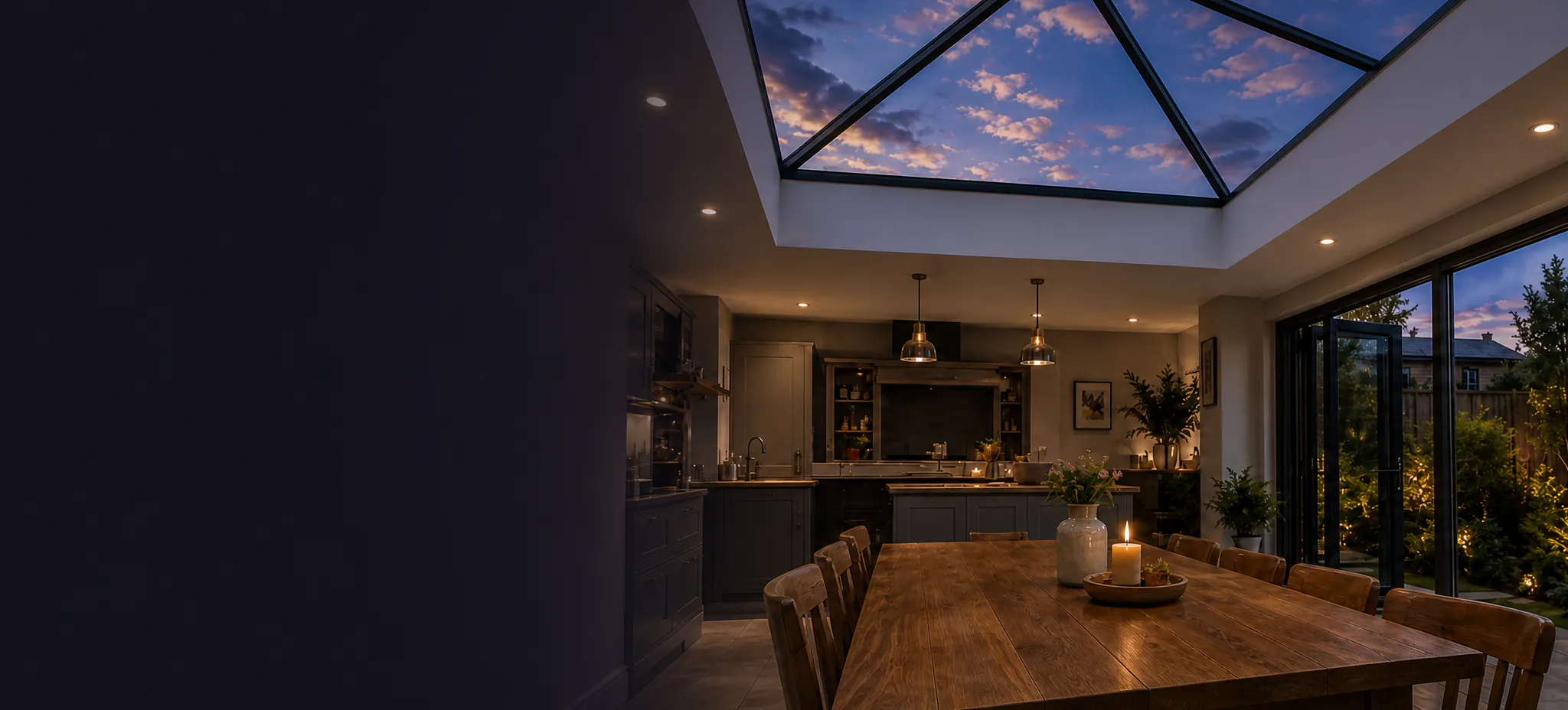
The view fogs and no clean brings it back
A lantern earns its keep on the view up, so the first real sign it is done is a view that will not come clean. A sealed double-glazed unit that has failed shows as a permanent haze or a ring of mist trapped between the panes, worse on a cold morning and never fully clearing even in full sun. Older polycarbonate lanterns, common on flat-roofed extensions built across Bretton, Orton and Werrington through the 1990s and 2000s, go a different way: the sheets yellow, pit and craze until the sky above the kitchen table reads as a grey smear rather than sky.
Our guide on the safest way to clean a roof lantern covers surface grime and how to shift it safely. If the haze sits inside the sealed unit itself, or is baked into the plastic, cleaning has nothing left to work on, and glass replacement is the only route back to a clear sky.
Water keeps finding a way in
One leak after a storm is a job for a look at the flashing and a bead of sealant. A leak that returns at the same corner every few months, after that joint has already been gone over more than once, is telling you the gasket or the fixing beneath it has moved past what sealant alone can hold.
On older lanterns the usual culprit is a perished rubber gasket around a glazing bar, or fixing screws that have corroded and no longer draw the frame down tight to the kerb. Our page on why condensation forms inside a roof lantern explains how to tell a genuine leak from condensation running down the inside face, since the two are often confused and lead to the wrong job being done.
The kerb or frame beneath the glass is going
The glass only ever performs as well as what it sits on. Lift a blind, or look along the inside lining, and check for staining, soft or spongy timber at the kerb, or bubbling paint where damp has been sitting under the frame.
- Soft or dark timber at the base of the kerb, especially on the shaded side of the roof
- White staining or pitting on an aluminium frame around the fixing points
- A ceiling stain directly below a corner that has never fully dried out
- A frame that no longer sits flush, with a visible gap opening at one edge
Once a timber kerb has started to rot, the frame above it has nowhere solid to sit, and no amount of fresh sealant will hold a straight, weathertight line again. A replacement is the chance to move to a properly insulated, factory-finished kerb, covered in our guide on roof lantern upstands.
The cracking has changed character
Every lantern ticks and creaks a little as the frame warms through the day and cools again at night. That is ordinary movement, not a fault, and it happens on new lanterns as much as old ones.
What matters is a change from that pattern: noises that are louder or more frequent than before, or that come with visible movement at a corner, or a new gap opening in a seal that was not there last year. Our answer on why a roof lantern makes cracking noises sets out the normal range; anything clearly outside it is worth having the frame and its fixings looked at properly, rather than waiting for the next warm spell to settle it back down.
The room stays cold and the glass streams every winter
Glazing specification has moved on a good deal over the years. A lantern fitted with older glass, whether that is true single glazing or an early double-glazed unit with a basic coating, loses heat through the glass and the frame far faster than a current specification with warm-edge spacer bars and better coatings.
| Sign | Usual cause | What it points to |
|---|---|---|
| Room noticeably colder | Dated glass or bar profile | Full glass and frame swap |
| Streaming glass on cold mornings | Poor insulation, no ventilation | New glass, checked ventilation |
| Draught at frame edge | Perished seals | New gaskets or full swap |
If the room below is colder than the rest of the house, or the inside face streams with condensation on cold mornings whatever the ventilation, the glass itself is the limiting factor. Replacing it is also the point to look at slimmer aluminium bars, which hold back less sky in the same opening: our guide on aluminium roof lanterns and slim rafters and our page on whether roof lanterns lose heat cover both sides of that change.
Weighing another sealant job against a new lantern
A single loose gasket, or one corner that needs going over again, is worth doing on its own: it is quick and it buys years. The point to stop and think is when the same lantern has needed sealant work more than once in a couple of years, when a glazier says a unit cannot be swapped on its own because the frame around it is out of date, or when the kerb underneath needs opening up anyway.
A frame that keeps needing attention at the same points is not asking for more sealant. It is asking to be replaced before the next one of those visits turns into a bigger job.
At that stage, further sealant work is money spent delaying a job that still has to happen, on a frame and glass that will still be the same age when it is finally done. Our page on what affects the cost of a rooflight sets out how age, size and specification change what a job costs, so the comparison can be made properly rather than guessed at.
What replacing an older lantern involves
A straight swap, glass and frame for glass and frame on an existing kerb, is usually the simplest version of the job. Where the kerb itself needs rebuilding, or the opening is being resized at the same time, it runs longer and involves the roof covering around it too.
Structural notification and current Building Regulations apply either way. Our guide to roof lantern building regulations explains what that covers, and we handle the Building Control notification as part of the job. Every quote for a roof lantern replacement in Peterborough comes with a sightline sketch, so you can see the view the new glass and bars will give from the table or the sofa before the old one comes off, not after: our page on the sightline sketch shows how that drawing is put together, and a 10-year workmanship guarantee covers the fitting itself.
If several of these signs match your lantern, book a home visit and we will look at the frame, the kerb and the glass together before deciding what it actually needs.
Questions people also ask
Can an old polycarbonate lantern just have new panels fitted?
Sometimes, if the frame and kerb underneath are sound and simply need new sheets. More often the frame has aged alongside the plastic, and moving to glass at that point gives a clearer, longer-lasting view for a similar amount of work. Our guide on replacing an old polycarbonate roof lantern sets out how that assessment is made.
Does a leaking roof lantern always mean a full replacement?
No. A single leak at one corner is usually a fixing or gasket issue and can be sorted on its own. It is a pattern of leaks returning at the same points, or a kerb that has stayed damp for a while, that points to replacement rather than another visit.
How long does fitting a replacement lantern take?
A like-for-like swap on a sound kerb is often a day or two. Rebuilding the kerb, or changing the size of the opening, adds time, since the roof covering around it has to be made good as well as the glazing itself.
Will a new lantern let in more or less light than the old one?
Usually more, and a clearer view with it. Slimmer aluminium bars and better glass coatings hold back less sky than the bulkier frames and dated glazing common on older lanterns, so the same size opening reads as more open above the room.
Book a home visit
Tell us which room
- No obligation
- Sightline sketch included
- 10-year guarantee
Or call 01733 736163