Question · Flat roof rooflights
Do Flat Rooflights Hold Standing Water?
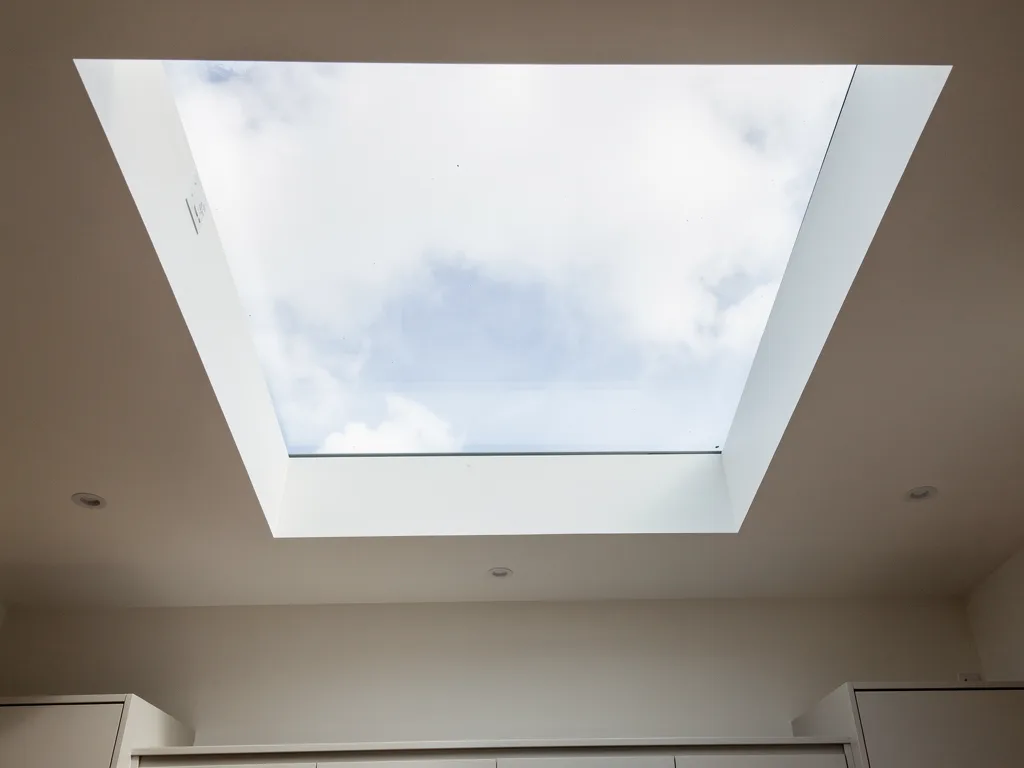
The fall that is meant to be there
"Flat" is the trade name, not a literal description. A flat rooflight is built on a slope, even if the eye cannot pick it out from the ground. The glass, the upstand beneath it and the kerb it sits on all carry a small fall so that rain finds a direction to travel in rather than sitting where it lands. A short film of water across the pane after a downpour is normal and clears within a few hours. What is not normal is a puddle that is still there the next day, or one that leaves a tide mark once it dries.
The size of that fall matters more than it looks. A pane laid dead level, or close to it, will pond almost anywhere a slight dip in the glass or a speck of debris interrupts the sheet of water. A pane with a proper fall clears itself because gravity is doing the work, not the wind or the sun. Our guide to why flat rooflights are not quite flat sets out how that fall is built in and how much difference a few millimetres makes to the finished view.
Where the fall is built: kerb or upstand
Two components carry the fall, and it helps to know which one is doing the work on your roof. A factory-made upstand arrives with the fall already machined into its top edge, so the rooflight sits true to it without anyone on site needing to measure a slope. A builder's kerb, built up on site from timber or block before the rooflight goes on, relies on whoever built it getting the same fall right by hand.
That difference is where most pooling problems start. A kerb built level, or close to it, because nobody thought to check, leaves the rooflight sitting flat on a flat base, and no amount of care with the glazing afterwards will fix that. Our page on kerbs and upstands for flat rooflights compares the two and explains why a factory upstand takes the guesswork out of getting the fall right.
What causes water to sit longer than it should
Standing water on a flat rooflight almost always traces back to one of a small number of causes. Most are fixable without replacing the unit; a few point to a fall that was wrong from the start.
- Leaves, moss or grit collecting at the low edge and damming the water behind them.
- A perimeter gutter or outlet nearby that has slowed or blocked, so water backs up onto the glass instead of running clear.
- A timber deck or joists that have deflected slightly over the years, flattening or reversing the fall that was there when the roof was built.
- A kerb or upstand that was fitted level, or with too shallow a fall, at the time of installation.
- A large single pane, where even a correct fall takes longer to clear across the full width of the glass than it would on a narrower unit.
The table below sets out roughly how each shows up, so a household can tell a quick clean from a job for a survey.
| What you see | Likely cause | What usually helps |
|---|---|---|
| Water clears within hours | Fall working as designed | Nothing, this is normal |
| Puddle at one edge, clears slowly | Debris or moss at the low point | Clear the edge and the nearby outlet |
| Puddle sits for days, same spot | Deck has sagged, fall lost | Survey the kerb and roof deck |
| Water sits across the whole pane | Kerb or upstand built too level | Rebuild the kerb to a proper fall |
Why it matters for the glass, not just the roof
Standing water changes what you see looking up as much as it risks the roof underneath. A film of water that sits and dries leaves mineral marks on the glass, and a puddle that never quite clears gives algae and grime somewhere to take hold, which is part of why some flat glass looks grubby within a season. Our page on why a flat roof skylight gets dirty so quickly goes into the low pitch, dust and bird traffic that add to it, and a working fall is the first defence against all three.
Cold weather adds another layer. Water that has been sitting rather than draining is the water most likely to freeze in a hard frost, and a sheet of ice sits on the glass for longer than rain ever would. Our answer on whether snow can sit on a flat rooflight covers loading and clearing in more detail. Kept clear of standing water, glass also holds a cleaner edge seal for longer, which is one of the things that keeps the view sharp rather than misty; our page on flat roof skylights and condensation explains the seal and coating side of that.
Checking and fixing a rooflight that pools
A survey settles the question quickly. It starts with the glass itself, checking whether the pane sits proud, level or dished, then moves to the kerb or upstand beneath it with a spirit level or a laser, and finishes by looking at the roof deck either side for any dip that has crept in over time. Where the fall is genuinely wrong rather than just blocked, the fix is a new kerb or upstand built to the correct fall, with the existing rooflight refitted onto it or replaced alongside the work if the glass has aged out at the same time.
Where a kerb is rebuilt or a rooflight is replaced, the work is installed to current Building Regulations and, where the job is notifiable, the Building Control notification is handled as part of it. Our page on what Building Control asks of a flat rooflight covers what that involves. Every quote for a flat rooflight comes with a sightline sketch, showing the view from where you actually sit, so the fall gets fixed without losing the piece of sky the room was built around, and our page on what affects the cost of a rooflight sets out where a kerb rebuild sits against a straightforward reglaze. For an overview of the whole job, see our page on flat roof rooflight installation in Peterborough.
Questions people also ask
Is a little standing water after rain always a problem?
No. A shallow film of water that clears within a few hours of rain stopping is the fall doing its job. It only becomes worth checking when a puddle is still there the next dry day, or leaves a mark once it has gone.
Can standing water cause a leak?
It raises the risk. Water that sits rather than drains has longer to find any weak point in the glazing seal or the upstand junction, so a rooflight that pools is worth checking sooner rather than later even if it has not leaked yet.
Does a bigger rooflight pool more?
A wider single pane does take a little longer to clear across its full width even with a correct fall, simply because the water has further to travel. It should still clear within hours, not days; if it does not, the fall itself is worth checking rather than the size of the glass.
Will replacing the glass on its own fix pooling?
Only if the glass itself was the problem, which is unusual. In most cases the fall lives in the kerb or upstand underneath, so new glass on the same base will pool in the same way. A survey of the kerb first saves fitting new glass onto an old fault.
Book a home visit
Tell us which room
- No obligation
- Sightline sketch included
- 10-year guarantee
Or call 01733 736163