Question · Flat roof rooflights
Why Does My Flat Roof Skylight Get Dirty So Quickly?
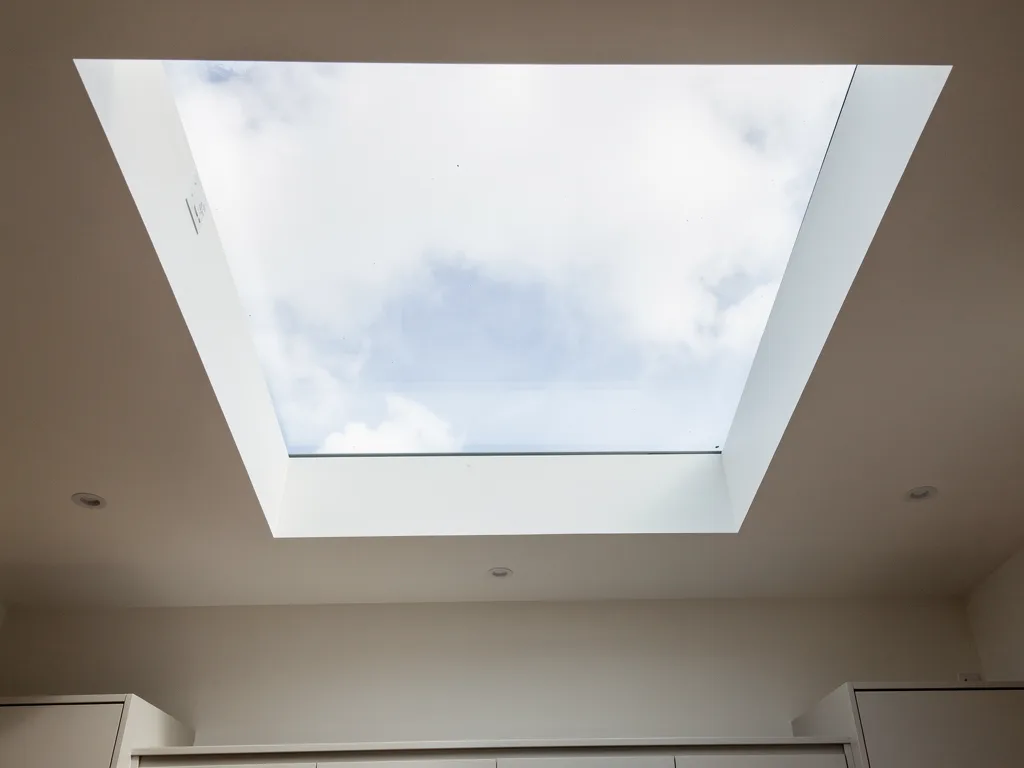
The pitch does less of the cleaning than a steep roof ever would
A roof window set into a pitched slope sheds rain fast enough that most loose dirt goes with it. A flat rooflight is never actually level: it carries a built-in fall, often around a ratio of 1:80, so water has somewhere to go rather than pooling on the glass. Even so, that fall is gentle compared with a 30 or 40 degree roof pitch, so water crosses the pane slowly and drops much of what it is carrying along the way instead of sheeting it clear.
That slower runoff is the whole story behind why a flat rooflight looks dustier sooner than a steep skylight above it would. The glass is doing the same job with less help from gravity, so anything that lands on it stays longer before the next fall of rain moves it on.
Dust, pollen and bird droppings account for most of the marks
Airborne grit and pollen settle on any horizontal surface, and a flat rooflight is one of the largest horizontal surfaces on most extensions. In spring, tree pollen and blossom debris are the main culprits; through summer it is dust and fine grit carried on the wind; in autumn, leaves and moss spores from nearby trees add to the mix.
- Fine dust and grit, which sit on the glass rather than washing straight off a shallow fall
- Pollen and blossom, heaviest for a few weeks each spring
- Bird droppings, where a flat rooflight offers a flat, level perch that a sloped one does not
- Moss and algae spores, which take hold fastest in a shaded, damp corner of the glass
Birds are worth a mention on their own. A flat pane is an easy landing spot, and droppings left on glass in direct sun bake on in a way that a quick shower will not always shift. That is a marking issue rather than a structural one: it does not affect the seal or the glazing, only how the glass looks from below.
Shade and nearby trees slow the natural cleaning down further
Where a flat rooflight sits close to an overhanging branch, a taller neighbouring roof or a chimney stack, it loses some of the direct sun and rain that would otherwise dry and rinse the surface. A shaded pane stays damp for longer after rain, and damp glass is exactly where algae and green streaking take hold first.
The same is true of a rooflight tucked against a parapet or a return wall, where wind driven rain rarely reaches one side of the pane. It is not a fault in the installation; it is simply a spot that gets less of the weather that would otherwise keep it clean, so it needs a little more thought at the coating and access stage.
A self-cleaning outer coating breaks the cycle before dirt sets
The most effective answer on a low pitch is specified at the glass, not added afterwards. A self-cleaning outer coating uses sunlight to loosen dirt at a molecular level and lets rain spread into a sheet across the whole pane rather than beading and running off in streaks. Instead of leaving trails and watermarks, the rain carries the loosened dirt away evenly.
It will not stop bird droppings landing or pollen settling, but it means normal rainfall keeps doing more of the work the fall alone cannot manage on a shallow pitch. We specify this coating on the outer pane as standard on flat rooflights, because it is the one detail that changes how the glass looks between one clean and the next, not just on the day it goes in.
Glass holds a clean surface for longer than polycarbonate does
Material matters too. Glass has a hard, smooth surface that a self-cleaning coating bonds to and keeps working over years. Polycarbonate is softer, scratches more easily in the wind and grit that cross a flat roof, and those fine scratches trap dirt in a way a smooth pane does not. A polycarbonate dome that has yellowed and hazed is one of the clearest signs of this over time, and it is a common reason households come to us wanting to replace an old dome with flat glass.
If you are weighing up glass against polycarbonate for a new flat rooflight, the surface finish over time is as much a part of that decision as the view on day one.
What actually keeps a flat roof skylight looking clear season to season
Put together, three things decide how quickly a flat rooflight picks up marks and how long they stay: the fall built into the glass, what is specified on the outer pane, and how sheltered or exposed the position is. None of them can be added back in once the roof is closed up, which is why they are worth getting right at the planning stage rather than the cleaning stage.
| Factor | What it changes |
|---|---|
| Fall across the glass | How fast rain sheets dirt away rather than pooling it |
| Outer glass coating | Whether rain rinses evenly or leaves streaks and residue |
| Position and shade | How long the pane stays damp and where algae takes hold first |
| Glass versus polycarbonate | Whether the surface stays smooth or scratches and hazes over |
A properly specified flat rooflight installation accounts for all four from the outset, including checking whether condensation on the inner pane is also likely to be a factor in how clear the glass looks from below. It is one of the details covered in the sightline sketch that comes with every quote, alongside the view itself and what affects the cost of a rooflight.
Also worth reading if you are deciding between a fixed pane and one that opens: why flat rooflights are not quite flat covers the fall in more detail, and frameless flat rooflights looks at how a slimmer frame changes what marks you actually notice from below.
Questions people also ask
Does a flat rooflight need cleaning more often than a roof window?
It needs a clean more often to keep the same appearance, because a shallow pitch relies more on the outer glass coating and less on gravity to shift dirt. A pitched roof window with the same coating will usually stay visibly clean for longer between cleans, simply because rain crosses it faster.
Would a steeper flat rooflight solve the problem?
A slightly steeper fall does help rain move across the glass faster, and this is one of the reasons a flat rooflight is never installed dead level. There is a practical limit to how much fall a kerb and upstand can carry before the unit stops reading as a flat rooflight at all, so beyond that point a self-cleaning coating and sensible positioning do more of the remaining work.
Do bird droppings cause any lasting damage to the glass?
On their own, no. Left to bake on in direct sun for a long stretch, droppings can leave a faint mark on an untreated pane, but they do not affect the seal, the glazing bars or the weathering detail underneath. A self-cleaning coating makes it far more likely that ordinary rain lifts the mark before it has the chance to set.
Does an opening flat rooflight get dirtier than a fixed one?
Not meaningfully. The vent and its seals collect the same dust and pollen as the fixed pane around them, but the main glass area is treated the same way whether the unit is fixed or opens. The choice between a fixed pane and an opening rooflight comes down to ventilation and use, not how quickly the glass picks up marks.
Book a home visit
Tell us which room
- No obligation
- Sightline sketch included
- 10-year guarantee
Or call 01733 736163