Question · Flat roof rooflights
Should a Flat Rooflight Be Glass or Polycarbonate?
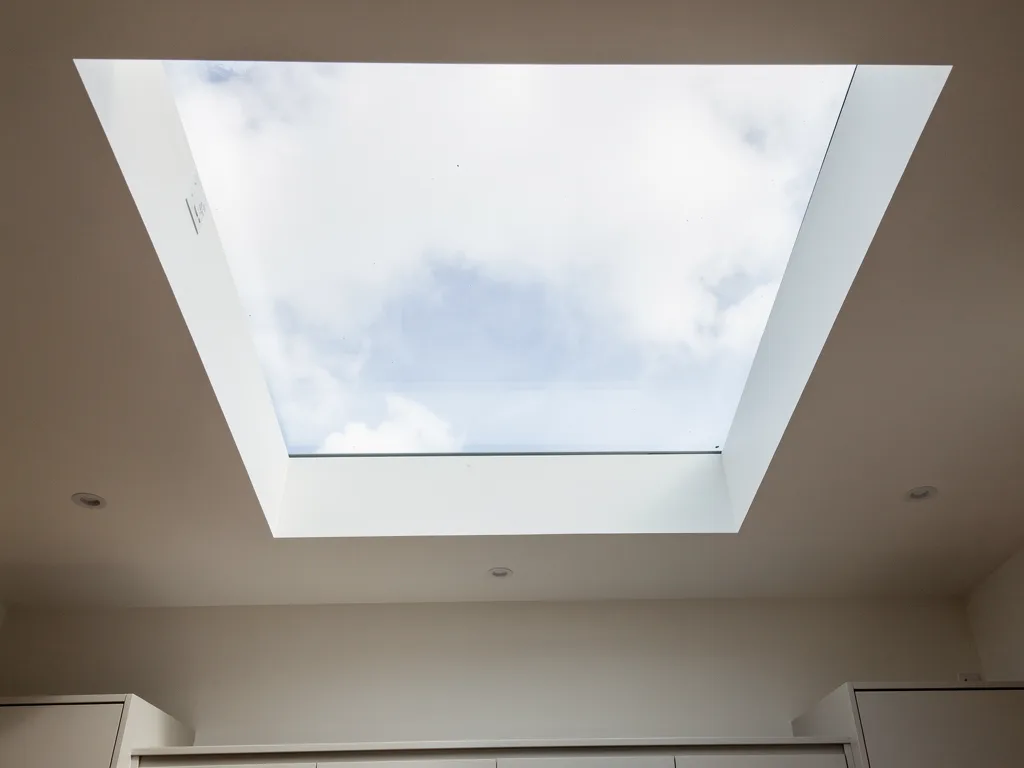
Clarity is the first difference you will notice
Look up at a rooflight from the sofa and the material sets what you actually see: a crisp square of sky, or a slightly hazed, sometimes greenish rectangle that never quite sharpens up.
A glass unit is built from one or more sheets of float glass, ground flat and fused with an interlayer or gas-filled cavity. Light passes through with almost no distortion, so a cloud edge stays a cloud edge and a blue sky stays blue rather than drifting toward grey-green. Most units carry a laminated inner pane for safety overhead, and the lamination adds no visible haze; it simply holds the glass together if the outer pane is ever struck.
Polycarbonate is an extruded plastic sheet, usually built as twin-wall or triple-wall with air channels running through it like a honeycomb. Those channels scatter some light on the way through, so the sky reads softer and less defined even on a fresh sheet. New polycarbonate can look perfectly clear in a showroom; the difference shows once it is fitted at a shallow pitch and you are looking through it at an angle, which is exactly how a flat rooflight is usually seen from a chair or a bed.
Rain, hail and the noise from below
A hollow, chambered sheet is a drum. Multiwall polycarbonate flexes slightly with every gust and every raindrop, and the air channels carry that vibration into the room as a rattle or a steady drone through a downpour. Hail on polycarbonate is loud enough to interrupt a conversation underneath it.
A glass unit is heavier and stiffer, and the sealed cavity between panes damps the impact of rain rather than amplifying it. The result from below is a soft, even patter rather than a drumbeat. This matters most over a room people actually sit in through the evening: a kitchen table, a reading corner, a cot in a nursery extension. It matters less over a utility room or a garage roof where the noise passes largely unheard.
Heat, movement and how long each surface stays true
Plastic and glass expand and contract at different rates, and polycarbonate moves noticeably more than glass across a Fenland summer to a Peterborough winter. Frames and gaskets are designed around that movement, but over years the fixings can work looser and a sheet can start to bow slightly across a long span.
Polycarbonate also degrades under ultraviolet light. Most sheets carry a UV-resistant coating on the outer face, but that coating wears thin over time, and the plastic underneath yellows and micro-scratches from wind-blown grit. Why does my flat roof skylight get dirty so quickly? covers how a low pitch collects dust and bird traffic on either material, but polycarbonate shows every mark more, because the surface itself is softer.
Glass does not yellow, and a hard, scratch-resistant coating on the outer pane keeps a sharp surface for the working life of the unit. Where solar gain is the concern rather than cosmetics, a solar-control coating on the glass cuts summer heat gain without tinting the view; will a flat rooflight make my extension too hot? goes through the coating and blind choices that keep a glazed extension comfortable.
Where polycarbonate still gets specified
Glass is not automatically right for every roof. Polycarbonate is lighter, so it asks less of the structure underneath, which suits a wide unsupported span, a lean-to over a workshop, or a roof where the joists were never sized for a heavy glazed unit. It also survives an impact that would crack glass, which matters on roofs people walk across for maintenance, or where falling debris is a real risk.
Some households simply want daylight rather than a view: an opal or diffused polycarbonate sheet spreads light evenly across a room without a defined shape in the sky at all, which suits a hallway or a store room better than a glass unit chosen for its sightline. Where the point of the rooflight is what you see through it, though, from a bed, a sofa or a kitchen sink, glass is the material built for that job. Our sightline sketch shows what either option would look like from your own seat before any decision is made.
Weighing the two side by side
Set out plainly, the two materials trade off in a consistent pattern: glass wins on the view and on how it ages, polycarbonate wins on weight and on cost.
| What matters | Glass | Polycarbonate |
|---|---|---|
| View from below | Sharp, neutral colour | Softer, can tint with age |
| Sound in rain | Muted, even patter | Louder, can drum in wind |
| UV and colour over time | Stays clear | Yellows as the coating wears |
| Weight on the roof | Heavier, needs a solid kerb | Lighter, easier on a weak span |
Structural questions run alongside that comparison rather than separate from it. A heavier glass unit needs a properly built kerb or upstand under it, and the same falls that keep a flat rooflight shedding rain, covered in why flat rooflights are not quite flat, apply whichever material sits on top.
Getting the choice right for your roof
Replacing a yellowed, ageing dome is the moment the choice comes up most often, and glass is usually the answer for the reasons above; replacing domed plastic rooflights with flat glass covers that swap and what changes once the old dome comes off. For a new opening over a kitchen extension, bedroom or landing, we work through pitch, span and what you will actually see from where you sit, then confirm the material against your roof and your budget during a home visit. What affects the cost of a rooflight sets out the factors that move the price either way, glazing choice among them.
Whichever material ends up on the roof, our flat roof rooflight installation service installs to current Building Regulations and handles the Building Control notification where the work needs it, with a 10-year workmanship guarantee on the finished job.
Questions people also ask
Does polycarbonate ever look as clear as glass?
A brand-new sheet can look clear from directly underneath, but the multiwall structure still scatters some light and the surface coating wears with UV exposure over the years. Glass keeps its clarity from the day it is fitted through the life of the unit.
Is glass safe to use overhead on a flat roof?
Yes. The inner pane of a flat rooflight unit is laminated, so if the outer pane is ever struck the glass stays held together rather than falling into the room. Why does a flat rooflight have a laminated inner pane? explains the build-up in full.
Can an old polycarbonate dome be swapped for a flat glass unit?
Yes, and it is one of the most common upgrades we carry out. The existing kerb is checked, the opening is often widened slightly to suit a modern unit, and the roof is weathered in around the new frame.
Does polycarbonate collect more condensation than glass?
Both materials can carry condensation on their inner face in cold weather; it comes down to the insulation value and ventilation around the unit rather than the glazing material alone. Do flat roof skylights get condensation? goes through what actually controls it.
Book a home visit
Tell us which room
- No obligation
- Sightline sketch included
- 10-year guarantee
Or call 01733 736163