Question · Flat roof rooflights
Why Does a Flat Rooflight Have a Laminated Inner Pane?
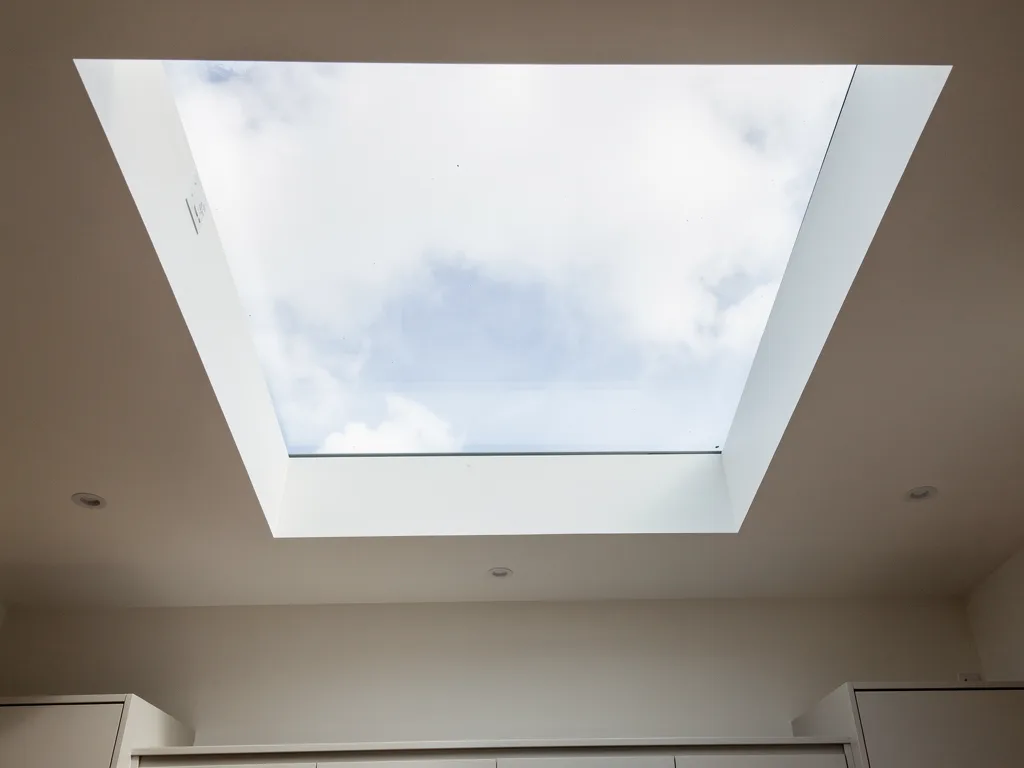
Overhead glass answers to a different set of rules
A window in a wall and a rooflight over a bed or a sofa are not treated the same way, and for good reason. If a pane in a wall fails, the glass falls sideways, mostly onto a sill or the floor near your feet. If a pane set into a flat roof fails, gravity takes every piece straight down onto whatever is underneath it: a mattress, a dining table, a worktop, a person standing there. Glazing installed overhead, at a low pitch or lying flat, is treated in the regulations as safety glazing precisely because of that difference in where the glass ends up.
The practical answer is to laminate the pane that faces the room. If the glass is ever damaged, by a falling branch, a dropped tool during a blind fitting, or simple age and thermal stress, it cracks in place rather than dropping. Nobody underneath it needs to know anything went wrong until the next service visit.
What the interlayer is actually doing
Laminated glass is not a single thick sheet. It is two sheets of ordinary float glass with a tough plastic interlayer, usually PVB, bonded between them under heat and pressure. The glass still behaves like glass: it is hard, it scratches the same way, and it looks completely clear. What changes is what happens once it is broken. Instead of the pane separating into hundreds of loose fragments, the interlayer holds every piece against the plastic film. The sheet cracks into a spider's web pattern but stays as one flexible unit, still doing its job of keeping weather out until it is professionally renewed.
This is worth separating from toughened glass, which is the other safety option and the one usually chosen for the outer pane instead. Toughened glass is heat treated so that if it does fail, it breaks into small, blunt granules rather than sharp shards. That is a sensible choice for a pane facing outward, where a failure means the pieces fall away from the building rather than onto anyone. Overhead and facing inward, granules falling from height are still a hazard, so lamination is the pane of choice there instead.
What actually happens if the inner pane is struck
In practice this is rare, but the sequence matters. A hard impact cracks the glass into a pattern of fine lines radiating from the point of contact. The interlayer keeps every fragment bonded in place, so the pane stays intact and weathertight in the short term, cloudy rather than clear at the damaged spot. There is no shower of glass into the room and no sharp edges left hanging. A cracked laminated pane is simply a job for renewal at the next opportunity, once the damage is noticed.
Why the split is outer toughened, inner laminated
A flat rooflight is very rarely single glazed. It is built as a sealed unit, usually double glazed and increasingly triple glazed for better thermal performance, with each pane doing a different job:
| Layer | Typical glass | Job |
|---|---|---|
| Outer pane | Toughened | Faces sun, rain and hail; sheds standing debris |
| Cavity | Gas filled, low-E coated | Insulation and solar control |
| Inner pane | Laminated | Faces the room; holds together if struck |
Swap that arrangement round and you lose the point of both choices. Toughened glass facing the room does not protect against overhead falls in the way laminated glass does, and laminated glass facing outward gains nothing over toughened against weather while costing more. The arrangement in the table is the sensible one, and it is what you should expect on a properly specified unit, whether it is fitted new or is replacing an older dome or upstand that predates the current rules.
Does the interlayer change what you see through the glass
This is the question that matters most to Clearview, because the view is the whole point of a rooflight. A modern PVB interlayer is optically clear and does not tint, yellow or bubble when it is manufactured and installed correctly, so from the bed, the sofa or the sink there is no visible line where the two sheets meet. What you are looking through is still the low-E coating, the gas fill and whatever solar control has been specified, exactly as you would on a non-laminated unit. Lamination changes what happens if the glass is ever damaged, not the clarity of the glass on an ordinary day.
Where it can matter to the sightline is at the edge, since a laminated pane sits fractionally thicker in its rebate than a single sheet of the same nominal thickness, which is one more reason the frame profile and reveal are planned together rather than as an afterthought. That planning is exactly what a sightline sketch sets out before the roof is opened.
Rooms where the rule matters most
The regulations do not distinguish by room type, but the reasoning behind them is easiest to picture in a few settings:
- A loft bedroom, where the glass sits directly over a bed and the pane is the last thing between the sleeper and the sky.
- A kitchen extension, where worktops, hobs and people stand under the glass for long stretches of the day.
- A garage conversion, where tools, ladders and shelving raise the odds of something striking the roof from below or above during other work.
- A flat roof that also carries occasional foot traffic for maintenance, where a laminated inner pane adds a further margin under normal glazing loads.
In every one of these, the logic is the same: whatever is underneath the glass stays underneath it, safely, if the glass is ever compromised.
What Building Control looks for
When a flat rooflight is installed or an old one is replaced, the glazing specification, including which pane is laminated and which is toughened, is part of what gets checked as notifiable work. It is not a judgement call left to taste. Where the work is notifiable, Clearview handles that notification as part of the job, and the unit is installed to current Building Regulations rather than to whatever the previous dome happened to meet when it went in years ago.
Questions people also ask
Does a laminated inner pane cost more than an ordinary pane?
It is priced as part of the glazed unit rather than as a separate extra, since it is the standard specification for overhead glass rather than an upgrade. Overall cost is driven far more by size, glazing performance and access than by the choice of inner pane. General cost ranges are covered on the costs page.
Can the outer pane be laminated as well as the inner one?
Yes, and it sometimes is, particularly on a walk-on rooflight or where extra security or acoustic performance is wanted. For a standard flat rooflight over a bedroom or extension, toughened outside and laminated inside covers the relevant risks without adding cost for no benefit.
Does laminated glass need any special cleaning or maintenance?
No. It is cleaned the same way as any other sealed unit, from outside or from a safe reach, and the interlayer sits sealed between the panes where dirt and weather cannot reach it. What affects how quickly the glass looks dirty is pitch and coating, covered on why a flat roof skylight gets dirty so quickly.
Did older dome-style rooflights have this safety glass?
Many did not, since older plastic domes and early double-glazed units were fitted under different rules. That is one of the reasons a tired dome is often renewed with a flat glazed unit rather than repeated in kind. See replacing domed plastic rooflights with flat glass for how that swap works.
A laminated inner pane is one part of a wider specification that a proper flat rooflight fitting gets right from the outset, alongside the fall that keeps the glass clear, the upstand that keeps water out and the reveal that shapes what you actually see. For how those pieces fit together on your own roof, see flat roof rooflight installation in Peterborough, and for what the finished view will look like from where you sit or lie, ask about a sightline sketch before any glass is ordered. Related detail worth reading alongside this: why flat rooflights are not quite flat, how a flat rooflight is weathered into the roof, do flat roof skylights get condensation, can snow sit on a flat rooflight, what Building Control asks of a flat rooflight and what you will see through a flat rooflight from the sofa.
Book a home visit
Tell us which room
- No obligation
- Sightline sketch included
- 10-year guarantee
Or call 01733 736163