Question · Flat roof rooflights
Should I add a rooflight when my flat roof is re-covered?
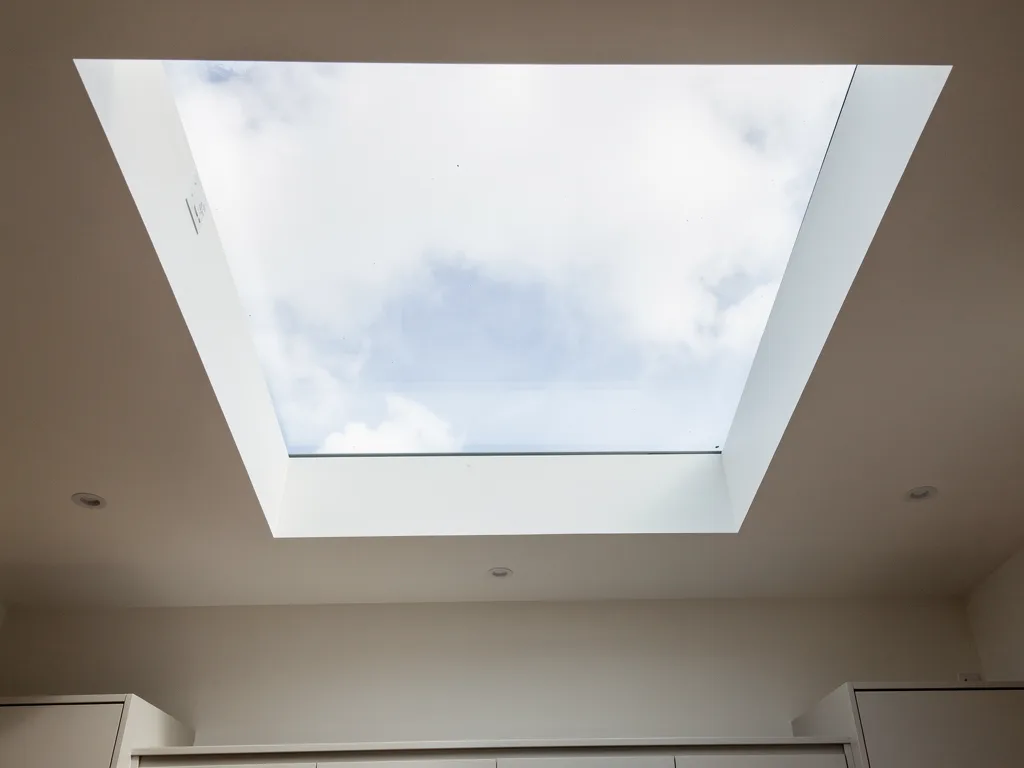
Two jobs on one roof cost less than two visits to the same roof
A re-cover strips the existing felt, EPDM or GRP back to the deck, so for a short window the whole roof is open rather than protected by a finished surface. That window is exactly what a new opening needs: a kerb built onto bare decking and dressed into a covering that is going on fresh in one continuous pass, not tied into a patch of old material years later.
Add a rooflight afterwards, once the re-cover is finished, and the same cutting, trimming and dressing work has to happen again, on a roof that is now new. Access, any scaffold or podium needed to reach it, and the labour of opening a finished covering back up are all paid for a second time, for a smaller job than the one that was just completed.
What a re-cover already gives the survey for free
Before any glass is chosen, a rooflight survey needs to know what the roof is actually built from: joist direction and spacing, the depth of insulation, and whether the build-up is a warm roof or a cold one. On a covered roof that means lifting a corner or trusting old drawings. On a roof stripped for re-covering, all of it is visible at once.
- Joist spacing and any existing notches or old alterations along the span
- The true condition of the deck, not just the covering above it
- Where insulation sits in the build-up, and how deep it runs
- Any sag or damp staining that only shows once the covering is off
That is the same information the survey for adding a rooflight to an existing flat roof has to go and find. A re-cover hands it over without extra digging, which is one reason the two jobs sit so comfortably together.
Falls and levels get corrected once, not twice
Flat roofs are laid to a fall, commonly at least 1:80, so rainwater runs to an outlet rather than sitting on the surface. Years of movement, added layers and settling timbers can leave an older roof close to flat in places, well short of what it was built to.
A re-cover is the point where that fall gets put right across the whole roof, with firring pieces or tapered insulation correcting any low spots. If a rooflight is going in at the same time, its kerb is built into that corrected fall from the start, so water is guided away from every side of the upstand rather than pooling against one edge because the surrounding roof was never quite level. Add the rooflight afterwards and the kerb has to work with whatever fall the finished re-cover left it, rather than shaping the fall around itself.
One continuous covering beats a covering with a join in it
The weakest point on any flat roof is where two different pieces of covering meet, and a rooflight kerb added after the fact always creates one of those joins: new material welted or bonded onto covering that is already fixed and weathered in.
| Timing | How the covering meets the kerb | Weak point created |
|---|---|---|
| Rooflight fitted with the re-cover | One continuous sheet dressed over the kerb as it goes down | None; the kerb is part of the same pour or run |
| Rooflight added afterwards | New material cut in and lapped onto the finished covering | The lap line itself, plus a second penetration through a roof that was just made watertight |
Flat rooflights on EPDM, felt and GRP roofs goes through how each material behaves at a kerb, and the same principle holds for all three: a join formed while the covering is still being laid is more reliable than one cut into it afterwards.
Replacing a tired plastic dome at the same time
Some re-covers already have a rooflight in place, usually an older domed plastic unit that has gone yellow and lets in a milky, diffuse light rather than a clear view of the sky. A re-cover is a natural point to swap it for flat glass rather than reinstating the same dome on the new covering, since the kerb is being rebuilt or re-dressed either way. Replacing domed plastic rooflights with flat glass covers what changes in the view once the plastic comes off.
The kerb height itself is worth checking at this point too, since older domes often sit on a low upstand that a current re-cover would not be built to today. Kerbs and upstands for flat rooflights sets out the height a new covering needs to shed water properly, whatever glass sits on top of it.
Choosing size and position while the ceiling is still open
A re-cover only settles the roof; the reveal underneath, the lined shaft between the kerb and the ceiling, is what actually shapes the view from the room. That reveal is easiest to build while the ceiling below is open for other reasons, rather than being cut into a finished ceiling on its own.
Where to place a flat rooflight in a deep extension and flat rooflight sizes and room proportion are worth reading before the re-cover date is fixed, since both are far easier to change on a drawing than on a roof that has already been dressed.
Building Control covers both jobs under one notification
A re-cover on its own can already be notifiable work, and adding a rooflight brings its own requirements: current thermal performance for the glass, and the structural rules that apply to trimming an opening into the joists. Doing both together means one survey, one specification and one Building Control notification rather than two separate paper trails for work on the same roof months apart. We handle that notification wherever the work is notifiable, and install to current Building Regulations either way. What Building Control asks of a flat rooflight sets out what applies.
Planning is usually a short check rather than a long one, since a flat rooflight sits low in its kerb rather than breaking the roofline. It is still worth confirming before work starts, particularly for flats and maisonettes or a property in a conservation area. Will my flat rooflight need a planning application? covers when that applies.
What this means for the room, not just the roof
None of the timing above changes what the rooflight looks like from below: the same questions about frame edge, reveal depth and where the eye sits still decide what you actually see. What a re-cover changes is how cleanly that outcome is built, since the kerb, the fall and the covering around it are all going in together rather than being made to fit each other after the fact. The sightline sketch plans that view before either job starts, and the full process for fitting the glass itself is covered on our flat roof rooflight installation page.
Questions people also ask
Does adding a rooflight during a re-cover add much time to the job?
It adds a day or so to the schedule rather than doubling it, since the roof is already stripped and the covering is going down in one continuous run either way. How many days does fitting a flat rooflight take? breaks a typical fitting down day by day.
What if I only decide I want a rooflight after the re-cover has started?
It is still possible, and better than waiting until the covering is finished and weathered, but the earlier the decision is made, the more of the roof build-up, the fall and the kerb detail can be planned around it rather than adjusted on site.
Is it worth re-covering the whole roof just to add one rooflight?
Only where the covering is genuinely near the end of its life anyway. If the rest of the roof is sound, a rooflight can be added on its own, as set out on our page about adding a rooflight to an existing flat roof. The saving described here only applies where a re-cover is already needed.
Does the rooflight have to be chosen before the re-cover date is booked?
The exact glass and blind can usually be confirmed later, but the size, position and kerb height need to be settled before the re-cover starts, since they decide how the fall and covering are built around the opening.
Book a home visit
Tell us which room
- No obligation
- Sightline sketch included
- 10-year guarantee
Or call 01733 736163