Question · Flat roof rooflights
What Will I See Through a Flat Rooflight From the Sofa?
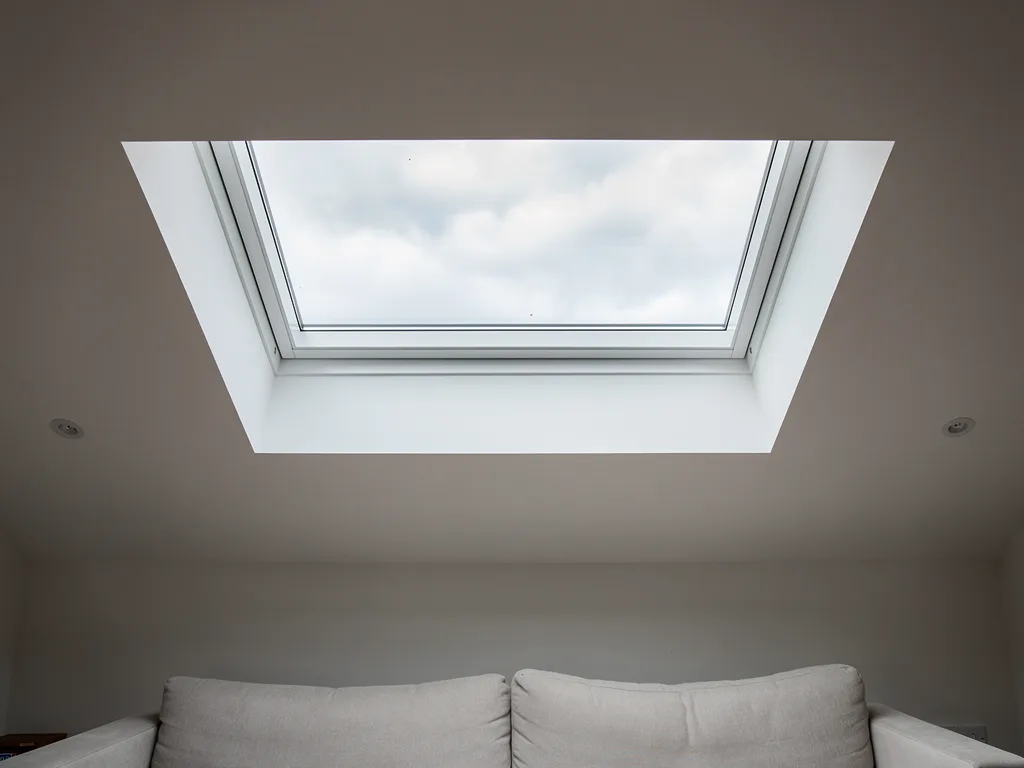
The sofa is a lower, further-back eye position
Every other sightline question on this site talks about the bed or the sink, both of which put your eye close to directly under the glass. A sofa rarely sits that way. It is usually pushed back against a wall, three or four metres from the rooflight, with your eye at around 1.1 to 1.2 metres off the floor once you are sat back in the cushions rather than perched forward.
That distance and that lower eye height change the geometry. Looking up from close underneath a rooflight, you see mostly sky. Looking up at the same glass from across the room, the angle is shallower, and the near edge of the reveal starts to close in on the view before the sky does. The further back you sit, the more the opening below the glass, not the glass itself, decides what you see.
The reveal and kerb frame the view before the glass does
A flat rooflight is never just a pane laid on the roof. Under it sits a kerb or upstand, and below that a lined shaft down through the ceiling depth to the room. The glass itself carries a built-in fall, and the kerb below it has its own height, usually enough to clear standing water and meet the roof's insulation depth. From a seat across the room, it is the top and sides of that lined shaft that cross your eyeline first, well before you reach the edge of the glass.
A deep shaft with square, unlined corners reads as a dark tunnel around a smaller patch of sky. Splaying the reveal, angling the lining outward as it drops from kerb to ceiling, opens that tunnel into more of a funnel, so the same rooflight shows noticeably more sky from a seated position further into the room. This is the single biggest lever an installer has for a sofa view, more than choosing a larger pane.
Where the rooflight sits over the room, not just its size
A rooflight fitted directly above where people sit shows more sky from a sofa than a larger one fitted a metre further along the ceiling, over a dining table or an island. In a single-storey extension, the temptation is to centre the glass on the roof structure or on the room's footprint. Placing it over the seating instead, even by shifting it half a metre, changes what a person on the sofa actually looks up into, because they are looking up at an angle rather than straight overhead.
- Sofa against the back wall, rooflight set forward over the room: you look up and slightly away from the wall, catching the far edge of the glass at a shallow angle.
- Sofa pulled in from the wall, rooflight overhead: the sightline is closer to vertical and the reveal has less chance to intrude.
- Sofa on the same wall as the extension's rear doors: the rooflight can sit further back over the kitchen or dining area and still open the room, though the direct sofa view will be smaller.
None of this needs guesswork before the roof is opened. A rough measure from the planned seat to the planned kerb position, worked out on the drawings, will tell you roughly how much sky a person will see from that spot.
A glazing bar changes what a seated eye meets first
Room proportion often pushes a flat rooflight wider than one pane can span, which means a bar or a join somewhere across the glass. From directly underneath, a central bar sits off to one side of the typical seated eyeline. From a sofa set back and to one side of the room, the same bar can land squarely in the middle of the view, because the viewing angle has shifted the apparent position of everything above.
A single pane removes the question. Where the room allows it, a frameless flat rooflight also drops the frame depth that would otherwise show as a dark border from a low, seated angle, leaving glass edge to glass edge with less to catch the eye than a boxier, framed unit. Where panes have to be linked for a long run of glass, it is worth checking where the join falls against the sofa's actual position, not just against the room's centre line.
What to check before the roof is opened
A sightline sketch drawn from the sofa, not just from the middle of the floor, is the only way to see this in advance rather than after the plaster is finished. We draw it from wherever the furniture will actually sit, showing the kerb, the reveal, any bar, and the piece of sky each leaves.
| Detail | Effect from a seated view |
|---|---|
| Kerb and shaft depth | Sets how much reveal crosses the eyeline before the glass does |
| Reveal shape | Square corners narrow the sky; a splay widens it |
| Glass position over the room | Overhead reads as more sky than glass set away from the seat |
| Bar or join position | Shifts across the view as the viewing angle changes |
We install to current Building Regulations and handle the Building Control notification where the work is notifiable, and every quote from Clearview Skylights comes with a sightline sketch for the room in question, drawn from the seat, bed or sink that matters to you. See the full range of flat roof rooflight installation we cover across Peterborough and the surrounding area, backed by a 10-year workmanship guarantee.
Questions people also ask
Does a bigger rooflight always mean more sky from the sofa?
Not on its own. A larger pane over the wrong part of the ceiling can show less usable sky from a seated position than a smaller one placed directly above where people sit, because distance and angle affect the view as much as the size of the glass.
Can I see the kerb from the sofa even with a splayed reveal?
A splayed, well-lined reveal hides most or all of the kerb from directly underneath, but from a sharp angle across the room, a sliver of the lining nearest the seat can still show. This is exactly what a sightline sketch checks for a given seat position.
Should the rooflight go over the sofa or over the room's centre?
Over or close to the seating usually gives the best view for the people using it most, though the centre of the room may suit daylight spread better if the room is used for several activities. We weigh both when we plan the position with you.
Does an opening rooflight change the view compared with a fixed one?
An opening unit needs a frame around its vent, which adds a little depth at the edge compared with a fixed pane. From a sofa well back in the room, that extra frame depth is rarely the deciding factor: reveal shape and position matter more.
Book a home visit
Tell us which room
- No obligation
- Sightline sketch included
- 10-year guarantee
Or call 01733 736163