Question · Flat roof rooflights
Do Flat Roof Skylights Get Condensation?
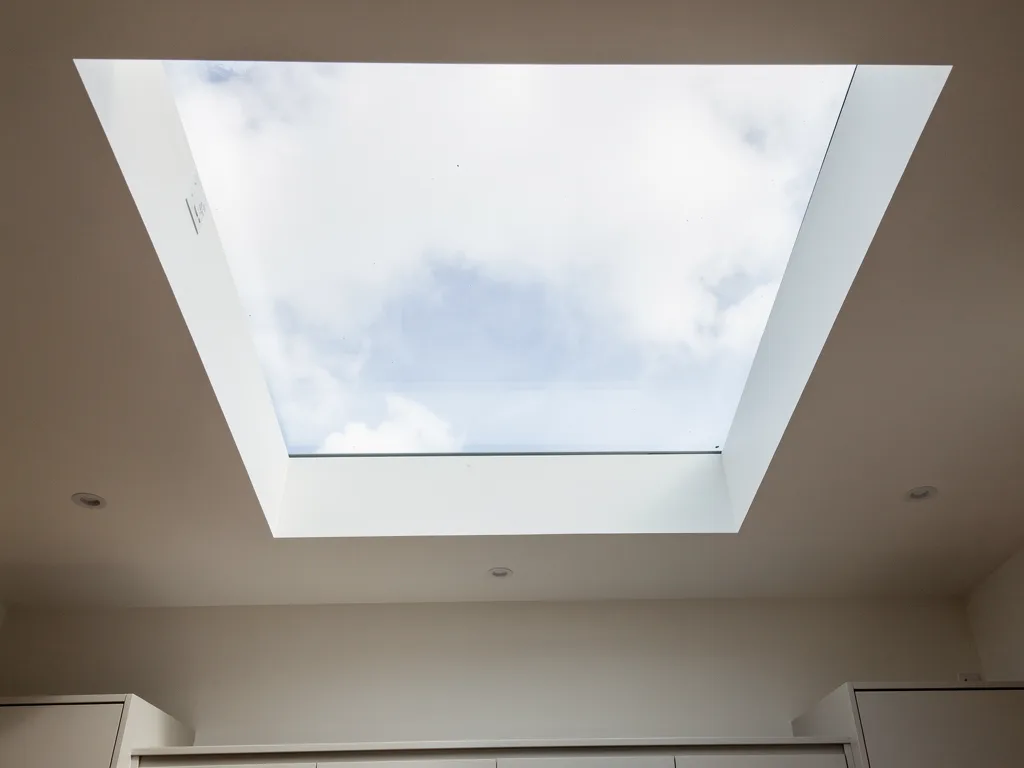
Two kinds of condensation, and only one is a fault
Outer condensation forms on the top surface of the glass when the pane radiates heat out to a clear night sky faster than the surrounding air can warm it back up, so the glass sits colder than the air just above it and moisture settles out as dew. It looks alarming from below, a grey bloom across the whole pane at first light, but it sits on the outer face only and burns off within an hour or two of daylight.
Inner condensation is different. It forms on the room-side face of the glass, sometimes as a fine mist and sometimes as running beads that mark the reveal lining underneath. That is the pane telling you the air in the room is carrying more moisture than the glass can keep warm enough to hold as vapour, and it does not clear on its own the way outer condensation does.
Why a flat rooflight cools faster than a wall or a pitched window
A flat rooflight faces almost straight up, so it has a clearer, more open view of the night sky than a wall window ever gets, and that open sky is what draws the heat out of the glass through radiant loss. A steeply pitched roof window sees more of the surrounding roofline and less open sky, so it loses heat a little more slowly on the same night. Low pitch and a big, unbroken pane, exactly what gives a flat rooflight its clean view of the sky by day, are also what make it the coldest surface in the room on a still, clear night.
Wind actually helps here, because moving air keeps mixing warmer air across the glass and stops it settling into its own cold layer, which is why outer misting is worst on calm nights and rare on blustery ones. Across the flat Fenland horizons around Peterborough, still, clear nights are common for exactly the reason those horizons give good sky views by day, so outer misting is something most flat rooflight owners will see from time to time, not a sign of a problem.
What the glass specification changes
The glass itself does most of the work against inner condensation. A sealed double-glazed unit holds a gas-filled gap between two panes, and a low-emissivity coating on the inner pane reflects room heat back into the room instead of letting it pass through to the outer pane. That keeps the room-side glass warmer than the air around it, above the dew point where moisture would otherwise settle out.
- Triple glazing adds a second gap and a second coating, holding the inner pane warmer again, which matters most in a room that is regularly warm and humid.
- A warm-edge spacer bar, the strip that separates the panes at the perimeter, cuts the cold bridge that a metal spacer used to create around the edge of the glass.
- An older single-glazed dome, or a unit with a failed seal that has lost its gas fill, gives none of this protection, which is why inner condensation is far more common on that kind of glass than on a current sealed unit.
We specify the glass against the room it sits over, not as a single default, because a bathroom and a hallway do not put the same load of moisture into the air below the pane.
What the roof build-up changes
The kerb and upstand that carry the rooflight above the roof deck are part of the condensation picture too. On a warm roof build-up, the insulation sits above the structural deck and wraps continuously up and around the kerb, so there is no cold bridge where warm room air can reach a chilled surface close to the glass. Older cold roof designs, with insulation between the joists and a ventilated void above, can leave the kerb itself running colder, and it is often the timber or lining around the glass that mists first in that case, not the glass.
The lined reveal under the rooflight matters for the same reason. A well-insulated, well-sealed reveal keeps warm, moist air from the room reaching the coldest part of the glazing unit at the edges, where the spacer bar sits. A gap or a thin patch in that lining shows up as a cold streak and a line of condensation running down from it, in a spot that otherwise looks unremarkable from the room.
Where the moisture in the room actually comes from
Cooking, bathing, drying washing indoors and simply breathing all put water vapour into room air, and warm air holds more of it than cold air, so the moisture stays invisible until it meets a cold surface and gives it up. A rooflight over a kitchen extension or an ensuite carries more of this load than one over a landing or a study, because that is where the moisture is generated in the first place.
| Room below | Typical moisture load |
|---|---|
| Kitchen extension | High: cooking, kettles, an open-plan link to living space |
| Bathroom or ensuite | High: bathing and showering, often with limited extraction |
| Bedroom or landing | Moderate: breathing overnight, doors closed for hours at a time |
An extractor fan that runs long enough to actually clear the air, rather than switching off the moment the light goes off, and a trickle of background ventilation elsewhere in the room, do more to stop inner condensation than any change to the glass on its own. The two work together: good glass keeps the surface warm, and controlled ventilation keeps the air from ever reaching saturation against it.
Reading a misted rooflight correctly
The clue is timing and location. Outer misting follows the weather: worse after a still, clear night, gone within an hour of sun on the glass, and present across the whole pane rather than in patches. Inner misting follows use of the room: worse after a bath or a big cooking session, slow to clear, and often heaviest at the edges of the pane where the spacer bar sits, or in a line that tracks a weak point in the reveal lining.
Persistent inner condensation on a unit that used to stay clear is also one of the signs a sealed unit has lost its gas fill, the same failure that leaves a milky haze between the panes that will not wipe away from either side. That is a specification problem the glass itself cannot fix, and it points to renewing the unit rather than to a ventilation change in the room.
Questions people also ask
Does triple glazing stop condensation completely?
It cuts the risk sharply by keeping the inner pane warmer, but it will not overcome a very damp room with no ventilation at all. Glass specification and room ventilation both need to be right together.
Is outer condensation a sign the rooflight was fitted badly?
No. It is a normal response to a clear night and an unobstructed view of the sky, the same view that makes a flat rooflight worth having, and it clears on its own once the sun reaches the glass.
Can condensation damage the roof around the rooflight?
Inner condensation that is left to run down into the reveal lining or the surrounding ceiling over a long period can leave staining or damp timber, which is another reason a persistent inside mist is worth looking at rather than wiping away and ignoring.
Does the room's extractor fan matter more than the glass?
Neither works alone. A cold-bridged kerb or an old single-glazed dome will mist even with good extraction, and a warm, well-sealed unit can still mist in a room with no ventilation and heavy moisture use.
We specify the glass, the kerb build-up and the reveal lining together against the room a flat rooflight sits over, and every quote includes a sightline sketch showing the view the glass will give as well as how it is built up. See the full flat roof rooflight installation service, read about why flat rooflights are not quite flat and how that fall keeps the glass shedding water and dirt, and how a flat rooflight stays clean. If you are planning a new extension roof, warm roof build-ups and how flat rooflights handle snow and frost both cover related cold-weather behaviour. General pricing sits on the cost guide, and when you are ready, book a home visit and we will look at the room, the roof build-up and the glass together before we specify anything.
Book a home visit
Tell us which room
- No obligation
- Sightline sketch included
- 10-year guarantee
Or call 01733 736163