Question · Flat roof rooflights
What Blinds Work Under a Flat Rooflight?
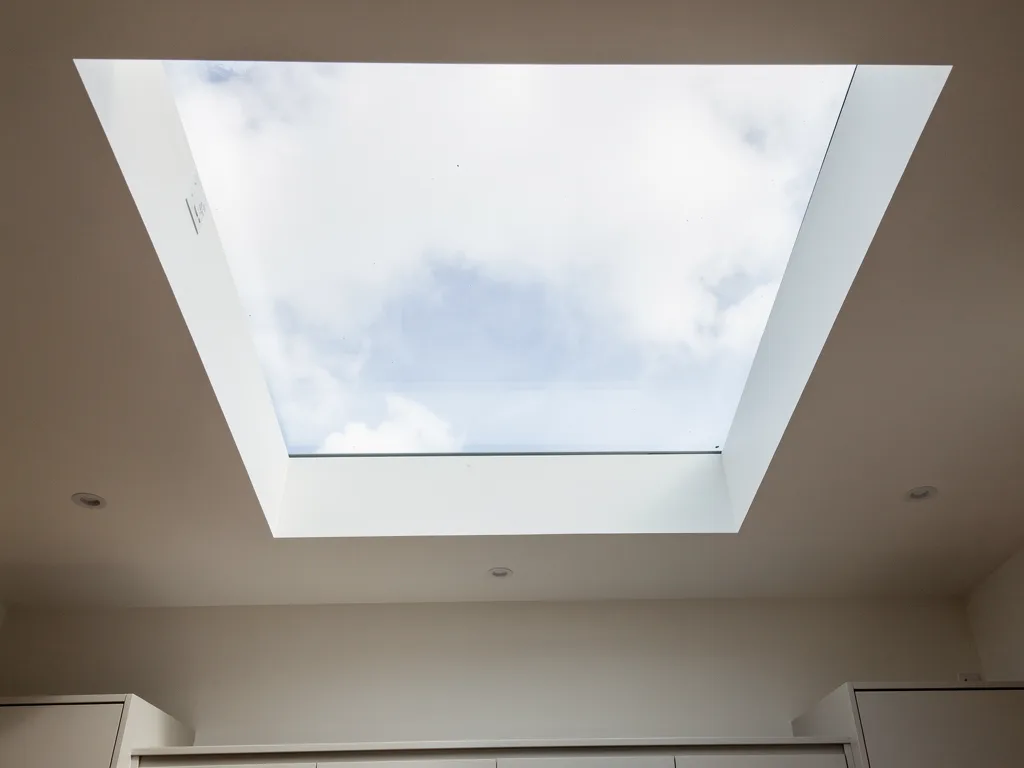
A level pane cannot hold a blind shut on its own
A blind on a pitched roof window has gravity doing part of the work: the fabric hangs against the glass and a spring or a light tension keeps it flat. A flat rooflight removes that help. The pane sits at little more than the fall built in for drainage, so a blind with no side support billows away from the glass, catches draughts, and leaves a strip of light down each edge instead of a clean line across the room. Every workable option for flat glass solves this the same way: guide wires or channels down each side hold the fabric flat to the pane as it opens and closes.
That is the main difference from a pitched roof window blind, and it is worth knowing before choosing a mechanism, because a track fitted at the wrong depth is one of the few blind problems that means taking the lining apart to put right.
Manual operation: a pole or a cord
Where the rooflight sits within easy reach of a telescopic pole, a pole-operated blind on a worm gear is the simplest fit. A short turn of the pole winds the fabric up or down along its channels, with no cord left hanging in a room with children or pets. A cord or chain-operated blind works the same way from a pull rather than a turn, and suits a rooflight closer to head height, over a landing or a kitchen sink rather than a vaulted ceiling.
Both need the pole or cord to reach a sensible working height, which is the detail that rules them out over a stairwell or a double-height extension. On a single-storey rear extension, a pole reaching from standing height is usually all that is needed, since the rooflight itself tends to sit at a normal ceiling height rather than up in a vaulted section of roof.
Motorised and solar-powered blinds
A motor moves the same guided fabric with a switch, a remote or an app rather than a pole. It suits a rooflight set high over a stairwell, a vaulted room or a linked run of glass where several blinds need to move together. Wiring can run in with the electrics at first fix if the rooflight is planned early, or a solar-powered version can be fitted with no cable at all: a small panel on the blind's own cassette charges from the daylight coming through the glass above it, enough to run the motor without drawing on the house supply.
The trade-off is cost and a mechanism to maintain rather than a length of fabric on a track, so it earns its keep where a pole genuinely cannot reach, rather than as a default for every rooflight in the house.
Fabric and how much sky the room keeps
The fabric itself decides what the room looks like with the blind partway down, which matters more on a rooflight than on a wall window because the eye is looking straight up into it. A blackout fabric earns its place in a loft bedroom, closing off early summer light without a curtain rail anywhere in sight, and Peterborough's new-town lofts across Bretton, Orton and Werrington are exactly the rooms this gets specified for.
A light-filtering or translucent fabric does something closer to the brand's own thinking: it softens glare on a bright day while keeping a pale wash of sky visible through the weave, so the room dims without the glass going dark. For a rooflight over a sofa or a table, where the point of the glass is the piece of sky it frames, a translucent fabric keeps that framing even half closed. Our answer on what you will see through a flat rooflight from the sofa goes into how kerb height and reveal depth set that view before a blind ever comes into it.
| Blind type | How it operates | Suits |
|---|---|---|
| Pole-operated | Turn of a telescopic pole | Reachable ceilings, no cord |
| Cord or chain | Pull from below | Head-height rooflights |
| Motorised | Switch, remote or app | Stairwells, vaulted rooms, linked runs |
| Solar-powered | Remote, charged by daylight | Where wiring is impractical |
Keeping the housing out of the sightline
A blind cassette bolted onto the plasterboard below a flat rooflight, rather than tucked into the head of the reveal, becomes the first thing the eye meets looking up: a box crossing the sky before the glass even starts. The better detail houses the cassette within the reveal lining itself, so the box sits behind the plane of the ceiling and the fabric drops from a point the eye does not register. On a frameless unit this matters more again, since the whole idea of a frameless flat rooflight is to hide the frame behind the glass edge; a visible blind box below it undoes that work. Our guide to frameless flat rooflights and the cleanest sightline sets out how that edge detail is built, and our page on internal reveal finishes under a flat rooflight covers how the lining is finished around it.
The kerb or upstand beneath the glass sets how much depth is available for that housing in the first place. A taller upstand gives more room to hide a cassette cleanly; a shallow one can mean the blind has to sit lower in the reveal, closer to eye level, unless the reveal is splayed to compensate. Our page on kerbs and upstands for flat rooflights explains how that depth is decided alongside drainage.
Heat, glare and condensation with the blind down
Closing a blind on a hot afternoon cuts glare in the room straight away, but it is the glass specification, not the fabric, that does most of the work against summer heat gain through a flat pane; our answer on whether a flat rooflight will make an extension too hot covers solar control glass and blind fabric together.
Our page on flat roof skylights and condensation sets out the glass and ventilation side of the same question in more depth.
Deciding at the point of installation
A blind track, a motor's wiring, or a solar cassette are all far easier to build into a reveal that is still open than to add once the plasterboard is finished and painted. Where a household already knows a bedroom rooflight will want blackout fabric, or a stairwell unit will need a remote rather than a pole nobody can reach, that decision is worth making before the reveal is lined, not after. It sits alongside other choices made at the same stage: whether the pane is fixed or opening, and how the glass is sized against the room below, since a wider pane needs a wider blind and a deeper housing to match.
Where privacy rather than glare is the concern, for instance a bathroom rooflight overlooked from a neighbouring roof, obscured glass is worth weighing against a blind: it keeps the sky pale and visible at all times rather than shutting it off completely. Our answer on whether a flat rooflight can have obscured glass compares the two. Every quote for a flat rooflight, blind included, comes with a sightline sketch showing the view from where the room is actually used, and our page on what affects the cost of a rooflight sets out roughly where blind options sit against the glass itself. For the wider job, see our page on flat roof rooflight installation in Peterborough.
Questions people also ask
Can an existing flat rooflight have a blind added later?
Sometimes, if there is enough depth in the existing reveal for a surface-mounted cassette and its side channels. It is rarely as neat as one built in at first fix, since the lining usually has to be opened up to run a track or a cable cleanly rather than clipping a box to the finished ceiling.
Do all flat rooflights need a blind?
No. Orientation, the room's use and how much the glass overlooks a neighbouring garden all affect whether a blind earns its place. A rooflight over a hallway with little direct sun may never need one, while the same pane over a west-facing bedroom usually will.
Will a blind block the view of the sky completely?
Only fully closed. A translucent fabric partway down still shows a pale wash of sky through the weave, and most blinds on flat glass are used for part of the day rather than kept shut, so the view returns as soon as it is wound back.
Is a motorised blind worth it over a pole?
Only where a pole genuinely cannot reach the rooflight, such as over a stairwell or a vaulted ceiling. On a rooflight within normal reach, a pole or cord does the same job with a simpler mechanism to look after over the years.
Book a home visit
Tell us which room
- No obligation
- Sightline sketch included
- 10-year guarantee
Or call 01733 736163