Question · Roof windows
How Long Does It Take to Install a Roof Window?
What happens on the day
The order of work is fixed, because the roof has to go back to being weathertight before anyone leaves, whatever else is going on. Access goes up first, then tiles or slates come off around the marked opening and the felt and battens are stripped back to bare rafters.
From there the opening is formed. If the window is wider than the rafter spacing, trimmers go in at the head and sill to carry the load around the gap. The frame is set into the opening, packed level, and fixed through the sides into the surrounding timber. The flashing kit goes on next: tucked under the covering above the window and dressed over it at the sides and below, so water runs over the glass and past the frame rather than finding a way in behind it.
- Access goes up and the roof covering is stripped back to the rafters
- The opening is formed and the frame is set and fixed
- The flashing kit is fitted around the frame
- Tiles or slates are relaid around the flashing
- The reveal is lined, or boarded up ready for a plasterer
The tiles or slates go back around the flashing last, cut in against the upstand rather than butted hard against it, and the whole job is checked over before the ladders come down. On a loft with easy access and no structural surprises, that sequence sits inside a single visit. See the roof window installation page for how this fits with sizing and choosing an opening type before the day.
What can push it into a second day
A few things routinely add time on site, and it is worth knowing which apply before a date goes in the diary.
Cutting a rafter is the biggest one. A window that needs to be wider than the gap between rafters means trimming one out and building in support either side, which is carpentry as well as glazing. Cutting a rafter to fit a roof window sets out what that support looks like.
The roof covering matters too. Interlocking concrete tiles lift off and go back in large, quick sections. Plain tiles and slate are laid in smaller overlapping courses, so cutting and relaying them neatly around a flashing kit takes longer and calls for a kit matched to that covering. Flashing kits for slate, tile and plain tile roofs and does a roof window work in a slate roof go into more detail on each.
Two windows on the same job, whether side by side or one above the other, mean two openings and two flashing details tied together rather than doubling a single task. Stacking roof windows for a taller piece of sky covers how that is planned.
Swapping an old roof window is often quicker than fitting a new one, because the opening in the rafters already exists. Replacing an old roof window in a tiled roof explains when that changes, such as failed flashing that has damaged the timber beneath it, or a larger window that needs the opening widened.
Before the day: survey to fitting
The time on the roof is only part of the timeline. A survey comes first, to measure the rafter spacing, confirm the roof covering, and decide whether the opening needs to be trimmed. This is also when the sightline sketch is drawn, showing the view the finished window will give from the bed, the desk or wherever the room is used from. See the sightline sketch for what that drawing covers.
The window and the flashing kit are then ordered to match the roof, since flashing is specific to a covering type and not something held ready off the shelf in every profile. Where the work is notifiable, the Building Control notification is submitted at the same stage, running alongside the order rather than adding a wait once the crew is on site.
Lining and making good after the glass is in
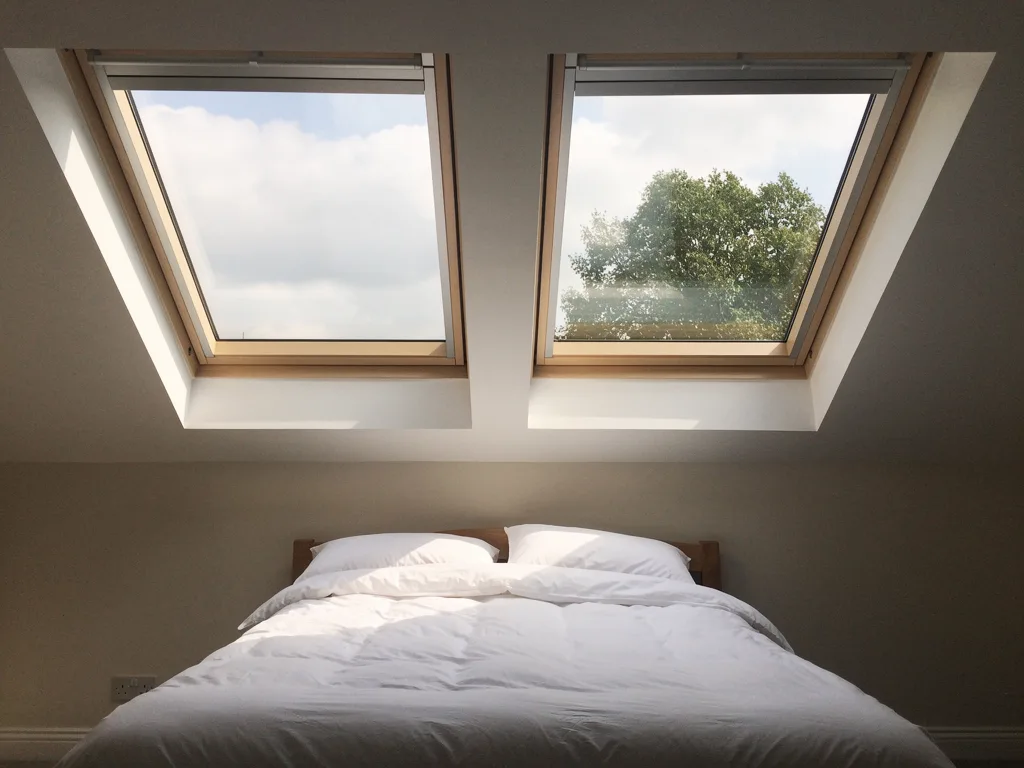
Once the window and flashing are done, the inside catches up. A splayed reveal, one that widens from the frame towards the room, is built and lined so the window reads bigger from below than the hole in the roof suggests. Lining a roof window so the opening widens towards the room covers how that shape is set out.
A vapour barrier collar goes in at the same stage, sealed around the frame before the lining closes over it, to stop warm, damp air from the room reaching the cold roof timber and condensing there. Does a roof window need a vapour barrier collar explains why that matters for a reveal that stays dry.
Plaster needs time to dry before it is decorated, so painting is usually a separate visit, once the room has had a few days to settle. That drying time sits outside the installation itself. For a sense of what all of this adds up to on a typical job, see what affects the cost of a rooflight, or book a home visit to get a timeline for your own roof.
Questions people also ask
Does the roof stay open overnight?
No. The opening is sheeted or dressed in before the crew leaves for the day, even if the lining and plastering are left for a return visit. The house is watertight at the end of every visit, not just at the end of the job.
Can two roof windows be fitted in one day?
Sometimes, if both openings sit within the rafter spacing and the roof covering is straightforward. Where a rafter needs cutting for either window, or the covering is slate or plain tile, two windows is more often a two-day job.
Does the size of the window change the timeline much?
A window that fits between existing rafters is quicker than one that needs the opening widened. Beyond that, most standard sizes add little time on their own; it is the trimming and the flashing detail around a larger opening that take longer, not the glass itself.
Is the plastering finished on the same day as the window?
Not usually. The lining and vapour barrier collar are fitted close to the window install, but plaster needs to dry before it is painted, so decorating tends to follow on a separate visit once the room has had time to settle.
Book a home visit
Tell us which room
- No obligation
- Sightline sketch included
- 10-year guarantee
Or call 01733 736163