Guide · Conservation rooflights
Conservation Rooflights That Open, by Hand or Motor
Most conservation rooflights are fixed, but many can open, by a pole-operated stay or a motor built into the frame, for a room that needs air as well as sky.
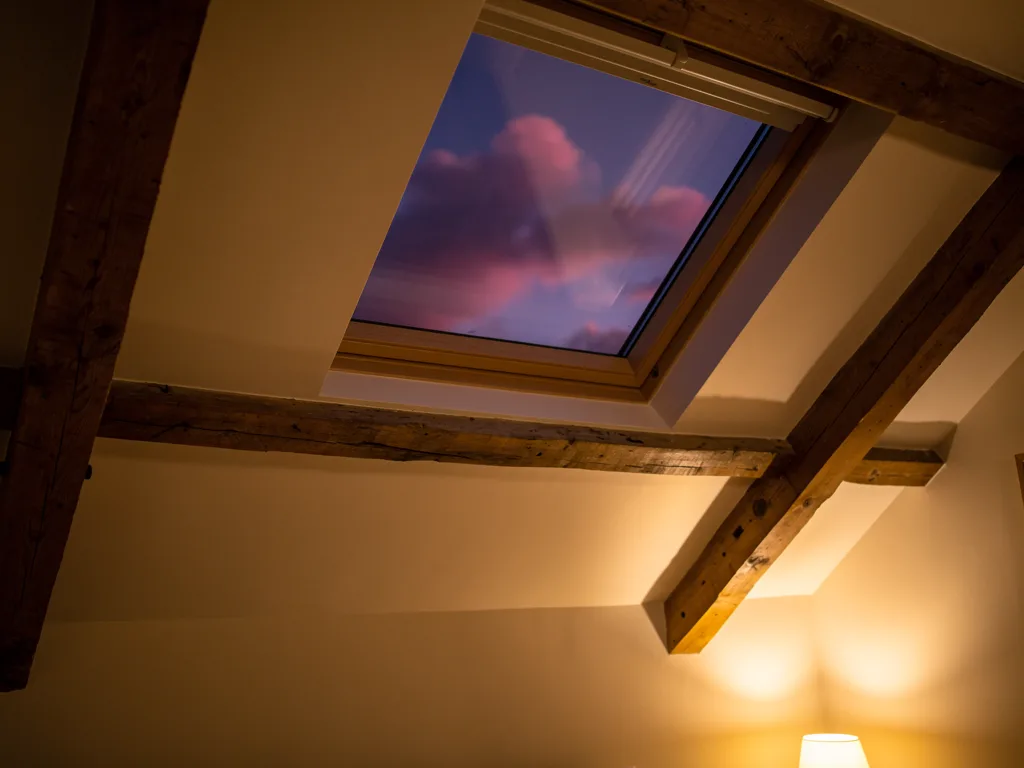
Fixed is the usual answer, but not the only one
Most conservation rooflights we specify in Peterborough are fixed, because a flush, slim, unopening pane is what a conservation officer expects to see on a Fletton brick terrace or a Collyweston stone roof, and it is the look the whole conservation rooflight style is built around. Fixed does not mean the choice ends there. The same ranges include opening versions, built to keep that narrow, low profile from the pavement while giving the room behind it a way to clear warm, damp air on a summer evening or after a shower.
The question is not whether an opening conservation rooflight exists. It does, in every material and finish used for conservation rooflight installation. The question is how you want to open it: by hand, with a pole and a stay, or by a small motor set inside the frame, and which of those suits the room, the pitch and the way you actually use the space.
Hand operation: a pole, a hook, a stay that holds its position
The simplest opening conservation rooflight uses a friction stay, a folding arm fixed between the frame and the sash that holds the glass open at whatever angle you choose and stops it slamming in a gust. You open it with a telescopic window pole, hooking the tip into a small eye near the sill or the head bar and pushing or pulling until the stay locks. There is no wiring, no transformer and nothing to fail in a power cut.
Reach decides whether this works well. A rooflight within easy pole distance of a landing or a raised bed platform is straightforward. One set high in a vaulted ceiling over a stairwell, reached only by leaning out over a drop, is a poor candidate for a pole and a better one for a motor operated from a wall switch at floor level.
- How high the rooflight sits above the floor, and whether a pole can reach it safely from a standing position
- How often the room needs venting: a bathroom used daily behaves differently from a rarely used box room
- Whether the same light is also relied on as an escape window, which affects how it is meant to be opened in a hurry
- Whether mains power can reasonably be run to that point in the roof void

Electric operation: a motor built into the frame, not bolted onto it
An electric conservation skylight uses a chain or spindle actuator set inside the frame profile, so the mechanism does not sit proud of the sash the way a surface-mounted arm would. Low-voltage cable runs back through the roof void to a small transformer and a wall switch, or a handheld remote, and the sash lifts and closes at the press of a button. Add a rain sensor and the light will close itself the moment it senses water on the glass, whether or not anyone is in the house.
This suits a rooflight that is genuinely out of reach: over a stair, above a vaulted landing, or set into a steep pitch where a pole would have to be worked at an awkward angle from below. It also suits a room used for sleeping, where closing a window by remote from the bed is simply more convenient than reaching up with a pole in the dark.
| Opening method | How it is worked | Suits |
|---|---|---|
| Manual pole and stay | Window pole hooks a lever; a folding stay holds the angle | Reachable pitches, no wiring wanted |
| Electric actuator | Wall switch or remote drives a chain inside the frame | High, steep or awkward pitches |
| Electric with rain sensor | Closes itself on rain; switch overrides it | Rooms left unattended, or a light left open overnight |
Where the mechanism sits in the view
Clearview's interest in an opening rooflight is the same as our interest in a fixed one: what you see from where you actually sit or lie. A top-hung opening sash, hinged at the head and lifting outward at the sill, keeps the same flush face as a fixed pane when it is closed, so from the pillow or the sofa there is no visible difference until the moment it is opened. The pole eye and the stay arm sit at the frame edge, out of the direct sightline upward, rather than crossing the pane the way a poorly placed bar would.
Size still governs the bar. Where a structural opening is wide enough to need a glazing bar under the conservation profile rules regardless of whether the light opens, that bar stays, and its position depends on the hinge: on a top-hung sash the bar usually sits below the hinge line, clear of the eyeline from a bed at the far side of the room; on a bottom-hung or pivot sash the geometry runs the other way. We work this out from the same eye position we use for every sightline sketch, not as an afterthought once the opening type is chosen. If a bar is genuinely unwanted, our guide on the central glazing bar sets out when it can be left out and when a conservation officer will expect to see one regardless of opening type.
Ventilation and what Building Regulations expect of the room
An opening conservation rooflight often does real work beyond comfort. In a bathroom without an extractor fan, it can provide the background and purge ventilation Building Regulations Part F expects for that room. In a loft bedroom, it may also be the means of escape in a fire, which sets a minimum clear opening height and width and a maximum cill height above the floor that the frame and hinge type have to meet. These are not decorative choices: a rooflight fitted as an escape window has to open to the full size the regulation requires, every time, which rules out some smaller conservation profiles for that particular room unless the layout is planned around it from the start.
We install every rooflight, opening or fixed, to current Building Regulations, and we handle the Building Control notification ourselves where the work is notifiable, so this is checked before glass goes in rather than queried afterwards.

A run of rooflights: deciding which ones open
Peterborough's conservation streets rarely take just one rooflight in isolation. A loft conversion behind a Fletton brick terrace, or an extension roof in one of the stone villages near Stamford, often carries two or three lights in a row on the same slope. It is common, and usually welcomed at application stage, to fix the end lights and let only the centre one open, or to fit opening lights only where a specific room needs them and leave the rest fixed. Consistency of appearance across the run matters more to a conservation officer than any single light opening or not, so this is worth settling before a listed building consent application goes in, not after. Our guide on how many rooflights one slope can take covers the numbers side of the same decision.
Steel or aluminium: what the frame has to carry
A steel-framed conservation rooflight, built to echo an original cast iron unit, is heavier than an aluminium equivalent of the same size. That weight has to be carried by whichever opening mechanism you choose: a manual stay needs to be strong enough to hold a heavier sash safely open in wind, and an electric actuator needs enough torque to lift it smoothly rather than straining. Neither is a problem in a rooflight specified correctly for its weight, but it is a reason the opening mechanism and the frame material get chosen together rather than one after the other. Our comparison of steel against aluminium frames looks at sightline and long-term care as well as weight.
Living with the light you open
An opening rooflight brings a small amount of upkeep that a fixed one does not. The hinge and the edge seal around a moving sash need the same attention as the glass itself if the view is to stay clear: a wipe when the frame is cleaned keeps grit from working into the moving parts. Opening the light briefly on a still day is also one of the simplest ways to clear the warm, moist air that causes condensation on a steel frame, rather than relying on coatings alone. Where blinds are fitted to an opening light, the track has to allow for the sash lifting clear without fouling the fabric, which is one more reason to plan blinds alongside the opening choice rather than adding them afterwards.
None of this changes what affects the price of the installation itself; that is covered in full, without naming figures here, on our page about what affects the cost of a rooflight.
Which rooms tend to ask for an opening light
Not every room needs one. A landing rooflight over a stair, there mainly to bring sky down into a dark stairwell, is often left fixed because nobody stands under it long enough to notice the air. The rooms that usually justify the extra mechanism, and the small extra care that comes with it, are the ones people spend real time in.
A bathroom without an extractor fan is the clearest case: steam has to go somewhere, and a rooflight that opens does that job quietly, without a fan running on a timer after the room is empty. A kitchen extension roof, whether it sits behind a Fletton brick terrace close to the city centre or on a newer build in Bretton, Orton or Werrington, sees the same problem from cooking rather than bathing, and an opening light over the hob end of the roof clears it in the same way. In a loft conversion turned into a bedroom, the case is different again: the rooflight may be doing double duty as the room's escape window as well as its ventilation, which is exactly the situation covered above under Building Regulations, and it is worth confirming at the design stage that the same unit can do both jobs to the sizes required.
Workshops and outbuildings converted for regular use follow the same logic as any other lived-in room: if someone is in there for hours at a time, an opening light earns its keep; if the space is used for storage and visited rarely, a fixed pane usually does the job just as well, for less to go wrong over the years.
Practical questions on opening and control
Can an opening conservation rooflight still look fixed from the street?
Yes. Closed, a top-hung opening sash in the same profile as a fixed pane looks almost identical from below or from the road; the hinge sits at the head, out of view, and the frame face width is unchanged. The difference only becomes visible once the sash is lifted.
Does an electric conservation rooflight need a mains socket at the roof?
No. The actuator runs on a low-voltage feed from a small transformer, usually sited in the loft or an airing cupboard, with a thin cable run to the rooflight and a wall switch or remote handset for control. No mains socket is needed at the frame itself.
Can a fixed conservation rooflight be changed to an opening one later?
Usually not by altering the glass alone. A fixed unit's frame does not carry the hinge and stay fittings an opening sash needs, so changing the type normally means renewing the whole rooflight rather than adjusting the existing one, and it may call for a fresh look at consent depending on the building. See our page on listed building consent if that applies to your roof.
Will an open rooflight let rain in?
It can, if a manual sash is left propped open on a stay during a shower. An electric unit fitted with a rain sensor closes itself the moment it detects water, which is the main reason we recommend a sensor for any light that will be left open unattended, particularly over a bed or a stair where a wet sash is more than just an inconvenience.
Keep reading
 GuideConservation Rooflights on Slate and Clay Tile RoofsHow a conservation rooflight is flashed and matched into slate, clay tile and pantile roofs.
 GuideWhen the Original Cast Iron Rooflight Has Had Its DayHow to tell when an original cast iron rooflight is beyond saving, and what a modern conservation unit changes.
 GuideConservation Rooflights in Barn ConversionsHow a conservation rooflight is fitted around a barn's trusses, long roof slopes and stone or pantile coverings.
Book a home visit
Tell us which room
- No obligation
- Sightline sketch included
- 10-year guarantee
Or call 01733 736163