Question · Conservation rooflights
Can Conservation Rooflights Have Blinds?
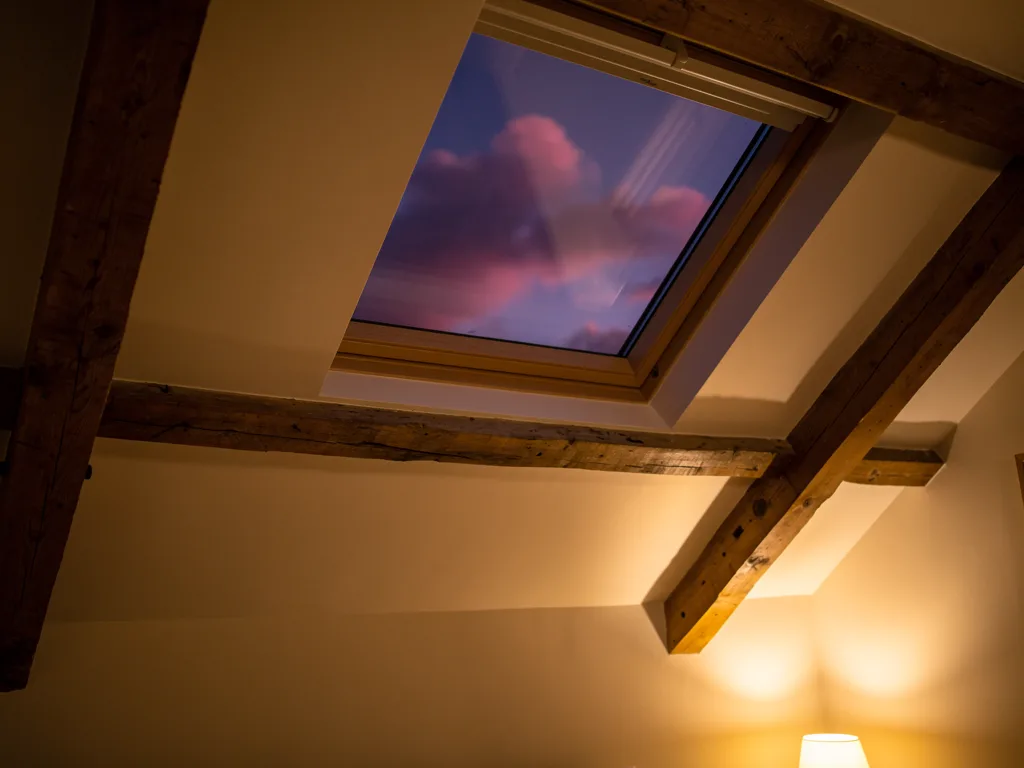
Why the fitting method matters more than the fabric
On a standard roof window, a blind usually clips onto guide rails screwed to the outer frame, with a bar or a bulky headbox sitting proud of the glass. A conservation rooflight is designed the opposite way: the frame is kept as narrow as possible so the view up is mostly sky, not metal. Bolt a wide external track to that frame and you have undone the point of choosing a conservation unit in the first place.
That is why an integral blind, one fitted inside the sealed unit between two panes of glass, suits a conservation rooflight so well. There is nothing added to the frame at all. The blind sits in the cavity, protected from dust and condensation, and the only visible change from the room is a slim control cord or a small wireless switch on the wall.
The three practical options
- Integral blind, between the panes: the neatest choice for a conservation profile. Nothing to clean, nothing outside the glass to catch dust, and no change to the flush external line.
- Internal pleated blind, fixed to the reveal: mounted just inside the plasterboard reveal rather than the frame, so it can be added or removed without touching the rooflight itself. It sits a little further from the glass, so it reads in the sightline sketch as a small loss of depth rather than a loss of sky.
- Roller blind on a slim cassette: works on a flat conservation rooflight with a deeper upstand, where there is room to hide a shallow cassette in the lining without it crossing the eyeline from the bed or the sofa.
Of the three, the integral blind is the one that keeps a conservation rooflight looking exactly as specified from outside and gives the cleanest line from inside. It costs more to add at the point of order, and it cannot be retrofitted later without changing the sealed unit, so it is worth deciding at the survey stage rather than after the glass is in.
Where the blind fixes changes what you see from below
A blind that clips to the frame reads in the view as a thin border around the sky, the same width as the frame it is mounted to. A blind fixed further back in the reveal reads differently: it sits above the opening rather than around it, so from a bed or a low sofa it can disappear from the eyeline entirely when it is open. This is exactly the kind of detail we work through on a sightline sketch before the roof is cut, because the drawing shows where the frame, any bar and the blind housing fall from the position you actually use the room from.
Control: cord, pole or motor
A rooflight fitted low in a wall or a dormer can take a simple cord or a pole reaching the bottom rail. Most conservation rooflights sit well above head height, on a pitched slope, so a cord alone is awkward to reach safely and a long pole is the minimum for a manual blind. Where the rooflight is out of reach altogether, such as over a stairwell or a vaulted landing, a small motor with a wall switch or a remote is the practical answer rather than a comfort extra.
We cover motorised opening on the rooflight itself in Conservation Rooflights That Open, by Hand or Motor, and the same choice, hand or motor, applies separately to the blind. A rooflight can open by hand with a motorised blind, or the reverse, depending on what is easier to reach in that particular room.
Blinds and the frame material
The choice between a steel-look and an aluminium conservation frame, covered in full in Steel Frames Against Aluminium in a Conservation Rooflight, has a small knock-on effect on blinds. A steel-framed conservation rooflight typically has a slightly deeper section to carry the traditional look, which gives an integral blind a touch more room in the cavity without widening the visible sightline. An aluminium unit with the same slim external profile can still take an integral blind; the difference is in the frame's depth, not in whether a blind will fit.
| Blind position | Effect on sightline | Best suited to |
|---|---|---|
| Integral, between panes | No change; frame stays as slim as specified | Any conservation rooflight, ordered at survey stage |
| Fixed to the reveal | Sits back from the glass, reads as depth not width | Existing rooflights, added later |
| Slim cassette in the lining | Hidden above the opening when raised | Flat conservation rooflights with a deeper upstand |
Does a blind need consent?
A blind is an internal fixture, not a change to the roof or the frame the planners or a conservation officer will have assessed. It does not sit within the scope of a listed building consent application or a conservation area consideration, which is concerned with the appearance of the roof from outside. Where consent for the rooflight itself is needed, see Preparing a Listed Building Consent Application for a Rooflight; a blind fitted afterwards, whether integral or added to the reveal, does not reopen that question.
Blinds, glass and condensation
An integral blind sits inside the sealed unit, in the same cavity as the low-E coating and any gas fill, so it has no bearing on condensation between the panes; that is governed by the seal itself, covered in Do Conservation Rooflights Get Condensation?. What a blind can do is trap warm, moist room air against the inner pane overnight if it is left fully closed in a bathroom or a kitchen, which shows as fleeting condensation on the room side of the glass rather than a fault in the unit. Leaving the blind open a little, or drawn back for the first hour after a shower, clears it.
What a blind does to the glass specification
Adding a blind does not change the choice of glazing covered in Glazing in a Conservation Rooflight, and it is a separate decision from a self-cleaning outer coating, which works on the outside face and is unaffected by anything fitted inside; see Can a Conservation Rooflight Have Self-Cleaning Glass?. The two specifications sit on opposite faces of the glass and can be combined freely.
Deciding at survey stage
Because an integral blind is built into the sealed unit, it is far simpler to specify before the rooflight is ordered than to add later. At survey we measure the eye position that matters in that room, from the pillow, the sofa or the desk, and show on the sightline sketch how the frame, any glazing bar and the blind, drawn both open and closed, sit against the sky. That is the point to say whether glare, a bedroom needing to darken fully, or simple privacy from a neighbouring roof is the priority, so the right blind position and fabric go on the order rather than being retrofitted around a finished reveal. See Conservation Rooflight Installation in Peterborough for how a conservation job runs from survey to sign-off, what governs the cost is set out in full in What Affects the Cost of a Rooflight, and the sketch itself is explained in The Sightline Sketch: How We Plan the View.
Questions people also ask
Can an existing conservation rooflight have a blind added later?
Yes, but not as an integral blind, since that has to be built into the sealed unit at the time it is made. The practical route on an existing rooflight is a blind fixed to the internal reveal rather than the frame, which can be added without touching the glazing or disturbing the flashing.
Will a blind make the room noticeably darker?
Only when it is closed. Left open, most conservation blind fabrics sit clear of the glass entirely, so the sky view and light are unaffected. A blackout fabric, used in a bedroom, is chosen specifically to cut light fully when closed and to be drawn back for daytime use.
Does a blind interfere with the central glazing bar?
No. Where a conservation rooflight keeps its traditional central bar, covered in The Central Glazing Bar: Keep It or Leave It Out, an integral blind sits behind the whole pane and is unaffected by the bar; a reveal-mounted blind simply runs the full width of the opening, bar included.
Can the blind be operated from a phone or a wall switch instead of a cord?
Yes, where it is motorised. A wall switch or a small remote is the usual control, and it can be set up alongside a motorised rooflight vent on the same switch plate or kept entirely separate, depending on what suits the room.
Book a home visit
Tell us which room
- No obligation
- Sightline sketch included
- 10-year guarantee
Or call 01733 736163