Guide · Conservation rooflights
Steel Frames Against Aluminium in a Conservation Rooflight
Both hold a narrow conservation profile, but steel and aluminium get there differently and age differently once the rooflight is on the roof.

Two frames for the same narrow face
A conservation rooflight only works if its frame face stays narrow under real load, and two materials are used to build that narrow face today: steel and aluminium. Neither is the wrong answer, but they get to the same slim sightline by different routes, and they behave differently once the rooflight has been on the roof for years rather than weeks. This page sets the two against each other on the two things that actually matter from inside the room: how much sky the frame leaves you, and how that view holds up over time.
Both materials can meet the shallow kerb, narrow face and shallow reveal that our guide to the conservation rooflight profile sets out as the three features that define the type. Choosing between them is not a question of which one qualifies and which does not. It is a question of finish, weight, ongoing care and, on some roofs, what a conservation officer expects to see given what the building already carries.
Steel: the profile the type descends from
Steel is the older of the two materials in this job, and it sits closest to the cast and wrought iron rooflights that the whole conservation profile is modelled on. Rolled steel is stiffer for its cross-section than aluminium, which lets a bar or a frame face be worked down thinner still and keep carrying the same wind and snow load. On a stone slate roof around Stamford or in one of the Nene valley villages, that extra thinness is often the detail that makes a new rooflight sit convincingly among slates or tiles laid a century or more ago.
The trade-off is maintenance. Bare steel corrodes where water is allowed to sit against it, so a steel-framed rooflight is painted or powder-coated, and that coating needs checking over the years the frame is on the roof, particularly at welds, fixing points and any corner where the finish can be scuffed during glazing or handling. Corrosion, where it happens, tends to start at those same points rather than along a flat run of section. Will a steel conservation rooflight rust on a damp slope? goes through what actually causes that and how the risk is managed on a shaded or damp-facing slope.
Steel is also a better conductor of heat than aluminium with a thermal break built in, which matters most where the frame meets the room rather than the roof. A steel bar can sit a shade colder on its inner face on a cold, still night, and that is worth knowing when judging what shows up on the glass near the bar lines. Do conservation rooflights get condensation? covers the difference between that surface condensation and an actual failed seal, and the answer is not the same for every frame material.
Aluminium: the newer standard for new work
Aluminium has become the more common choice for new conservation rooflights, and for reasons that have little to do with how it looks. Extruded aluminium can be worked to a face almost as narrow as steel, it needs no ongoing coating beyond the factory finish, and it is markedly lighter to lift, position and fix, which matters on a roof where access is already awkward, such as a steep slate roof over a stairwell or a stone outbuilding with no scaffold platform.
A well-detailed aluminium section carries a thermal break, a strip of low-conductivity material set into the extrusion that separates the outer face from the inner one, which keeps the inside of the frame closer to room temperature than a plain steel bar and reduces the surface condensation risk described above. The finish is usually a powder coat baked onto the aluminium rather than a paint applied on top, and it holds its colour for longer with less attention than a steel frame's coating typically needs, though neither finish is maintenance-free forever.
What aluminium does not offer is the same claim to authenticity on a building where the original ironwork survives, or where a conservation officer is judging a like-for-like replacement against a specific historic profile. On those roofs, the case for steel is about matching what was there, not about which material performs better in the abstract.
Sightline, side by side
The honest comparison is narrower than either material's marketing would suggest, because a genuinely conservation-grade unit in either steel or aluminium is built to the same shallow kerb and shallow reveal. The difference that reaches the eye sits mostly in the bar and frame face width, and in how each one is finished.
| Property | Steel | Aluminium |
|---|---|---|
| Narrowest achievable face | Slightly finer for the same load | Close behind, adequate for most spans |
| Weight on the roof | Heavier to lift and fix | Lighter, easier on awkward access |
| Ongoing coating care | Paint or powder coat needs checking over years | Powder coat holds with less attention |
| Best suited to | Like-for-like on original ironwork, listed buildings | New conservation-style units on any roof |
Neither column changes the fundamentals set out in our guide to what actually defines a conservation rooflight. Both materials can carry a central glazing bar as a period detail, and both can be built into a unit slim enough to disappear against the roof plane from the street. The choice sits in the columns above, not in the shape of the sightline itself.
What changes over the years each frame is on the roof
A rooflight is judged on the day it goes in, but it is lived with for decades, and the two materials age differently. Steel, left unattended, will eventually show corrosion at a weld or a fixing screw, usually long before the glazed unit inside it fails, and a coating that has worn thin on a weather-facing edge is the visible early warning. Recoating a sound steel frame is straightforward and keeps the same narrow profile indefinitely; it is corrosion allowed to progress at a structural point, rather than surface rust on a flat run of bar, that eventually forces a frame to be renewed rather than repainted.
Aluminium does not corrode in the same way, and its powder-coated finish is generally more forgiving of a Peterborough winter with no attention at all. Its own ageing shows up differently: a scratched or chipped powder coat can expose bare aluminium at that one point, and while the metal itself will not rust, a visible chip on a slim conservation frame is exactly the kind of detail that stands out against the roof it is meant to disappear into. Neither material is maintenance-free, and neither is fit-and-forget on the timescale a conservation rooflight is expected to last.

Where a conservation officer has a view, and where the choice is genuinely open
On most conservation-area roofs, an officer is checking for the shape of the profile, the kerb depth, the frame face width and the reveal, not asking for one named material over the other. Where the choice narrows to a single material, it is almost always because original steel or wrought iron survives on the same building, or on a terrace where the surviving examples nearby are consistently one material, and a like-for-like replacement is expected to match what is there.
Listed buildings are the setting where this matters most, because a listed building consent application is judged against the specific building's own fabric and history rather than a general standard. Choosing a rooflight for a listed building goes through how that specification is put together, and material choice sits inside that wider drawing, not as a separate decision made afterward. Where an original cast iron unit has reached the end of its working life, when the original cast iron rooflight has had its day weighs renewing it in steel to the same section against a slim aluminium alternative with the same proportions.
Outside a listed building, and in most conservation areas with no surviving original ironwork to match, the choice between steel and aluminium is the homeowner's, weighed against weight, ongoing care and, sometimes, what a builder already has experience fitting well.
Where the extra care and cost sit
Whichever material is chosen, the glass sitting inside it is built to the same shallower cavity that a conservation kerb demands, and getting the low-emissivity coating and gas fill right in that slimmer build-up is a glass-making question rather than a frame question. Glazing in a conservation rooflight goes through that separately from the frame choice covered here.
The cost difference between a steel and an aluminium conservation unit of the same size is usually smaller than the difference between either one and a standard, non-conservation rooflight, because most of the extra cost sits in the narrow tolerance the frame is held to and the hand-dressed flashing around a shallow kerb, not in the raw material itself. Why do conservation rooflights cost more? sets that out in full, and our costs guide gives general market ranges across all ten of our services as a guide, never a fixed price for a specific roof.
The view from the room, whichever frame is chosen
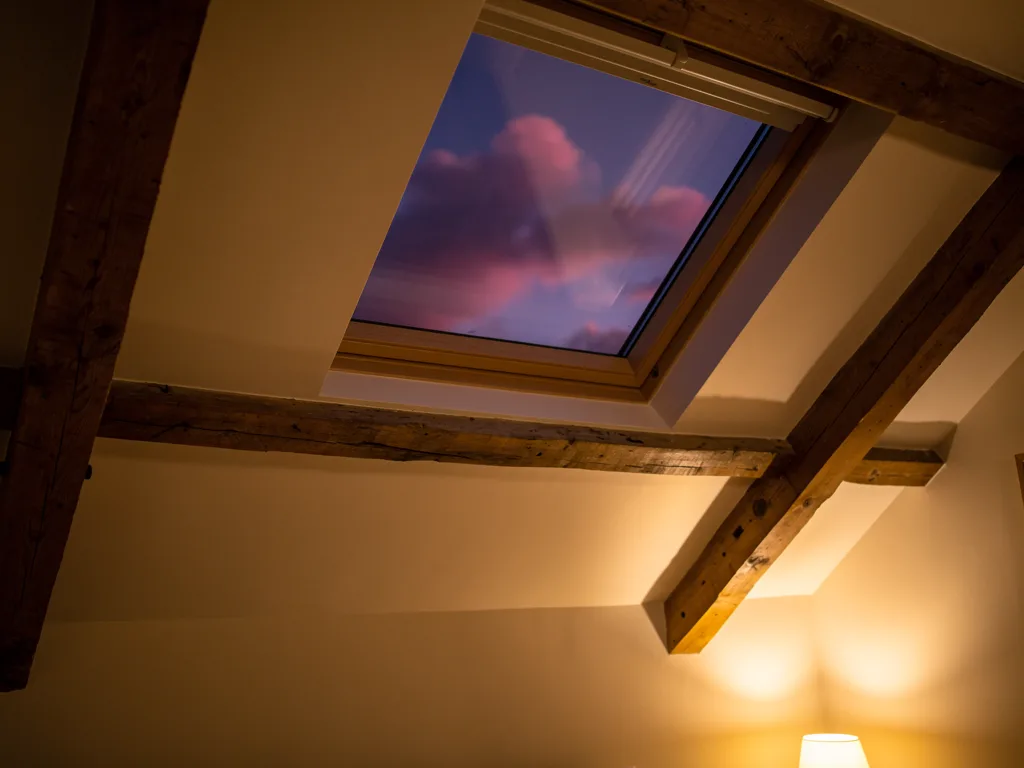
None of the differences above matter as much as what is actually seen looking up from the bed, the sofa or the sink in the room the rooflight serves. A narrow steel bar and a narrow aluminium bar of a similar width take a similar bite out of the sky from most seated or reclining positions, and the finish, the coating and the years of care each one needs are the questions that separate them, not the sightline itself.
That is why every quote we give, on either material, comes with a sightline sketch: a drawing of the actual view from the exact room the rooflight is going into, showing where the frame edge and any bar fall and how much open sky is left. It is drawn from the real roof and the real room rather than a standard diagram for either frame type, which is the only way to compare steel against aluminium honestly before the roof is opened. Our full conservation rooflight installation service covers the survey, the drawing, the specification and the fit for either material, to current Building Regulations, with the Building Control notification handled where the work is notifiable and a 10-year workmanship guarantee on the finished job.
Settling the choice on your own roof
Does a conservation officer ever insist on steel over aluminium, or the other way round?
Only where surviving original ironwork on the building gives a reason to match it. Away from that, most officers are judging the profile, the kerb and the reveal rather than the material, and either can be specified to meet the brief.
Which material actually gives the narrower sightline?
Steel can be worked marginally finer for the same load, but the difference on a typical domestic rooflight is small next to the difference between a genuinely conservation-grade unit in either material and a standard rooflight with a dark frame added on top.
Does aluminium fail faster than steel on an exposed conservation roof?
Not in the way steel can fail: aluminium does not rust. Its own weak point is a chipped or scratched powder coat exposing bare metal at one spot, which is a cosmetic issue rather than a structural one, and it is worth catching early on a frame meant to disappear against the roof.
Can steel and aluminium units sit on the same roof slope?
Yes, where two separate rooflights are going into the same slope for different reasons, such as a like-for-like steel unit over an original stairwell and a new aluminium unit lighting an extension added later. What matters to the eye from the street is that both keep the same narrow profile and a consistent dark finish, not that both share one material.
Keep reading
 GuideConservation Rooflights That Open, by Hand or MotorHow a conservation rooflight opens for ventilation, by hand or by a hidden electric motor, without disturbing its slim, flush profile.
 GuideConservation Rooflights in Barn ConversionsHow a conservation rooflight is fitted around a barn's trusses, long roof slopes and stone or pantile coverings.
 GuideGlazing in a Conservation RooflightHow spacer bars, coatings and laminated glass decide the look and performance of a conservation rooflight.
Book a home visit
Tell us which room
- No obligation
- Sightline sketch included
- 10-year guarantee
Or call 01733 736163