Question · Energy efficient rooflights
Does triple glazing give skylight glass a green tint?
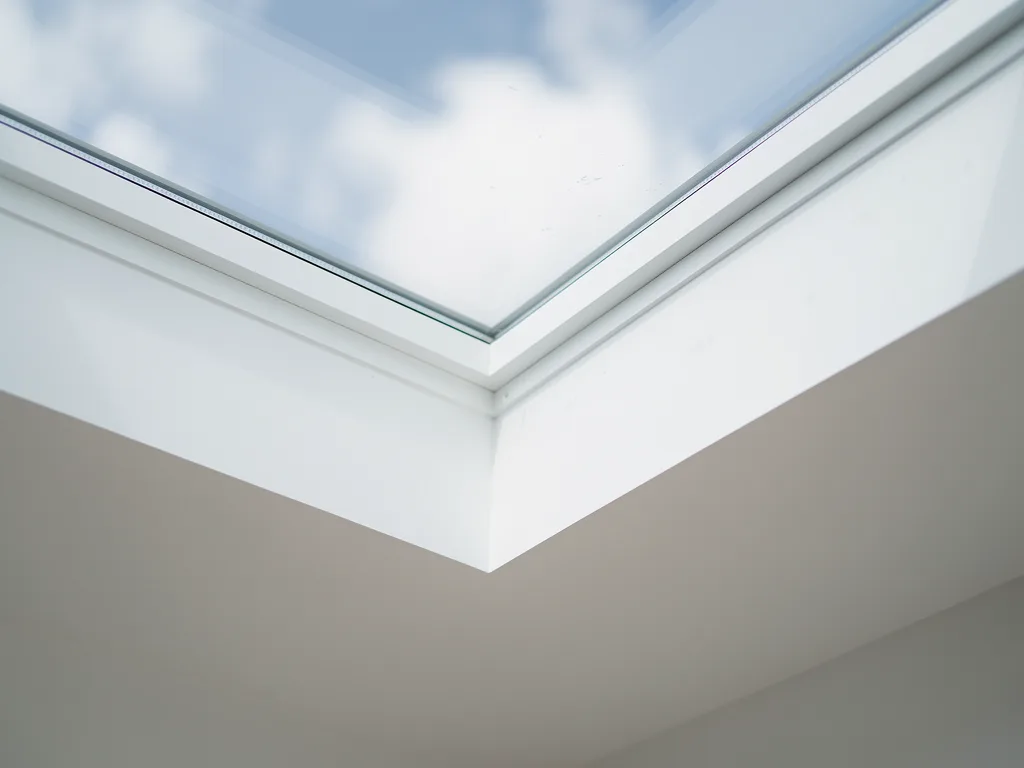
Where the tint actually comes from
Ordinary clear glass is never perfectly colourless. The raw sand used to make float glass carries a small amount of iron oxide as an impurity, and iron oxide absorbs light unevenly across the colour spectrum. It lets blue and green wavelengths through more readily than red, so any thickness of standard glass carries a faint green cast rather than being truly neutral.
Through a single pane a few millimetres thick, that cast is close to invisible. The light only travels a short distance through the glass itself, so there is not enough iron oxide in the path to shift what your eye reads as white or grey sky. Look along the cut edge of the same pane of glass, where the light travels sideways through several centimetres of it rather than straight through, and the green becomes obvious. Builders' merchants and glaziers see this constantly on stacked sheet glass in a warehouse; it is simply thickness making a weak effect visible.
Why triple glazing shows more than double
A double-glazed rooflight unit has two panes of glass with a sealed gap between them. A triple-glazed unit has three, with two gaps. Add the panes together and light passing through a triple unit crosses roughly half again as much actual glass as it does through a double unit, even though both units might sit at a similar overall thickness once the gaps are included.
That extra pane is exactly where the tint accumulates. Each sheet contributes its own small share of iron oxide absorption, and the shares stack. On their own none of it would register, but added together across three panes the cast becomes just enough to notice under the right light, most often against a large area of pale ceiling paint or plasterboard reveal rather than against the sky itself, where changing light and colour already mask small shifts.
None of this is a fault in the unit or a sign of a failed seal. It is the ordinary, expected behaviour of standard clear glass, and it applies equally to any triple-glazed window in the house, not just a rooflight. A rooflight simply puts it under a spotlight, because you are looking near-vertically through it at open sky rather than glancing through it at a garden.
Why a rooflight makes it more noticeable than a wall window
A vertical window is usually seen against varied colour: brick, trees, sky, a neighbour's roofline. A rooflight is seen against one flat, even field, the sky, often on an overcast day when that field is a uniform pale grey rather than blue. Uniform, pale backgrounds are exactly the conditions your eye is best at picking up a subtle colour shift in, the same reason a slightly tinted pair of sunglasses is obvious against a white wall but invisible against a busy street.
The reveal lining around the glass matters too. A bright white plaster reveal, common on a loft conversion in the newer townships of Bretton, Orton and Werrington, gives your eye a neutral reference right next to the glass to compare the sky against. A deeper, shadowed reveal gives less of that comparison, so the same unit can read as more neutral in one room than another purely because of how the opening is lined, not because the glass itself has changed.
Low-iron glass, and what it changes
Low-iron glass, sometimes called extra-clear or optically clear glass, is made from a purer sand mix with far less iron oxide in it. The colour absorption that causes the green cast is reduced to a small fraction of what standard float glass carries, so a triple-glazed unit built from low-iron panes reads much closer to true colourless, even along a cut edge.
- Colour rendering: the sky, and anything seen through the glass, keeps its true colour rather than shifting slightly green.
- Edge appearance: the cut edge of the glass, visible on some frame details and from an angled seat, shows far less of the tell-tale green line.
- No change to warmth: low-iron glass is a colour specification, not a thermal one; the U-value of the unit is set by the coatings, gas fill and spacer, covered on our page about low-E coatings and gas-filled glass.
It is a specification you ask for by name rather than something every triple-glazed rooflight includes as standard, and it is worth raising early, before the unit is ordered, because it is set at manufacture rather than added afterwards.
When it is worth asking for
Whether the standard green cast is worth avoiding depends on the room and the glass area, not a fixed rule. A single rooflight over a hallway or a small landing rarely shows it in daily use. A wide expanse of glass over an open-plan kitchen extension, seen against a bright white ceiling every day from the same seat at the table, is where the tint has the best chance of being noticed and, once noticed, of being hard to unsee.
| Situation | Standard glass | Low-iron glass |
|---|---|---|
| Small rooflight, varied outlook | Cast rarely noticed | An extra refinement, not essential |
| Large pane, plain pale reveal | Cast can be visible against the ceiling | Keeps the sky reading true |
| Glass edge visible from an angled seat | Green line along the edge | Edge stays close to neutral |
Where solar control or self-cleaning coatings are also specified, each of those layers adds its own faint colour effect on top of the base glass, which is why the two questions are worth answering together rather than one at a time; our guide to solar control glass for skylights sets out how each coating colours the view, and do heat-reflective coatings affect the view through the glass? answers the closely related question about reflection rather than tint.
Weighing it against the reason for triple glazing at all
Triple glazing is chosen for warmth, not colour, and the small increase in green cast is a side effect rather than the point of the specification. If the room, the reveal and the pane size make the cast unlikely to be noticed, standard glass in a triple-glazed unit is a perfectly sound, ordinary choice. If the room is exactly the kind described above, large pane, pale reveal, direct daily sightline, then asking for low-iron glass at the specification stage removes the question entirely rather than leaving it to be discovered once the roof is closed up.
Every quote from us comes with a sightline sketch, the drawing of the view from the seat, bed or sink that matters in your room, and glass specification, including whether low-iron glass suits the opening, is settled at the same visit rather than guessed at afterwards. We install to current Building Regulations with a 10-year workmanship guarantee, and where the job is notifiable we handle the Building Control notification. See the full range of options on our energy efficient rooflights page, or compare the warmth and clarity trade-offs in two panes or three: glazing a rooflight for warmth and clarity and is it worth replacing a double-glazed rooflight with triple? before you order.
Questions people also ask
Does the green tint fade over time?
No. It comes from the composition of the glass itself, set permanently at manufacture, so it neither fades nor gets worse with age. A unit that shows no obvious cast on day one will look the same in ten years, and the reverse is also true.
Does a bigger rooflight show more tint than a small one?
Pane thickness, not pane area, drives the effect, so a large rooflight and a small one glazed to the same specification carry the same cast per centimetre of glass. A larger pane simply gives more area of that same, mild colour to look at, and more pale reveal around it for the eye to compare against, which is why size and tint often get confused.
Is low-iron glass only used for skylights?
No. It is common in shopfronts, glass balustrades and display cabinets, anywhere true colour matters more than usual, and rooflight manufacturers offer it as one option among their standard glass specifications rather than a bespoke order.
Can low-iron glass be added to an existing rooflight later?
Not to the sealed unit itself. The glass composition is fixed when the unit is manufactured, so a change from standard to low-iron glass means replacing the unit rather than adjusting the one already in the roof.
Book a home visit
Tell us which room
- No obligation
- Sightline sketch included
- 10-year guarantee
Or call 01733 736163