Question · Energy efficient rooflights
Do heat-reflective coatings affect the view through the glass?
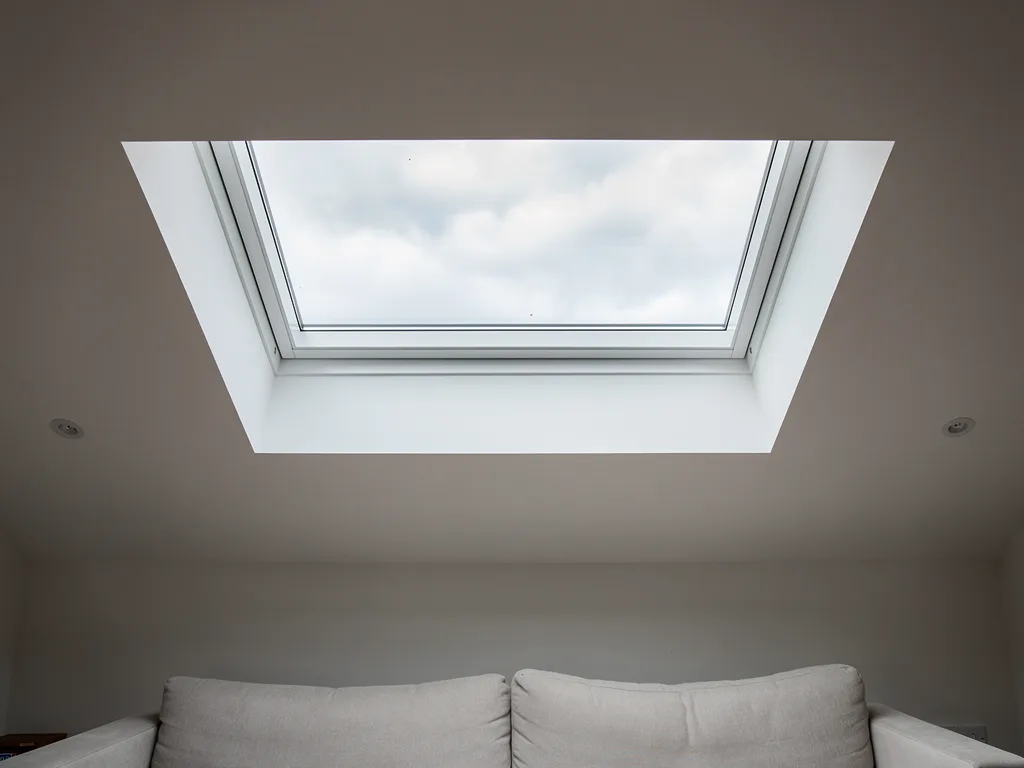
Reflective is a description of the coating, not one fixed product
"Heat-reflective" covers more than one way of building a coated pane, and the term alone does not tell you what the glass will look like from underneath it.
An older style of reflective coating works by bouncing back a broad band of the sun's energy, heat and visible light together, in a layer thick and uniform enough to give the glass a silvered or bronze sheen you can see from the street. It cuts heat well, but it does the job bluntly, and the same layer that reflects infra-red also reflects a good share of what your eye would otherwise read as open sky. A current solar control coating is built differently: a few atoms of metal oxide, tuned to reflect the sun's infra-red band while leaving the visible spectrum largely alone, so it rejects heat without behaving like a mirror in the process. Both are fairly described as heat-reflective. Only one of them actually looks it. Our guide to solar control glass for skylights goes through how these coatings are built and what they cost in light transmittance.
Two different views, and two different questions
A rooflight is looked at from both sides, and a coating can change each view in a different way, which is why the answer to this question depends on where you are standing when you ask it.
Seen from outside, on the roof or from a neighbour's upstairs window, a reflective coating can give the glass a mirrored or silvery cast, most obvious at a low sun angle when the pane throws back a bright, hard reflection rather than showing the room below. That is a planning and street-scene question as much as a comfort one, and it rarely troubles anyone actually living in the house. Seen from underneath, looking up from a bed, a sofa or a kitchen table, the coating shows up as a faint loss of clarity rather than a mirror during the day: the sky reads slightly less crisp, a shade duller, than it would through uncoated glass, in much the same way a good pair of sunglasses softens a view without changing its colour. Whether solar control glass dims the room below covers that daytime brightness question on its own; this page is about what happens to the reflection itself, not the light level.
Why the mirror effect shows up after dark, not at noon
A pane of glass reflects light from whichever side is brighter, and through most of the day that is the sky side, so any reflection you are looking through is thin and easily lost against the far stronger light coming from outside. Once the room lamps are on and the sky outside has gone dark, that balance flips.
At night, the room is the brighter side of the glass, so a rooflight with any reflective quality at all starts to show the ceiling, the light fitting and the shape of the room back to you instead of the sky above it. This is ordinary glass behaviour, not a fault, and it happens to some degree with any glazed roof opening after dark. A heat-reflective coating makes it more pronounced, because the coating is already built to bounce a share of the light hitting it back the way it came, which is exactly the behaviour that turns a dark pane into a mirror once the room is lit and the sky is not. Lying under a rooflight at night and seeing your own bedside lamp looking back at you is the most common way this question actually gets asked, rather than anything noticed at midday.
The fix is rarely the glass alone. A blind closed at dusk removes the reflection along with the view, which some rooms are happy to trade and others are not; a lower-reflectivity coating reduces the effect without removing the option to see stars on a clear night; and where the coating is fixed, changing how a room's own lighting is arranged, keeping bright fittings out of the direct sightline up through the glass, softens the effect considerably.
What changes, side by side
The table below sets the daytime and night-time picture against each other, since a coating that behaves well in one can behave differently in the other.
| Coating type | Outside look | Daytime view up | Night view up |
|---|---|---|---|
| Clear, uncoated | Glass reads plain | Sky at its crispest | Room reflects clearly once lit |
| Spectrally selective solar control | Faint sheen, rarely obvious | Close to clear, slightly softer | A little more reflection than clear glass |
| Older broad-spectrum reflective | Visibly silvered or bronze | Noticeably duller sky | Strongly mirrored, room shows plainly |
| Low-iron, low reflectivity build | Close to invisible | Closest to true clear | Reflection present but weakest of the four |
Every row still reflects something after dark; glass always does. The differences in the last column are a matter of degree, and the degree is set at the specification stage, not fixed by physics alone.
Which specifications stay closest to clear
Three choices, taken together, decide how close a heat-reflective pane stays to a plain sheet of glass in daily use, and none of them is only about the number on the datasheet.
- A spectrally selective coating over a broad-spectrum one: it is doing the same job, cutting infra-red heat, with a far lighter touch on the visible light your eye actually uses, which keeps both the daytime view and the night reflection weaker.
- Low-iron base glass under the coating: reducing the glass's own green cast leaves less colour for a reflection to carry, so a mirror image at night reads more neutral rather than tinted. Does triple glazing give skylight glass a green tint? covers that base-glass question on its own.
- Which face of the unit the coating sits on: soft, sputtered coatings are protected inside the sealed cavity rather than on an exposed face, and their exact position within the unit is one of the things a specification can be asked to state, since it affects how strongly the outer or inner pane throws back a reflection.
None of these is visible on a general product name. A datasheet will state a g-value and a light transmittance figure, covered in our guides to low-E coatings and gas-filled glass and reading a rooflight U-value, but neither figure describes how mirror-like the pane looks after dark. That is a question worth asking directly, and answering by looking at a sample, not by reading a specification sheet on its own.
Where this matters most on a Peterborough roof
A flat rooflight over a rear extension in one of the newer townships, Bretton, Orton or Werrington, sits parallel to the sky with nothing shading it, which is exactly the placement where a strong solar control coating earns its keep against summer heat, and exactly the placement where a bedroom or bathroom below is most likely to notice the coating's reflection once the lights go on at night. A pitched roof window over a landing, seen at an angle rather than straight up, shows the same effect more mildly, since you are rarely looking directly along the reflective plane from a fixed spot the way you are from a bed underneath a flat opening.
This is one of the things a sightline sketch settles before the roof is opened: not just how much sky you see by day, but where the glass sits relative to where you actually lie or sit after dark, and whether the specification needs to lean harder against daytime heat or against the night reflection, since the two do not always pull the same way. See the sightline sketch: how we plan the view and the full range of glazing options in energy efficient rooflights in Peterborough. Coating choice is one line on the quote alongside frame, glazing build and installation; what affects the cost of a rooflight sets out the rest.
Questions people also ask
Does every heat-reflective coating turn a rooflight into a mirror at night?
No. Every pane reflects more once the room is brighter than the sky outside, but a spectrally selective coating over low-iron glass keeps that reflection weak. A heavily reflective older build shows it far more strongly, close to a true mirror in a well-lit room.
Can a mirrored look be fixed after the rooflight is fitted?
Not by treating the glass itself. The coating is set into the sealed unit at manufacture and cannot be altered afterwards, so where the reflection is unwanted, a blind, a change to the room's own lighting, or replacing the unit with a different coating are the only routes available.
Is the reflection the same problem as the sky looking tinted?
No, and it is worth keeping the two apart when you are asking a supplier about it. A tint is a colour cast on the glass itself, present in daylight, and covered on our page about whether triple glazing gives skylight glass a green tint. A reflection is the room bouncing back at you, mainly an after-dark effect, and the two can be present together or separately on the same pane.
Does a reflective coating affect the view in daylight as much as at night?
Less. Through the day the sky is almost always brighter than the room, so a well-specified coating reads as a small softening of clarity rather than a mirror. It is once the light balance reverses, lamps on, sky dark, that the same coating shows its reflective side most clearly.
Book a home visit
Tell us which room
- No obligation
- Sightline sketch included
- 10-year guarantee
Or call 01733 736163