Guide · Energy efficient rooflights
The Invisible Layers: Low-E Coatings and Gas-Filled Glass
Two layers you never see, a coating on the glass and gas between the panes, do most of the work of keeping a rooflight warm. Neither one dulls the view from the bed, the sofa or the sink.
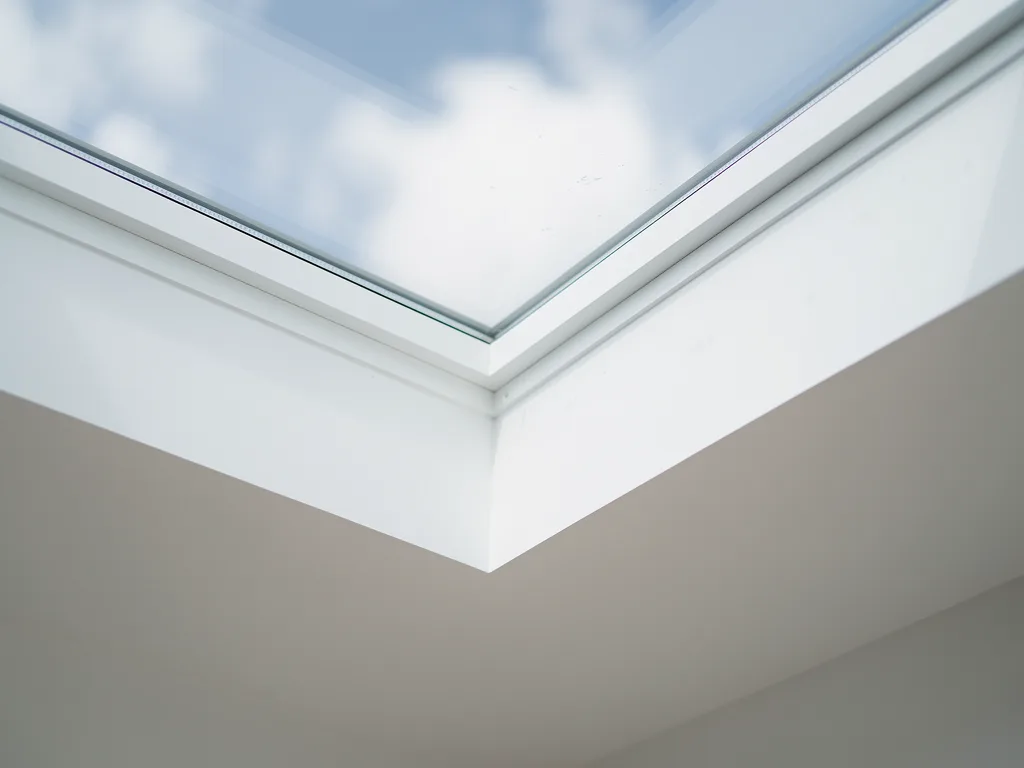
Stand under a good rooflight and you notice the sky, not the glass. That is deliberate, and most of the work happens in two layers you cannot see: a coating fired onto the glass itself, and a gas sealed between the panes. Neither shows up as a colour, a texture or a line across the view. Both decide how warm the room stays and how honest the sky above it looks.
The two layers, named
A low-E coating is a microscopically thin metal oxide layer, applied to one face of the glass before the unit is sealed. Gas fill is the mix of gases trapped in the cavity between the panes, in place of ordinary air. Together they do more for a rooflight's warmth than the thickness of the glass or the width of the frame ever could.
Neither layer is visible to the eye in daylight. You will not see a shimmer or a tint from below unless you know exactly what to look for, and even then only at a raking angle. That matters here because the whole point of a rooflight is the view from the bed, the sofa or the sink. A coating that changed the colour of the sky would defeat the reason for cutting the roof open in the first place.
What a low-E coating actually does to the glass
Ordinary glass lets heat radiate through it in both directions, out in winter and in during a hot spell. A low-E coating is engineered to reflect long-wave heat radiation back the way it came, while still passing visible light through almost unchanged. Inside the cavity of a sealed unit, that means the warmth generated by the room below is reflected back into the room instead of escaping through the glass and frame.
The coating sits on an inner glass surface, inside the sealed cavity, where it is protected from cleaning, weather and hands. It is applied during manufacture, either baked onto the glass while it is still hot (a hard coat) or laid down in a vacuum chamber afterwards (a soft coat). Soft-coat low-E is the more common choice in sealed rooflight units because it performs better thermally, and being sealed inside the cavity, its more delicate surface is never exposed to the outside world.

Hard coat and soft coat: two ways of getting the same layer onto the glass
A hard coat is fused onto the glass while it is still hot, straight off the float line, so the coating and the glass become one fired surface. It is tough, resists scratching if it were ever exposed, and can be handled roughly during manufacture. What it gives up is thermal performance: a hard coat lets more heat pass through than a soft coat does, because the coating layer itself is thicker and less selective about which wavelengths it reflects.
A soft coat is built up afterwards, layer by layer, in a vacuum chamber, using a stack of metallic films only atoms thick. That stack is far more effective at reflecting heat back into the room, which is why it has become the standard choice for a rooflight cavity, but it is also soft enough that it would mark or corrode if it were ever left facing the weather. That is not a flaw in the design. It is the reason the coating always sits on an inner surface, sealed inside the cavity, protected on both sides, rather than anywhere it could be touched or washed.
Why the coating's position on the glass is not a detail to skip
Manufacturers number the glass surfaces from the outside in: surface one faces the weather, surface two and three face the cavity, and surface four faces the room. Where the low-E coating sits among those surfaces changes how much heat it holds back and how it behaves in a Peterborough winter against a Peterborough summer. A coating placed to hold heat in for cold nights over Fletton-brick terraces and new-town lofts is doing a different job to one placed to keep a west-facing extension from overheating.
This is a specification decision, not a fitting one. It is made when the glass unit is ordered, based on the room, the pitch and the way the roof faces, and it cannot be changed once the unit is sealed. A rooflight quoted without this thought given to it is glass chosen off a shelf rather than glass chosen for the room.
Gas fill: replacing air with something slower to move heat
Air conducts heat reasonably well when it is free to circulate, and inside a sealed cavity a few millimetres wide, ordinary air still carries warmth across from one pane to the other through slow convection. Argon is denser and moves more sluggishly, so it conducts and convects less heat across the same gap. Swapping air for argon in the cavity is one of the simplest, most effective changes a sealed unit can make, and it changes nothing about what the eye sees through the glass.
Krypton does the same job again, more effectively, because it is denser still. It costs more to produce and is used mainly where the cavity has to be narrow, in a slim conservation profile where the reveal cannot take a thick unit, or in a triple-glazed unit where two cavities have to fit inside a frame no deeper than a double-glazed one. For a standard cavity width, argon does the job well and is the gas fitted in the great majority of rooflight units sold today.
Filling the cavity happens at the point the unit is sealed, not afterwards. The two or three panes are brought together around the spacer bar, the ordinary air already inside is displaced, and the chosen gas is introduced through a small port that is then sealed shut as the final step of manufacture. From that moment the unit is a closed system: nothing is added, topped up or adjusted once it leaves the factory, which is exactly why the gas fill and the seal around it have to be right before the rooflight ever reaches the roof.
| Gas | Relative density | Where it is used |
|---|---|---|
| Air | Lowest | Budget units, wide cavities where the gain matters less |
| Argon | Moderate | Standard cavity widths, the usual choice for double and triple units |
| Krypton | Highest | Narrow cavities, slim conservation profiles, tight triple-glazed frames |

The edge that has to hold the gas in for decades
Gas fill only earns its keep if it stays where it was put. The spacer bar running round the edge of the unit, and the seal around it, are what keep argon or krypton from slowly working its way out and ordinary air working its way in. An older-style aluminium spacer conducts heat and cold straight across that edge, which is also where condensation forms first on a cold morning. A warm edge spacer, made from a material that conducts far less, keeps that edge closer to room temperature and keeps the seal it sits inside doing its job for longer. See Warm Edge Spacers: Keeping the Glass Edge Clear for how that edge is built and what a poor one costs you at the corners of the pane.
A sound edge seal is also why gas fill is not something to worry about topping up. A properly sealed unit is not designed to be opened, and any loss of gas over its working life is accounted for when the unit's performance is rated in the first place. What actually fails a unit early is a broken seal, letting in moisture that fogs the cavity from the inside, at which point the fix is a new sealed unit, not a refill.
What it does to the view, not just the bill
None of this is only about heating cost. A cold pane of glass invites condensation to form on its inside face on a winter morning, and condensation is what turns a clear pane into a misted one exactly when you want to look up from the pillow. A well-specified low-E, gas-filled unit with a warm edge stays closer to room temperature across its whole surface, including the edges, which is precisely where fogging starts first. Keeping the glass warm and keeping the glass clear are the same job seen from two directions.
- Low-E glass lets you keep a rooflight over a bed or a sofa without the room losing its warmth back out through the roof each night.
- Argon or krypton fill does that quietly, adding nothing you would notice from below and nothing to maintain.
- A warm edge spacer stops the coldest part of the unit, the rim, from misting first and spoiling the view from underneath.
Put together, the glass does its work without asking anything of the person underneath it. That is the standard we plan a sightline sketch against: not just how much sky you will see, but whether that sky will still be clear to look at on a cold morning in February.
Reading a spec sheet instead of trusting the label
"Low-E glass" and "argon filled" are both true of the great majority of modern rooflights, so on their own they tell you very little. What separates a well-specified unit from an ordinary one is where the coating sits, how wide the cavity is, which gas fills it and what edge holds it together, and those four things together are what produce the U-value and g-value printed on the spec sheet. See Reading a Rooflight U-Value: Whole Unit or Centre Pane for how to read that figure properly, and What is the g-value of a rooflight? for the summer side of the same specification.
Two panes with the same nominal glazing and gas fill can still perform differently once the frame, the spacer and the coating position are accounted for, which is why the whole-unit figure matters more than any single ingredient named on its own. For the wider decision between two panes and three, see Two Panes or Three: Glazing a Rooflight for Warmth and Clarity, which weighs low-E and gas fill in a double unit against the extra cavity a triple unit adds.
The same combination of coating, gas fill and edge is also what a Building Regulations submission is checked against under Part L, and what an assessor enters into a SAP calculation on a new build or a substantial extension. None of that arithmetic changes what the glass looks like from below; it exists to confirm, on paper, that the specification chosen for the room actually performs the way it is described.
All of this sits under Energy Efficient Rooflights in Peterborough, where the coatings, gas fills, frames and spacers described here come together as one specification decided for the room, not chosen off a standard list. Every quote includes the sightline sketch, so you can see what the finished glass will look like from where you actually sit, alongside what it will do for the room's warmth.
What people ask about the glass they cannot see
Does the argon inside rooflight glass slowly escape?
A sound edge seal is built to hold gas fill for the working life of the unit, and any gradual loss is already allowed for in its rated performance. See Does the argon inside rooflight glass slowly escape? for what a failing seal looks like instead.
Does triple glazing give skylight glass a green tint?
Ordinary float glass carries a faint green edge that becomes more visible through three panes stacked together, though low-iron glass is available where a true sky colour matters most. Full answer at Does triple glazing give skylight glass a green tint?
Do heat-reflective coatings affect the view through the glass?
A correctly specified coating passes visible light through almost unchanged and is not something the eye can pick out from below in normal daylight. See Do heat-reflective coatings affect the view through the glass? for where a heavier coating does start to show.
Why does condensation form on the rooflight frame and not the glass?
A modern sealed unit is often warmer across its face than an untreated frame, so moisture finds the colder surface first. See Skylight Condensation: Causes and Cures and Thermally Broken Frames and Cold Bridging for how frame and glass are specified together to stop it happening at all.
Keep reading
 GuideReading a Rooflight U-Value: Whole Unit or Centre PaneTwo U-values can sit on one rooflight quote, and only the whole-unit figure describes what you actually get once it is fitted.
 GuideTwo Panes or Three: Glazing a Rooflight for Warmth and ClarityDouble or triple glazed: what changes in warmth, weight, cost and the clarity of the view through a rooflight.
 GuideSolar Control Glass for Skylights: Keeping the Heat Out, Not the LightSolar control glass cuts summer heat through a rooflight, and the same coating can change the colour of the sky you see.
Book a home visit
Tell us which room
- No obligation
- Sightline sketch included
- 10-year guarantee
Or call 01733 736163