Guide · Energy efficient rooflights
Warm Edge Spacers: Keeping the Glass Edge Clear
The middle of a rooflight pane is usually the best insulated part of the unit. The spacer at the edge decides whether that stays true.
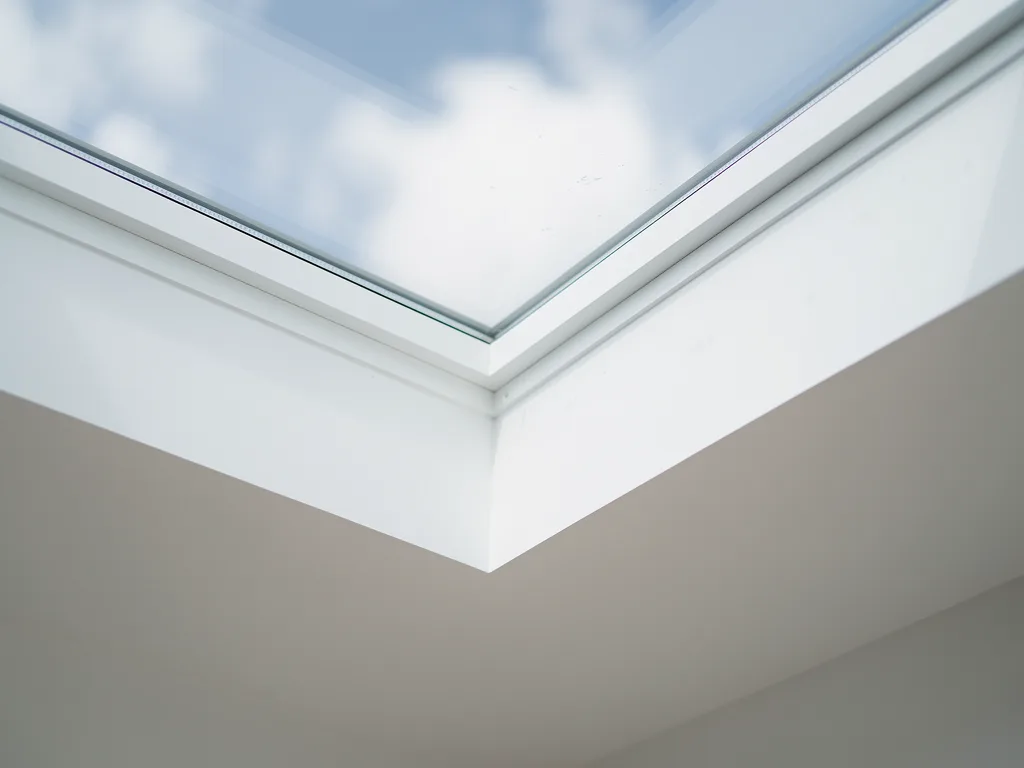
Where the spacer sits, and why it is doing more than holding the gap
A warm edge spacer is the strip running round the perimeter of a sealed glazing unit in a rooflight or skylight, set between the two or three panes to hold them the correct distance apart and to seal the gas-filled gap from the outside air.
Every double or triple unit needs something in that position: without a spacer the panes would simply touch, or the gap would fill with ordinary air rather than the argon that helps a modern rooflight hold its heat. For decades that job was done by a hollow aluminium box, folded into a rectangle, filled with a drying agent called a desiccant that keeps any trace of moisture out of the sealed gap. It worked, and it is still found in older units across Peterborough. What it did badly is stop the metal itself from carrying cold straight from the outer pane to the inner one, because aluminium conducts heat about a thousand times faster than the warm edge materials that have largely replaced it.
The coldest inch of the glass is rarely in the middle
Ask where a rooflight loses the most heat and the instinct is to picture the centre of the pane, but the centre is usually the best insulated part of the whole unit.
Low-E coatings and an argon-filled gap do their work across the main body of the glass, holding the inner surface close to room temperature even on a frosty night. The perimeter is a different story. Here the glass, the spacer and the frame all meet within a few millimetres of each other, and a spacer that conducts heat well gives that cold a direct path inward. The result is a narrow band around the edge of the pane that sits several degrees colder than the glass just a little further in, and it is this band, not the middle of the unit, that reaches dew point first when the room is warm and moist. Our guide to the wider picture of where that moisture comes from and what stops it covers the full mechanism: Skylight Condensation: Causes and Cures.
The frame itself can run cold for a separate reason, covered in Why does condensation form on the rooflight frame and not the glass? The spacer sits between those two problems, part of the glazing unit rather than the frame, and it is worth treating as its own line item on a quote rather than assuming it is covered once the frame and the glass are specified.

What a warm edge spacer is actually made from
A handful of materials have replaced the plain aluminium box, and each trades off conduction, flexibility and how the unit ages differently.
| Spacer type | Edge conduction | What it means in use |
|---|---|---|
| Plain aluminium box | High | Cold ring at the pane edge, the older standard, still found in existing units |
| Thermoplastic spacer (extruded or applied hot) | Low | No metal path across the gap, a common current warm edge choice |
| Stainless steel thin-wall box | Low to moderate | Keeps some rigidity of a metal spacer with a much thinner conducting path |
| Silicone foam strip | Low | Flexes with the glass as temperature changes, common on larger units |
None of these need naming on a quote for you to ask the underlying question: does the spacer carry a warm edge rating, and is that reflected in the whole unit figure rather than just the glass. A unit built with a low-conduction spacer but priced as though the frame alone decides performance is not telling the full story.
The choice between these materials is not purely a thermal one. A thermoplastic spacer applied hot bonds directly to the glass with no separate corner keys, which removes one of the weaker points in an older aluminium box design, the mitred or crimped corner where a seal can fail years before the rest of the unit does. A stainless steel thin-wall box keeps a little more rigidity across a wide span, which matters on a large lantern pane where the spacer also has to hold its shape under the weight of the glass itself. Silicone foam is the most flexible of the group, expanding and contracting with the glass through a hot summer and a hard frost without opening a path at the corner, which is one reason it turns up often on larger flat rooflights where movement across the pane is greatest.
None of this needs to be memorised to ask a useful question of whoever is quoting. The point worth holding onto is simpler: a spacer described only as "warm edge" without naming the material is not a red flag on its own, but it is worth asking which of the four builds above it actually is, since the answer changes how the corner of the unit is likely to age.
What changes at the edge of the view
Clearview's angle on a rooflight is the view from the pillow, the sofa or the sink, and the edge of the pane is part of that view whether anyone thinks to look at it or not.
A cold ring of glass does not just risk condensation. Even before any moisture appears, a cold perimeter can carry a faint haze or a slightly different clarity to the last centimetre or two of pane, right where the eye meets the frame, because the temperature difference across that narrow band bends light very slightly compared with the rest of the glass. On a low pitch or a flat rooflight, where the whole unit sits closer to eye level from below, that band sits exactly where a frame edge already narrows the sky, so a cold spacer compounds a sightline problem rather than causing a separate one. On a steep roof window seen from further back, the same ring matters more for what it does over a winter, as a place where mist forms first and streaks form as it dries.
Warm edge spacers and the whole-unit figure Building Regulations check
Part L judges a rooflight on its whole unit performance, glass, spacer, gas fill and frame together, precisely because a strong centre-pane figure paired with a poor spacer does not add up to a compliant installation on paper or in the room below.
The industry term for this is the edge effect: engineers can calculate a separate figure for how much heat moves through the perimeter strip compared with the centre of the glass, and a warm edge spacer narrows that gap considerably. On a small rooflight the edge makes up a larger share of the total glazed area than it does on a large one, which is why spacer choice matters proportionally more on a compact roof window than on a wide lantern. We set out how the whole unit figure is measured and quoted, and why it differs from a centre-pane number alone, in Reading a Rooflight U-Value: Whole Unit or Centre Pane, and the fuller list of what Part L asks for section by section in What Part L of the Building Regulations Asks of a Rooflight. We install to current Building Regulations as standard, and handle the Building Control notification where the work is notifiable.

Triple glazing asks more of the spacer, not less
Adding a third pane sounds like it should always improve on double glazing, but a triple unit has two sealed gaps and two spacer runs instead of one, so a poor spacer choice is doubled rather than halved.
- Two internal edges instead of one means twice the length of spacer conducting heat if the material is a plain metal box.
- A heavier unit puts more load on the spacer's own rigidity, which is one reason some manufacturers favour a stainless steel thin-wall box over foam on larger triple units.
- The middle pane in a triple unit runs cooler on its outer face than a double unit's single inner pane would, so a warm spacer at both edges matters for keeping that middle pane's perimeter clear too.
None of this argues against triple glazing, only for checking the spacer specification as carefully on a triple unit as the glass itself. Our comparison of the two builds sets out the fuller trade in Two Panes or Three: Glazing a Rooflight for Warmth and Clarity, and the seal that keeps the argon in either build is covered in Does the argon inside rooflight glass slowly escape?
Peterborough's glass edges: old aluminium boxes and new units side by side
Peterborough's building stock puts old spacers and new ones within a few streets of each other, and the two behave very differently once a Fenland frost sets in.
Terraces and semis in the city's own Fletton brick, where a loft has often been converted with a pitched roof window let into the rafters, still commonly carry an original double-glazed unit built on a plain aluminium box spacer, and a cold ring round the pane edge on a still winter morning is one of the clearer tells that the unit predates current practice. Flat-roofed kitchen extensions across the new-town townships of Bretton, Orton and Werrington, and the later township of Hampton, tend to carry newer units, though the age range varies enough that the spacer is still worth checking rather than assumed. Around Stamford and the Nene valley villages, where Collyweston stone slate and limestone cottages call for slim, flush conservation profiles, a warm edge spacer matters as much as anywhere else in the city, since a narrow conservation sightline puts the eye closer to the frame edge than a bulkier profile would.
None of that changes the physics of how a spacer conducts heat. It changes which streets are more likely to be looking at an aluminium box that has been doing its job since the unit was first sealed, and which are more likely to already have a current warm edge build.
What this means when you are choosing or checking a rooflight
The spacer rarely gets a line of its own on a quote, so it is worth asking the question directly: what is the spacer material, and does the figure you have been given reflect the whole unit or the centre of the glass alone.
On a replacement job, a visible cold ring or a line of mist that sits at the very edge of the pane rather than spread across the glass is one of the more useful signs that the sealed unit, not just the frame, has reached the point of being worth renewing. Replacing that unit with a current warm edge build usually clears the edge of the view along with improving how the room holds heat, because the two problems share the same cause. Every quote we give includes a sightline sketch, a drawing of the view from the pillow, the sofa or the sink, so you can see how a clearer edge changes what the last inch of sky looks like as well as how the room performs through a Fenland winter. See The Sightline Sketch: How We Plan the View, and for the wider picture of what drives cost across frame, glass and spacer choice, see What Affects the Cost of a Rooflight. For the full range of glazing and specification choices this guide sits within, visit Energy Efficient Rooflights in Peterborough, and for older single-glazed units the spacer question does not really apply until the unit itself is renewed, covered in Replacing Single-Glazed Rooflights With Modern Glazing.
Questions on the cold ring around the glass
Can a warm edge spacer be fitted to an existing sealed unit?
No. The spacer is built into the unit when the two or three panes are sealed together at manufacture, so an existing unit cannot have its spacer swapped without remaking the whole sealed pane. Where a cold edge is the concern, the practical answer is a new unit built with a warm edge spacer from the outset.
Does a warm edge spacer make the glass edge invisible?
Not invisible, since the spacer still sits behind the sightline of the frame in most builds, but it removes the temperature difference that makes the edge feel or perform differently from the rest of the pane. The frame profile and reveal shape still decide how much of the perimeter you see at all, covered on our costs and specification pages.
Is the spacer the same thing as the desiccant that keeps the unit dry?
The desiccant sits inside the spacer, a drying agent that absorbs any trace of moisture left in the gap when the unit is sealed, so the two are closely linked but not the same thing. A warm edge spacer still carries a desiccant fill, it is simply built from a material that conducts far less heat than a plain metal box while doing the same drying job.
Keep reading
 GuideWhat Part L of the Building Regulations Asks of a RooflightThe whole-unit U-value Part L sets for a rooflight, how new builds differ from replacements, and what Building Control actually checks.
 GuideThe Invisible Layers: Low-E Coatings and Gas-Filled GlassHow low-E coatings and argon fill keep a rooflight warm without dimming the clear sky you see from below.
 GuideBalancing Daylight and Heat Loss When SizingHow the size of a rooflight trades daylight and view against winter heat loss, worked through on two common Peterborough roofs.
Book a home visit
Tell us which room
- No obligation
- Sightline sketch included
- 10-year guarantee
Or call 01733 736163