Guide · Energy efficient rooflights
Solar Control Glass for Skylights: Keeping the Heat Out, Not the Light
A solar control coating holds back summer heat while still letting daylight through, but the same layer can put its own colour on the sky. Here is what that trade means for your roof.
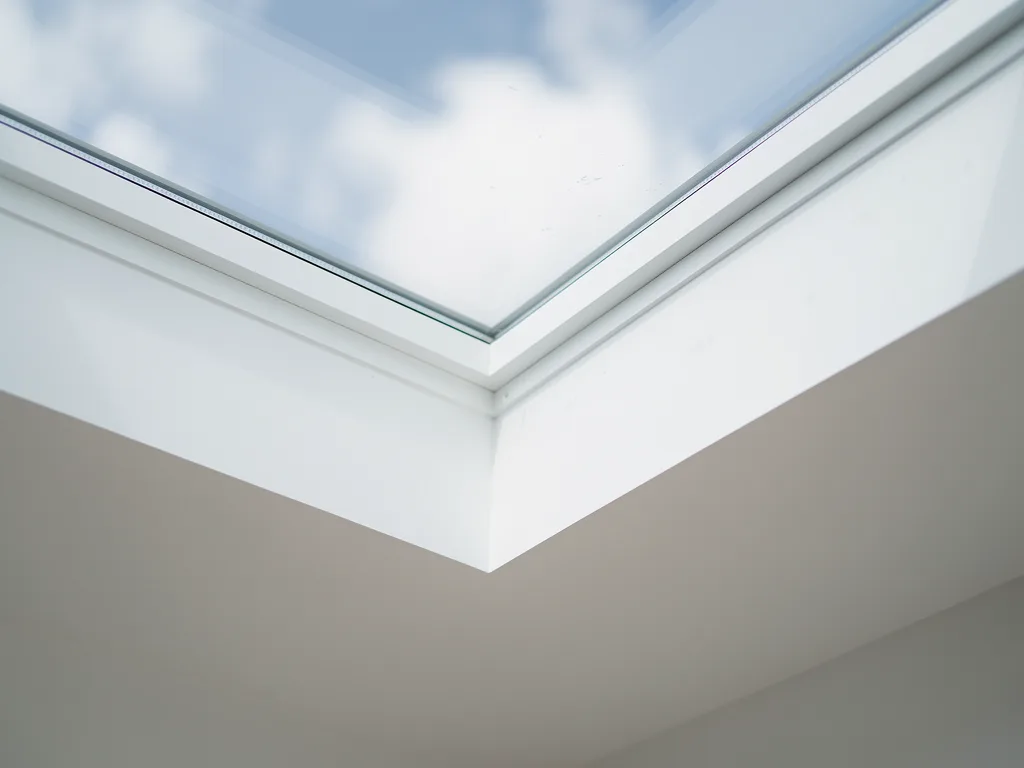
A rooflight faces the sun in a way no wall window ever does, and for a few months of the year that difference decides how a room underneath it actually feels to sit in. Choosing the glass that manages this is one part of the wider work covered in our guide to energy-efficient rooflights in Peterborough; this page goes into one layer of that specification on its own. It covers what a solar control coating is actually doing at the surface of the glass, the trade it makes between heat kept out and light let in, where Building Regulations expect that trade to be calculated rather than guessed, and how the same coating can change the colour and clarity of the sky you see once the roof is closed back up.
A rooflight meets the sun differently to a wall window
A vertical window in a gable wall only catches direct sun at a low angle for a few hours either side of sunrise and sunset through high summer; a rooflight set into a pitched or flat roof can sit close to face-on to the sun for most of the middle of the day, for months at a stretch, which is why the same glazed area lets far more solar energy into a room from above than it would set into a wall.
Through a June afternoon the sun sits high enough over the Fens that a roof pitched at 30 to 45 degrees, the common range for a loft conversion or rear extension, is close to perpendicular to the incoming light, so the glass receives close to the full strength of that light rather than the glancing, oblique dose a wall window gets. A flat rooflight, common on the single-storey rear and side extensions built across the newer townships, lies parallel to the sky and is more exposed still, with nothing about its angle to soften the sun through the middle of the day.
The result shows up as heat rather than glare in most rooms: a bedroom above a loft conversion, or a kitchen extension with a decent-sized rooflight over the table, can run several degrees warmer through a sunny afternoon than the same room would with wall glazing alone, particularly where the floor or worktop below is dark and holds the heat it gathers rather than reflecting it back out. Ordinary double glazing, built to keep heat inside a room through a Peterborough winter, does very little to slow that gain coming the other way in summer. Solar control glass is the specific answer to that different problem.
What a solar control coating is actually doing to the glass
A solar control coating is a layer only a few atoms thick, applied to one face of the glass inside the sealed unit, made from metal oxides that reflect a share of the sun's infra-red energy back outside before it ever reaches the cavity, while letting most of the visible part of the spectrum straight through to the room.
Sunlight arrives as a mix of ultraviolet, visible light and infra-red energy, and a solar control coating is engineered to treat those wavelengths differently rather than blocking everything equally. It reflects and absorbs a large share of the infra-red, which is the part of the spectrum that carries most of the sun's heat, while staying as transparent as it can to the visible band that makes a room feel bright. Two manufacturing routes produce this layer: a pyrolytic, or hard, coating baked onto the glass while it is still hot during production, tough enough to handle on its own but limited in how selective it can be; and a sputtered, or soft, coating applied afterwards under vacuum in thin, precisely controlled layers, which gives finer control over the balance between heat rejected and light admitted. Soft coatings are not durable enough to leave exposed to weather or cleaning, so they always sit on an internal glass surface, protected inside the sealed cavity of a double or triple unit.
It is worth keeping this distinct from an ordinary low-E coating, covered in our guide to low-E coatings and gas-filled glass. A standard low-E coating is tuned mainly to reflect the long-wave heat a warm room radiates back inside during winter, holding warmth in. A solar control coating is tuned the other way, to reject the sun's short-wave energy before it gets in during summer. Many current rooflight specifications combine both jobs in a single pane, sold as solar control low-E glass, so the winter and summer performance are not usually a choice between two separate products but two duties asked of the same coated surface.

G-value and light transmittance, read side by side
Two figures on a glazing datasheet describe what a coating actually costs and buys: the g-value, the share of the sun's total energy that passes through the glass, and the light transmittance, the share of visible light that passes through it. A good solar control choice is the one where the gap between those two figures is as wide as the room can use, holding brightness up while g-value comes down.
| Glass build | G-value (approx) | Light transmittance | What changes at roof level |
|---|---|---|---|
| Clear double glazed, no coating | 0.75 to 0.80 | 78 to 82% | Full solar gain, brightest option |
| Standard low-E double glazed | 0.60 to 0.65 | 75 to 80% | Winter warmth kept in, little summer control |
| Solar control double glazed | 0.30 to 0.45 | 55 to 70% | Noticeably less heat, some loss of brightness |
| Solar control triple glazed | 0.25 to 0.35 | 50 to 65% | Lowest gain, dimmest of the four |
The ranges above are general figures published across the glazing industry rather than any single maker's exact numbers, and a real quote should always carry the specific figures for the pane being offered. Reading the two columns together matters more than chasing the lowest g-value on the sheet: a coating that cuts g-value hard but also drags light transmittance down with it can leave a room feeling duller than the sky outside suggests it should, and on a grey Fenland day, when every percentage point of daylight counts for more than it does under a clear sky, that loss is felt more than the heat saved on the handful of hot afternoons a year actually justifies. For a room used mainly for daylight, a landing or a kitchen worked in through the day, holding light transmittance as high as the aspect allows, then choosing g-value from what is left, tends to serve the room better than starting from g-value alone.
The coating can put its own colour on the sky
The same reflective layer that rejects heat can also tint or mirror the glass to some degree, and on a rooflight, where the glass is the sky itself rather than a backdrop behind a garden view, that tint is far more noticeable than the same coating would be set into a wall window.
Seen from outside, a strongly reflective solar control coating can give a roof a silvery or faintly blue sheen. Seen from underneath, the effect is usually a softer colour cast rather than a mirror, but it is a cast all the same, and it varies by coating recipe, by how many panes the light has already passed through, and by the base glass the coating sits on. Ordinary float glass carries a slight green tint of its own, caused by trace iron in the raw sand, which becomes more visible as glass thickness increases across a double or triple unit; a low-iron, sometimes sold as extra-clear, base glass removes most of that green cast and is worth asking for specifically where a coating is also going onto the pane, since the two together decide the true colour of the sky you end up with. Our answers on whether triple glazing gives skylight glass a green tint, whether solar control glass will dim the room below and whether heat-reflective coatings affect the view through the glass each take one of these questions further.
Part O and where solar control becomes part of the calculation
Since Part O of the Building Regulations came in for new dwellings and for extensions and loft conversions that create new habitable rooms, the amount of solar gain a glazed roof lets into a space is no longer only a comfort question. It can be a figure a building control body actually checks before the work is signed off.
Part O sets out two routes to showing a room will not overheat: a simplified method, which limits glazing area against floor area by orientation and requires a minimum level of openable ventilation and cross-flow, or a full dynamic thermal modelling assessment for rooms or layouts that fall outside the simplified limits. Rooflight glazing is weighted more heavily than vertical windows in both routes, in recognition of exactly the exposure set out earlier on this page, so a loft conversion with a generous flat rooflight is more likely to need the fuller assessment than the same floor area lit from a gable window. The g-value of the glass specified is one of the direct inputs to that calculation, alongside shading, orientation and ventilation, which is why the glass choice on a rooflight going into a new habitable room is increasingly a design decision made early rather than a finish picked at the end. Our guide to rooflights and overheating under Part O goes through both routes in full.

Coatings, blinds and shading, working together
A coating and an internal blind solve overlapping but different problems, and treating a solar control unit as the only line of defence against a hot room misses what a blind still adds on the handful of afternoons a year when the sun is at its most direct.
- A solar control coating works continuously through daylight hours, whether or not anyone remembers to close a blind before leaving the house.
- An internal honeycomb or pleated blind adds a still layer of air under the glass, cutting glare and a further share of heat on the room's hottest afternoons, at the cost of losing the view while it is closed.
- External shading, more common on a roof lantern than a single rooflight, blocks heat before it ever reaches the glass, the most effective single step available but rarely practical on a sloped roof face.
- Orientation and the use of the room below decide how much of this a given opening actually needs; a north-lit landing rooflight rarely calls for the same specification as a south-facing kitchen extension used daily through summer.
None of these steps replaces the others so much as covers a different part of the day or a different kind of weather, and a specification that leans on the glass alone, or on shading alone, tends to leave one gap the other would have closed.
Specifying it for a Peterborough roof
The Fens run flat to the east and north of the city, with little rising ground or tree cover to interrupt the sun over a garden or extension roof, so a south or west-facing flat rooflight on a rear extension in one of the newer townships gets a long, unbroken run of direct sun for hours at a stretch through summer, with nothing nearby to shade it. That exposure is worth weighing against the room below: a rooflight over a hallway or landing, used briefly and rarely sat under for long, can often carry a lighter specification than one over a kitchen island or a sofa where people spend whole afternoons.
A useful habit at survey stage is to treat each opening on its own aspect rather than applying one blanket glass specification across an entire roof. A pair of rooflights on the same extension, one facing south over open ground and one facing north into a neighbour's taller roofline, can reasonably carry two different coatings, one doing more work against heat, the other left brighter because it never sees direct sun for long. Sizing the openings themselves against how much heat gain a room can absorb is covered in our guide to balancing daylight and heat loss when sizing a rooflight, and the wider cost implications of these choices, alongside frame, glazing and installation, are set out in what affects the cost of a rooflight.
A coating also does nothing for ultraviolet light on its own account unless it is built to, and most solar control and laminated builds now cut a large share of UV as a normal part of the same layer, which matters for anyone worried about fabric or flooring fading under a rooflight that gets long daily sun; our answer on whether energy-efficient skylights block UV covers that separately from the heat question addressed here.
Where solar control glass earns its place on a quote
Does every rooflight need solar control glass?
No. A small rooflight lighting a north-facing landing, or one shaded for most of the day by a neighbouring roofline or a taller part of the same house, may perform perfectly well with a standard low-E specification and no added solar control layer. The coating earns its place fastest on a larger opening facing south or west over a room used through the day, a kitchen, a living space or a bedroom someone sleeps in through summer mornings, where the extra heat rejected is heat that was genuinely going to be felt.
Can solar control glass be added to an existing rooflight?
Not as a coating applied afterwards. The reflective layer is built into the glass during manufacture and sealed inside the unit, so it cannot be brushed or sprayed onto an older pane the way a film can be added to a car windscreen. Where an existing single or older double-glazed rooflight is overheating a room, the practical route is to upgrade the glazed unit itself, replacing it with a new coated build sized to fit the existing kerb or frame wherever that is possible, rather than treating the old glass in place.
Why do two solar control units from different makers look like different colours of sky?
Coatings vary by recipe, by how many metal oxide layers are used and in what order, and by the base glass they sit on, low-iron or ordinary float, so two units with very similar g-values on paper can still cast a noticeably different colour once fitted. That is the main reason a datasheet figure is not enough on its own, and why a physical sample, viewed against real sky rather than under an indoor showroom light, is worth insisting on before a specification is signed off.
Keep reading
 GuideRooflights and Overheating: Part OWhat Part O of the Building Regulations asks of a new rooflight, and how glazing area, ventilation and solar control glass keep a room from overheating.
 GuideReplacing Single-Glazed Rooflights With Modern GlazingWhat changes when an old single-glazed rooflight or dome is replaced with modern glazing.
 GuideSelf-Cleaning Glass: Clarity and Efficiency on a RooflightA self-cleaning coating uses daylight and rain to keep rooflight glass clearer for longer, especially on flat and low-pitch roofs.
Book a home visit
Tell us which room
- No obligation
- Sightline sketch included
- 10-year guarantee
Or call 01733 736163