Guide · Roof windows
When the Roof Is Shallow: Roof Windows Below the Usual Pitch
A shallow roof changes how a roof window sheds water, how the glass stays clear and what the sky looks like from below.

A low pitch roof window is not a different product from the one fitted into a steep slope, but it is asked to do a harder job with the same glass and the same frame. Every roof window range is designed around a pitch band, and most of what makes a good installation on a 40 degree slope, the flashing, the fall of water off the glass, the way the reveal frames the sky, starts to behave differently once the roof drops toward the shallow end of that band. Some of the shallowest slopes are better served by a flat rooflight or a kerb-mounted unit rather than a pitched window at all. Everything in between, the genuinely low pitch roof window, is what this guide is about: what changes, what to check, and what still looks the same from where you actually sit or lie once the work is done.
Where "shallow" starts, and why the number on the box matters
Every pitched roof window range publishes a minimum pitch it is designed to work within, usually somewhere in the teens of degrees at the bottom end, with a lower figure possible once extra flashing measures or a dedicated low-pitch kit are added. That published number is not a suggestion. It sets how fast water leaves the glass, how far it can be blown back up the pane by wind, and how much overlap the flashing needs to carry it clear of the frame rather than under it. A window fitted at the bottom of its rated range, or below it without the extra measures the maker specifies, is not simply "a bit riskier"; it is being asked to shed water at an angle it was never proven to manage.
Peterborough gives plenty of reason to ask the question early. New-town homes across Bretton, Orton and Werrington include flat-roofed and low-pitched extensions from the same era, and a bungalow loft or a lean-to often has less fall in the roof than the main house it sits against. Before a window is chosen, the actual pitch of the actual roof, measured rather than guessed from the street, decides which parts of this guide apply.
Water needs a steeper path to shed than the eye assumes
Standing under a roof from inside, a slope that reads as "not that shallow" to the eye can still be well below what a window's flashing is designed to shift water across. Rain does not fall vertically once it reaches a roof; wind drives it up a slope as often as gravity pulls it down one, and the shallower the pitch, the further a gust can push standing water back toward the top of the frame before it drains away. A standard flashing kit is built with laps sized for its own pitch range, tile or slate over apron, apron over frame, each edge sitting far enough proud of the one below it to survive normal weather. Drop the pitch and those same laps carry less margin, which is exactly why low-pitch flashing kits exist as a separate part, not a substitute fitted from habit.
A low-pitch flashing kit typically adds depth to the upstand around the frame and extends the apron further up the slope above it, buying back some of the margin a steeper roof gets for free. Our guide to flashing kits for slate, tile and plain tile roofs goes through how the covering itself changes the choice; on a shallow slope, covering and pitch are decided together, not one after the other.
Glass that has to work harder to stay clear
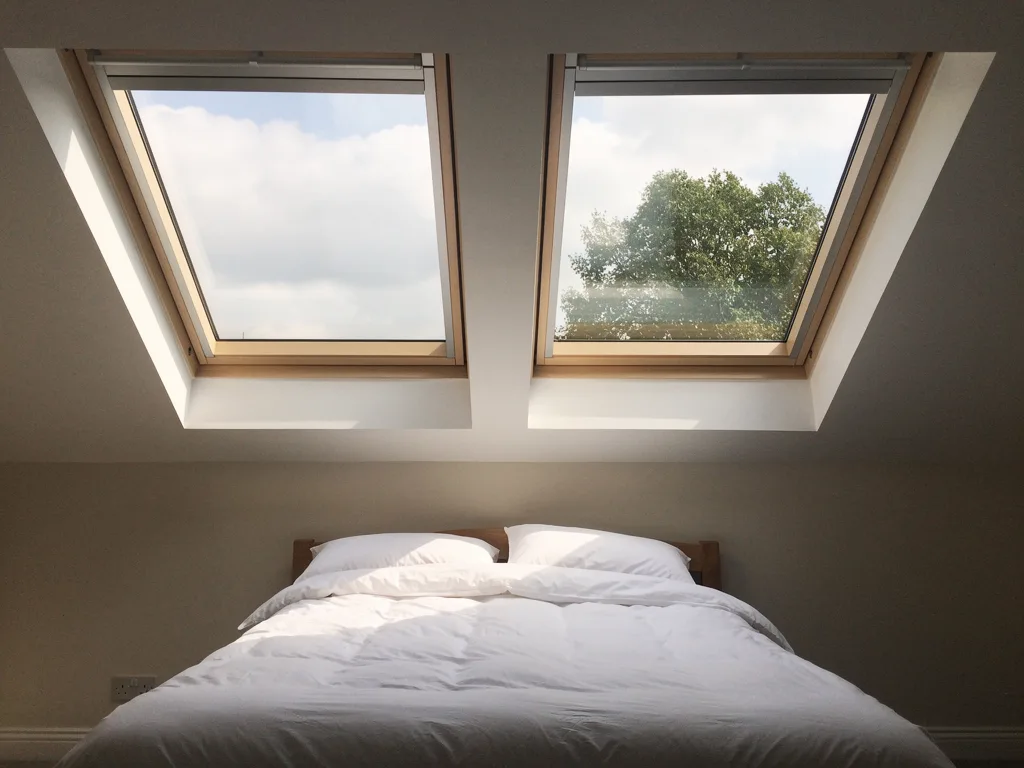
The view through a roof window depends on the outer pane staying clear, and a shallow pitch makes that harder in two separate ways. Rain runs off a steep pane quickly enough to carry most surface dirt with it; on a shallower slope the same rain sits longer and drains more slowly, so dust, pollen and general grime settle rather than being washed clear. A self-cleaning outer coating, which breaks down organic grime under UV light and lets rain sheet the loosened dirt away rather than beading over it, earns its place far more on a low pitch than a steep one, where gravity was already doing most of that work.
The second problem sits on the inside of the glass, not the outside. A shallower unit holds a larger area of warm room air close to a cold outer pane for longer through a still night, and where that pane's edge seal or the frame's own insulation is doing less than it should, condensation collects at the lowest point of the sightline, which is precisely where the eye lands from a bed or a chair. Our answer on whether a roof window needs a vapour barrier collar covers the fitting detail that keeps warm, moist room air away from the cold zone at the frame's edge, and it matters more on a shallow slope than a steep one for the same reason the outer coating does: less natural drainage of both water and warmth.
The sightline flattens along with the roof
Pitch does not only change how the roof sheds water; it changes what the window shows the room underneath it. On a steep slope, a roof window looks out at an angle, so the sky it frames sits partly ahead of the eye as well as above it, closer to a normal window's view tilted upward. Flatten the pitch and that same frame turns to face more directly overhead, so the sky in view becomes a wider, flatter piece of open air rather than a slice with a horizon caught in the lower edge. Neither is better in the abstract, but they are different views, and a reveal shaped for a steep pitch does not automatically suit a shallow one.
The reveal itself, the lined opening between the glass and the plasterboard, carries more of the work on a shallow pitch because the frame sits further from the eye relative to how much sky it can show. A deep, square reveal that would barely register on a steep slope can visibly shrink the patch of sky on a shallow one, since less of the frame's true width is foreshortened by angle. Our guide to setting the sightline for sitting and standing goes through eye position in detail, and on a shallow roof that measurement is worth taking before the reveal is built, not after.
Choosing the opening type for a flatter slope
A shallow pitch often puts a roof window lower in the room than the same size unit would sit on a steep one, simply because the roof itself is lower over more of its run. That changes which opening type earns its keep. A top-hung sash, hinged along the top rail so the moving part stays clear of the lower two-thirds of the opening, tends to suit a window within easy reach of a hand, which is common on a shallow bungalow loft or a lean-to ceiling. A centre-pivot sash, which rotates through its own middle and is happier operated from a pole or a crank, still has its place where a shallow roof carries a window high above a stair or a landing rather than low over a bed. Our guide to centre-pivot or top-hung roof windows sets out the mechanical difference in full.
Bungalow lofts are worth a mention on their own, since a shallow pitch and a lower overall roof height often arrive together in the same room. Our answer on whether roof windows can be fitted in a bungalow loft goes through headroom and pitch side by side, since one rarely changes without the other.

Roof coverings with their own limits at the shallow end
A roof covering has a minimum pitch of its own, set by how well it sheds water once the fall is reduced, and that limit sits alongside the window's rather than replacing it. Plain tiles and natural slate both carry published minimum pitches, and a roof already close to that limit for its covering leaves very little room to spare once a window opening, with its own frame edges and flashing laps, is cut into the same slope. Our answer on whether a roof window works in a slate roof goes through how the covering and the flashing meet, which is worth reading alongside this guide wherever a shallow pitch and a traditional covering occur together, as they do on the stone and slate roofs around Stamford and the Nene valley villages.
Interlocking concrete and clay tiles generally tolerate a shallower pitch than plain tiles or slate before their own minimums are reached, which is one reason low-pitch roof windows turn up more often on later extensions and new-town roofs than on older stone-slated cottages. The covering does not decide the window's pitch limit on its own, but it narrows the margin either way.
Shallow pitch, at a glance
Put the three concerns side by side and the pattern is consistent: less margin, in three different senses, the closer the roof gets to the window's own limit.
| Pitch position | Flashing | Glass and coating | Sightline effect |
|---|---|---|---|
| Well within the rated range | Standard kit, normal laps | Coating a preference, not a need | Reveal depth barely noticed |
| Toward the bottom of the range | Low-pitch kit, deeper upstand | Self-cleaning coating earns its place | Reveal shape worth checking against the sightline |
| At or below the rated minimum | Extra measures or a different unit | Coating and edge seal both matter | A flat rooflight may suit the room better |
Where this comes up across Peterborough
A lean-to extension roof is the clearest local example: a single-pitch roof built shallower than the main house behind it, often to keep a doorway or a boundary clear, and one of the first places a homeowner asks whether a roof window is possible at all. Our answer on whether a roof window can go in a lean-to extension roof sets out the minimum pitch that type of roof needs before a pitched unit is the right answer rather than a flat rooflight.
The Fens run flat to the east and north of the city, and roofs built to catch every inch of headroom in a loft over a bungalow or a single-storey new-town home tend to end up shallower than the same style of roof further west, where the ground itself has more fall in it. None of that changes the physics above; it just means the question comes up more often here than it might elsewhere, and it is worth settling at survey stage rather than after a frame has been ordered.
What to check before a shallow roof window is ordered
A shallow pitch is not a reason to rule a roof window out, but it does change what a good specification needs to cover before glass is cut into the roof. Before ordering, it is worth confirming:
- The actual pitch, measured on site, rather than assumed from the roof's general appearance, since a few degrees either side of a window's rated minimum changes what else needs specifying.
- Whether a low-pitch flashing kit is needed, and whether the covering itself, tile or slate, has enough of its own margin left at that pitch to take a window opening.
- Whether a self-cleaning outer coating and a vapour barrier collar are included, since both do more work on a shallow slope than a steep one.
- How the reveal is lined, since a shape that suited a steeper roof elsewhere in the house may shrink the sky more than expected once the pitch flattens.
- Whether the pitch has actually fallen below what any pitched roof window can take, in which case a flat rooflight, on its own upstand, is worth discussing instead.
Every quote from our roof window installation service includes a sightline sketch drawn for the actual pitch on site, not a generic one, so the view a shallow roof will actually give is agreed before the roof is opened. The job is installed to current Building Regulations, with the Building Control notification handled where the work is notifiable, and it carries our 10-year workmanship guarantee whatever the pitch. A rough figure on what a job like this involves is set out on our page on what affects the cost of a rooflight.
Questions about a flatter slope
Can any roof window be fitted to a shallow pitch with the right flashing?
Not quite any. Extra flashing measures extend a window's usable range downward, but every range still has a genuine floor below which no amount of flashing is enough, because the glass itself needs a minimum fall to shed water safely. Below that floor, a flat rooflight on an upstand is the safer answer.
Does a shallow pitch mean a smaller roof window?
Not for size reasons on its own. Pitch and width are decided separately, one against water shedding and flashing, the other against the rafters either side of the opening. A shallow roof can usually still take a wide window; it is the flashing and coating specification that changes, not the frame dimensions.
Is a low pitch roof window and a skylight for a shallow roof pitch the same product?
Yes: "roof window", "rooflight" and "skylight" describe the same family of product in everyday use, and a low-pitch job simply means choosing the right flashing, coating and, where the pitch is too shallow even for that, the right product from within that family.
Should the pitch be checked before or after a room is planned around the window?
Before. The pitch decides the flashing kit, the coating, and how much reveal a given opening will lose from the view, all of which affect where a bed, desk or sofa should sit relative to the window once it is in.
Keep reading
 GuideStacking Roof Windows for a Taller Piece of SkyHow stacking two roof windows one above the other gives a taller run of sky than a single window can.
 GuideBalcony Roof Windows: Stepping Out Into the ViewA balcony roof window folds open into a small railed platform, but only on roofs steep and strong enough to take one.
 GuideRoof Windows as a Fire EscapeBuilding Regulations set a minimum size and sill height for escape roof windows in loft conversions.
Book a home visit
Tell us which room
- No obligation
- Sightline sketch included
- 10-year guarantee
Or call 01733 736163