Question · Sun tunnels
What Does a Sun Tunnel Look Like From Outside?
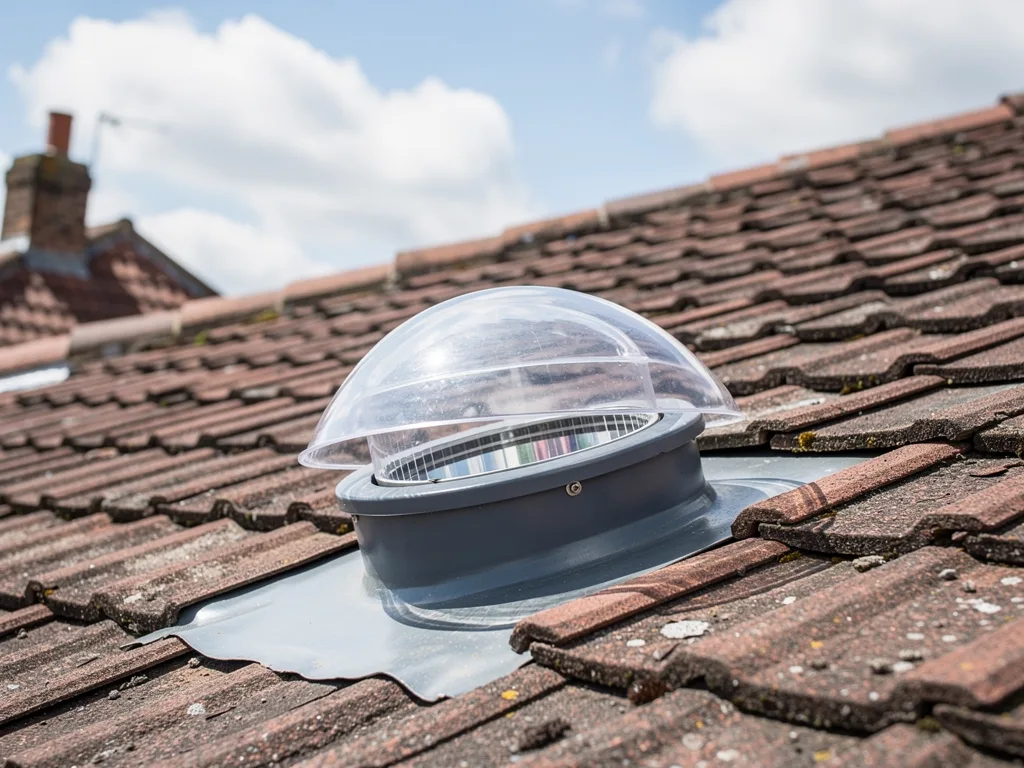
The dome is the only part anyone outside ever sees
Everything that does the actual work, the reflective tube and the ceiling diffuser, lives inside the roof and the loft. From the garden, the street or a neighbour's upstairs window, a sun tunnel is one component: a moulded dome, usually polycarbonate or acrylic, fixed into a flashing collar and sealed to whatever the roof is covered in. It has no frame in the way a roof window does, no glazing bar, and no opening vent. It is a fixed dome over a hole, and that simplicity is exactly why it sits so quietly on a roof.
Most domes are moulded clear, so from directly below on a bright day they can catch a flash of reflected sky, but from ground level and at an angle, which is how almost everyone actually views a roof, the dome reads as a plain, pale disc rather than a bright feature. A light prismatic or slightly frosted finish, which some ranges fit as standard, softens that reflection further and reads as a matt, uniform circle instead.
Size against the roofline
A sun tunnel dome is sized to match the tube behind it, and the tube diameters most commonly fitted on a UK house sit well under half a metre across. Set against a roof slope covered in rows of tiles or courses of slate, a dome that size is a small, isolated circle rather than a shape that competes with the roof's own pattern. Sun tunnel sizes and diameters sets out which diameter suits which room; from outside, the point that matters is that even the largest domestic diameter still reads as modest next to a roof window or a rooflight cut into the same slope.
How the flashing decides the profile on a pitched roof
On a tiled or slated roof, the dome sits inside an adjustable flashing collar shaped to step around the coursing above and below it, so the housing follows the same angle as the surrounding roof rather than standing at odds with it. Fitted well, the flashing disappears under the eye and the dome is the only thing left to notice, a low, rounded shape sitting flush with the pitch rather than a box bolted on top of it. Our page on sun tunnel brands and flashings covers how the flashing kit is matched to plain tile, interlocking tile or slate, and what flashing a sun tunnel needs on a slate roof looks specifically at the soaker arrangement that keeps a slate installation flush, which matters on the Collyweston stone slate and limestone roofs around Stamford and the Nene valley villages as much as anywhere else.
On a flat roof, the dome stands a little taller
A flat roof changes the geometry. There is no coursing to step around, so instead of a flashing collar the dome sits on a raised upstand, or kerb, high enough to clear standing water on the membrane below. From the garden that reads as a slightly taller shape than the pitched-roof version, closer to a low box with a rounded dome on top than a disc sitting flush to the surface. It is still far smaller than a flat rooflight of any real size, and on the flat-roofed rear extensions common across Peterborough's newer townships it is often the least visible way to bring daylight into a kitchen or bathroom that has no wall left for a window. Taking a sun tunnel up through a flat roof covers the kerb detail properly.
| Roof type | What sits on the roof | How it reads from the ground |
|---|---|---|
| Pitched tile or slate | Dome in an adjustable flashing collar | Low, flush, following the pitch |
| Flat roof | Dome on a raised kerb | A little taller, a small rounded shape |
Colour, clarity and what changes over years
A new dome is clear or lightly frosted, and a properly UV-stabilised outer skin is standard across every reputable range, which is what keeps that clarity from fading in the first place. Over time, some discolouration is possible on any plastic dome left exposed to years of UK sun, and it is a fair question to ask before you buy. We have written that up on its own rather than folding it in here: does a sun tunnel dome turn yellow over time? covers what causes it and what a documented UV rating actually protects against.
How visible it actually is from the street or next door
For most houses the honest answer is: barely. A single dome the width of a dinner plate, sitting flush on a slope already broken up by ridge tiles, a chimney and a soil vent pipe, is not something a passer-by registers. Where it is more likely to be noticed is on a roof slope that faces directly onto the street at close range, or where a neighbour's upstairs window looks almost level across a low extension roof rather than down onto it. Even then, what registers is a small pale circle rather than anything resembling a window, because there is no frame, no glazing bar and nothing behind the dome catching the eye the way glass in a vertical window does.
Where a low, flush profile matters most
Visibility from outside becomes a genuine design question on a few particular roofs rather than most of them: a front-facing slope on a terrace with a strong, uniform roofline, a listed or older building, or a roof inside a conservation area where the local authority takes an interest in anything added to the street-facing pitch. A well-fitted sun tunnel is already about as unobtrusive as a hole in a roof gets, but where it matters, asking for the lowest-profile flashing option and a frosted rather than fully clear dome keeps the finished job as quiet as possible on the slope. Whether the work needs planning permission at all is a separate question, covered properly on will a sun tunnel need a planning application?, which sets out permitted development and where it stops applying.
One dome or several, seen together
A single sun tunnel on a roof slope reads as one small, isolated circle. Fit two or three to serve a hallway, a landing and a bathroom from the same loft, and they still read as separate, modest domes rather than a cluster, because each one is sized to the room it serves rather than to a fixed standard diameter. How many sun tunnels does a room need? covers when one dome is enough and when a second earns its place, and sun tunnel or rooflight: light or view covers the different question of when a rooflight, with its visible frame and an actual view of the sky, is the better fit for the room instead.
What it looks like after dark
At night, an unlit sun tunnel goes dark on the outside the same way any skylight does once the room behind it is unlit, since it has no glow of its own without power. Some ranges offer a low-voltage night-light add-on fitted into the diffuser housing, which lets the same fitting serve as a small ceiling light after dark, and on those installations the dome can show a faint glow from outside in the evening. Add-on kits for sun tunnels covers that option alongside the extractor fan kits some bathroom installations use.
Getting the profile right before the roof is opened
Which flashing, which diameter and which dome finish sit on your particular roof is worked out on the survey, against your actual tile, slate or membrane, not guessed from a catalogue photograph. Every quote comes with a sightline sketch showing where the diffuser will sit in the room, and the same survey settles the dome position and flashing detail on the roof itself. See our sightline sketch page for how that drawing is put together, our costs page for the general factors that move a sun tunnel or rooflight quote, or the main sun tunnel installation page for the full range of what we fit across Peterborough and the surrounding villages.
Questions people also ask
Does a sun tunnel dome stick up much above the tiles?
On a pitched roof, very little. The flashing collar is designed to follow the pitch, so the dome sits close to the surrounding tiles or slates rather than standing proud of them. A flat roof version sits a little taller, on its raised kerb.
Can you choose a dome colour to match the roof?
Domes are moulded in clear or lightly frosted finishes rather than roof-matching colours, since the material has to let daylight through. What you can choose is the clarity of the finish and, on a pitched roof, a flashing kit sized and profiled to sit as flush as possible against your particular tile or slate.
Will it be visible from next door's upstairs windows?
Possibly, if their window looks nearly level across a low roof rather than down onto it, but what is visible is a small pale dome rather than anything resembling a window, since there is no frame or glazing bar to catch the eye.
Does the outside appearance differ between rigid and flexible tube kits?
No. The tube sits entirely inside the loft and has no bearing on what the dome looks like from outside. The dome, the flashing kit and the roof covering decide the exterior appearance; the tube choice is about light output and route through the loft.
Book a home visit
Tell us which room
- No obligation
- Sightline sketch included
- 10-year guarantee
Or call 01733 736163