Question · Sun tunnels
Can you see the sky through a sun tunnel?
A light fitting, not a window
A sun tunnel is three parts working together: a clear or low-profile dome on the roof, a reflective tube running down through the loft, and a diffuser set into the ceiling. Its job is to move daylight from outside to inside with as little loss as possible. Nowhere in that chain is there a requirement, or even an attempt, to carry a recognisable image of the sky down with it.
Compare that with a flat rooflight or a roof window. Both use clear, uninterrupted glazing set into an upstand or a frame, so light rays keep their direction as they pass through. Lie on a bed under one and you see actual sky: blue, grey, moving cloud, a gull crossing overhead. Stand under a sun tunnel and you see none of that, because the tube and diffuser are designed to stop it.
Why the diffuser stands between you and the sky
Most sun tunnel diffusers are opal or prismatic acrylic, chosen deliberately to break up direct sunlight into soft, even light rather than a hot, moving spot on the ceiling. An opal diffuser scatters light rays in every direction as they pass through it, which destroys any coherent image on the other side. A prismatic diffuser bends light through small ridges to spread it further across the room. Both do their job well. Neither lets an image of the sky through, because scattering the light is exactly what they are there to do.
The tube adds to this. Even a rigid, highly reflective tube bounces light down its length off the inner wall rather than transmitting it in a straight line, and any bend in the run (see sun tunnel routes through lofts) breaks up the light further. By the time it reaches the diffuser, what is travelling down the tube is daylight, not a picture.
What you actually see, standing underneath
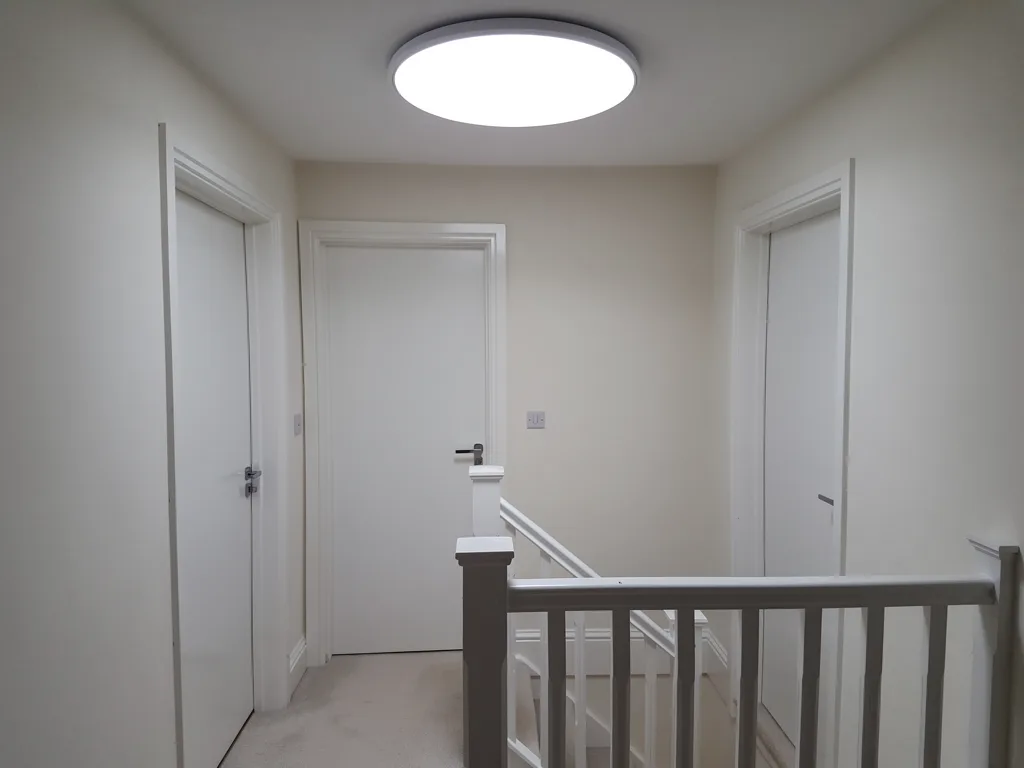
Look up at a working sun tunnel and you see a bright, roughly circular disc set into the ceiling, glowing white or pale depending on the sky outside and the type of diffuser fitted. On a bright day the disc is strong; under heavy cloud it dims, but it does not go dark the way a room with no natural light source would. What it never does is move, frame a view, or show weather. There is no cloud crossing it, no blue deepening toward evening, no sense of the sky's actual shape. It reads as a light fitting that happens to be powered by the sun, and that is a fair description of what it is.
People who expect a small window are usually disappointed for a moment, then adjust once they understand what the product is for. It is worth setting that expectation before the roof is opened, not after.
Sun tunnel, flat rooflight or roof window: what each one shows you
The right choice depends on whether the room needs a view at all, or just daylight.
| Product | What you see from below | Suits |
|---|---|---|
| Sun tunnel | An even disc of daylight, no image | Hallways, landings, bathrooms, stores |
| Flat rooflight | Open sky, framed by kerb and glazing bars | Kitchens, living rooms, loft bedrooms |
| Roof window | Sky through a pitched frame, and it can open | Loft conversions, bedrooms, studies |
Our own guide to that choice sets it out in full: sun tunnel or rooflight: light or view. The short version is that a sun tunnel wins on reach into a windowless space and on a tidy fit through a flat roof or a long loft run; a rooflight or roof window wins wherever the person underneath wants an actual view of the sky.
Where light without a view is exactly what is wanted
There are plenty of rooms where nobody is lying on a bed looking up, and a picture of the sky would be wasted:
- A windowless hallway or landing that only needs to stop feeling like a corridor lit by a bulb, day and night (sun tunnels for hallways and landings).
- A bathroom or en suite where privacy matters more than a view up, and where steam and splashing rule out an opening window (sun tunnels in bathrooms and en-suites).
- A walk-in wardrobe or store cupboard, where a small-diameter tube fits a short, direct run.
- A room in the middle of a bungalow, far from any external wall, where a rooflight simply cannot reach and a tube is the only route to daylight (bringing daylight to the middle of a bungalow with a sun tunnel).
In every one of those rooms, the diffuser's lack of a view is not a shortcoming. It is the point: a bright, even ceiling of light, with nothing to look at because there is nothing that needs looking at.
If the view is what you actually want
Where the reason for wanting "the sky" is really a view from a bed, a sofa or a desk, the honest answer is to fit a flat rooflight or a roof window in that room instead of a sun tunnel, or alongside one where the room already has both a dark corner and a wall that could take glazing. We plan every rooflight and roof window around the sightline from the exact spot where someone sits or lies, and every quote for one comes with a sightline sketch showing what will actually be visible once the frame is in (the sightline sketch: how we plan the view). A sun tunnel does not get a sightline sketch, because there is no sightline to plan; there is only a diffuser to size correctly for the room, which our guide to sun tunnel sizes and diameters covers, along with sun tunnel diffusers and ceiling finishes for the options at ceiling level.
If cost is part of the decision between the two, our guide to what affects the cost of a rooflight sets out the general ranges for UK homes, as a guide rather than a quote.
Getting the fit right either way
Whichever route suits the room, the roof detail still has to be right. A sun tunnel taken through a flat roof needs its own upstand and weathering, covered in taking a sun tunnel up through a flat roof, and the parts working together from dome to diffuser are set out in inside a sun tunnel: dome, tube and diffuser. We install and replace sun tunnels, flat rooflights and roof windows to current Building Regulations, and we handle the Building Control notification ourselves where the work is notifiable, with a 10-year workmanship guarantee on the finished job. See the full range on the sun tunnel installation hub, or book a home visit and we will tell you plainly whether a room needs light, a view, or both.
Questions people also ask
Does the reflective tube let any image through, even a blurred one?
No. A rigid tube's inner surface is designed to reflect light down its length, and a flexible tube adds ridges that scatter light further still. Neither is transparent in the way glazing is, so no shape, colour or movement from outside survives the journey to the diffuser.
Would a completely clear dome and diffuser show the sky properly?
Not in practice. Even with the clearest dome and diffuser available, a bend in the tube run or a long vertical drop through a loft breaks up any image long before it reaches the ceiling. A short, straight run through a flat roof with a clear diffuser gets closest, but it still will not match a flat rooflight's open view.
Does a sun tunnel look like a proper window from inside the room?
No, it reads as a round or square light fitting set flush into the ceiling, glowing rather than framing a scene. Some diffuser trims are designed to look neat against a painted ceiling, but none of them are trying to pass as a window.
Should I fit a rooflight instead if seeing the sky matters to me?
Yes, where the room and the roof allow it. A flat rooflight or roof window gives an actual view of the sky, weather and light together, while a sun tunnel gives daylight alone. Tell us which one matters for the room during the home visit and we will plan for that from the start.
Book a home visit
Tell us which room
- No obligation
- Sightline sketch included
- 10-year guarantee
Or call 01733 736163