Question
Does a rooflight frame block the view?
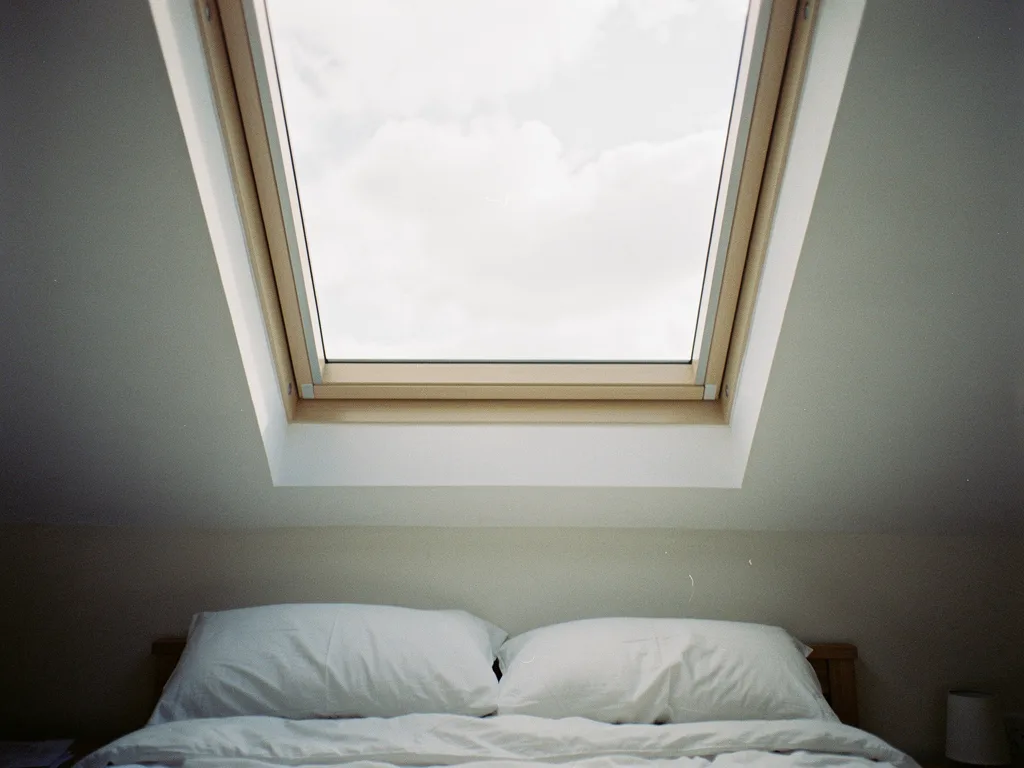
Three things add up to make the answer
No single number tells you how much frame you will see, because three separate parts of the rooflight all take something from the sky, and they do it in different ways.
- Face width, the visible strip of frame material around the glass itself, seen straight on.
- Depth and upstand, the part of the frame and any raised kerb that sits between the glass and the roof covering, seen as a shadowed band when you look at an angle.
- Viewing angle, which changes how wide that band appears, and can turn a modest frame into a wall of shadow from the wrong seat.
Add these together and a rooflight that reads as almost frameless from directly underneath can still lose you a surprising slice of sky from the pillow or the sofa, purely because you are looking across it rather than through it. That is the part most product brochures leave out.
Face width: the part everyone means by "the frame"
Face width is the flat strip of aluminium, uPVC or timber that surrounds the glass and holds it in place. On a well-made flat rooflight it can be a slim band, sometimes not much wider than a couple of fingers, and painted or powder-coated to match the ceiling so the eye reads past it rather than at it. On an older or budget unit the same strip can run wider, with a visible screw line or a thicker capping that draws the eye rather than letting it slide off.
Roof windows on a pitch generally carry a broader face than a flat rooflight, because the sash needs room to open and seal. That is not a flaw in the product, only a fact worth knowing before you compare a brochure photograph of one type against a room-fitted photograph of another. Our guide to frame profiles and sightlines sets the common widths against each other so you are comparing like with like.
Depth and the upstand add a second, quieter loss
Face width is the loss you notice looking straight up. Depth and upstand are the loss you notice from the side, and it is easy to miss both because nobody points at them on a sample in a showroom.
A flat rooflight sits on a raised kerb, called the upstand, which lifts the glass clear of standing water and lets the roof covering turn up and under the flashing. From directly below, that upstand is hidden behind the frame face. From a chair a metre or two off centre, you are looking along the inside of the upstand rather than through the glass above it, and what you see is a dark, shadowed collar rather than sky. A low, well-detailed upstand keeps that collar shallow. An older design with a tall timber kerb can make the same size of glass feel noticeably smaller from an angled seat.
Pitched roof windows have their own version of this in the reveal, the plastered box that lines the gap between the ceiling and the glass. A deep reveal works exactly like a deep upstand: fine from directly under the opening, a letterbox of sky from anywhere else in the room. How that box is shaped matters as much as the frame itself, and it is covered fully in choosing a reveal shape.
Why glancing across the room is not the same as looking straight up
This is the part that turns a small frame into a bigger problem, or a slightly larger frame into a non-issue. Your eye does not view a rooflight from one fixed angle. It views it from wherever you happen to be sitting or lying, and the frame's apparent width changes with that angle.
Stand directly under a rooflight and look straight up, and you see the glass at its true size, with the frame reduced to the thinnest possible line around it. Move your eye a metre to one side, towards the bed head or the back of a sofa, and the near edge of the frame swings towards you while the far edge tips away. The near band of frame widens in your view even though nothing about the product has changed. This is the same effect that makes a picture frame look thicker on one side when you view a painting from an angle rather than face on.
It explains why a rooflight that felt generous when you stood underneath it in a showroom can feel tighter once it is over your own bed, positioned for the roof structure rather than for your exact eye line. Planning the position from where you actually lie, sit or stand, not from the centre of the ceiling, is the single biggest lever for keeping the frame out of your eyeline, and it is exactly what our page on placing a rooflight over the bed works through room by room.
How the common types compare
Put face width, depth and angle together and the rooflight types line up in a fairly consistent order, though the exact figures vary between manufacturers.
| Frame type | What you see from below | Effect on the view |
|---|---|---|
| Flush-fit conservation rooflight | A slim band close to the roof plane | Least visible edge, especially on a low pitch |
| Standard flat rooflight on an upstand | Frame face plus a shadowed kerb | A little more loss from an angled seat |
| Roof window with a glazing bar | Frame plus a bar across the pane | Splits the sky into two smaller rectangles |
| Large single-pane flat rooflight | One sheet of glass, a narrow surround | Least interruption across a wide room |
A single large pane, without a central glazing bar, keeps the sky whole rather than splitting it, and is worth asking for wherever the roof structure allows it. Where a bar cannot be avoided, its position relative to your eye line matters more than its width; our page on glazing bars and the view sets out where to put one so it misses the sightline that counts.
Older units lose more than the frame alone accounts for
On a rooflight that has been in place for years, the frame is often not the only thing narrowing the view. Timber frames can swell slightly with damp over time, and a seal that has hardened can leave a wider bead of sealant showing at the glass edge than the original design intended. Neither is a fault you can fix by cleaning the glass, and both add a little to whatever the frame profile already takes. A frame that looked slim when it was fitted can end up reading as heavier a decade or two on, which is one of the things worth checking if a replacement is on the cards.
Conservation and flush-fit designs, specifically
Where a low-pitch roof or a conservation area calls for a flush profile, the frame sits nearly level with the surrounding covering rather than standing proud of it. Seen from inside, that shows up as a narrower shadow line at the edge of the glass, because there is less depth of upstand for your eye to travel along when you look at an angle. It is one of the reasons a flush-fit unit is often chosen on Collyweston stone slate and limestone roofs around Stamford and the Nene valley, where a clean sightline matters as much as the daylight, and it is covered in full on our conservation rooflight installation page. The same low-profile thinking applies to flat roofs generally; see flat roof rooflight installation for how upstand height is kept down across an extension roof, and roof window installation for the equivalent choices on a pitched loft conversion.
Planning the frame out of your view before the roof is cut
Every quote we give comes with a sightline sketch, a drawing from the exact spot you will use the room from, showing where the frame edges and any bar fall and how much open sky is left once they are drawn in. It is the only way to answer this question for your own room rather than in general terms, because the same rooflight can read as nearly frameless from one seat and noticeably framed from another only a metre away. You can see how the drawing is put together on the sightline sketch page, and the full range of rooflights and skylights we plan this way is on our Peterborough rooflight and skylight installation page. Every installation is carried out to current Building Regulations with a 10-year workmanship guarantee, and where the job is notifiable we handle the Building Control notification. Book a home visit and we will mark up your own ceiling before anything is ordered.
Questions people also ask
Does a bigger rooflight mean a bigger frame?
Not proportionally. Frame face width is usually set by the product range rather than the size ordered, so a larger pane of glass carries roughly the same width of frame around it as a smaller one from the same range. The bigger unit simply gives you more sky per centimetre of frame, which is why upsizing an opening often improves the view more than swapping to a slimmer product.
Do dark frames block more of the view than light ones?
Colour does not change the physical width of the frame, but a dark frame against a pale ceiling reads as a stronger edge, so it can feel more present even at the same size. A frame finished close to the ceiling colour tends to disappear from view rather than draw the eye to where the glass stops.
Can a frame be made invisible from inside?
No, because the glass has to be held and sealed by something. The realistic aim is to reduce the frame to a thin, level edge and to place the unit so that edge falls outside your normal eyeline, rather than to remove it altogether.
Does the frame matter more for a bedroom than a kitchen?
It tends to matter more wherever you spend long, still periods looking at one fixed point, which usually means the bed rather than a kitchen where people move around. In a kitchen, the sink or the table is the seat to plan around instead, and the same viewing-angle effect applies there too.
Book a home visit
Tell us which room
- No obligation
- Sightline sketch included
- 10-year guarantee
Or call 01733 736163