Guide · VELUX windows
The VELUX CABRIO: A Roof Window That Becomes a Balcony
The CABRIO folds a sealed pane into a small balcony. Here is the pitch it needs, what the roof structure gives up, and what changes for flashing and planning.

A window with a second job built into it
The CABRIO is the one VELUX product that is not simply a bigger or smaller version of the standard roof window range. It is sold under its own model letters, GDL, apart from the GGL and GPL codes used for the centre-pivot and top-hung windows covered in our guide to choosing between GGL and GPL, because it is built to do something neither of those windows attempts: open from a sealed pane of glass into a platform a person can stand on.
Closed, a CABRIO reads from inside as a tall run of glass angled up the pitch, a fixed upper section and a lower section that looks, at first glance, like any other roof window. Release the catch built into the sill and the lower section swings outward and down on its own hinge, a railing lifts clear from inside the frame as it moves, and the sealed opening becomes a doorway with somewhere to step through it onto. Nothing about the closed view gives that second function away, which is part of why a CABRIO is chosen for the room it lights first, and the balcony it occasionally becomes second.
The pitch band a CABRIO will actually fit
Every VELUX range has a pitch it is designed around, and the CABRIO's is narrower than most. Where a standard centre-pivot window will sit happily from roughly 15 to 90 degrees, a CABRIO wants a roof somewhere between 35 and 53 degrees, and that is not a marketing preference but a matter of the lower pane physically clearing the tiles beneath it as it swings out.
Below that band, the geometry runs out before the pane does: the swinging section would meet the roof surface long before it reached anywhere near upright, so the balcony function simply cannot open. Above it, the roof is already steep enough that a full-height glazed opening starts to compete with the wall it is cut into, and other products in the VELUX range, including a fixed roof window set into a near-vertical gable, do that job better. A pitch survey is the first thing that rules a CABRIO in or out of a shortlist, well before size, glazing or finish come into the conversation.
| Window | Model code | Pitch range | Opening |
|---|---|---|---|
| Centre-pivot | GGL | 15 to 90 degrees | Sash rotates on a centre pivot |
| Top-hung | GPL | 15 to 90 degrees | Sash hinges at the head |
| CABRIO balcony window | GDL | 35 to 53 degrees | Upper pane tilts, lower pane folds out to a platform |
What the roof structure gives up to take it
A CABRIO's structural opening runs to roughly twice the height of a standard window in the same range, because the fixed upper pane and the folding lower section sit stacked inside one frame rather than side by side. An opening that tall almost always spans more than one rafter bay, which usually means cutting through at least one rafter rather than fitting neatly between two of them. Where a rafter is cut, a doubled timber goes in either side of the gap to carry the load that rafter was taking, sized against the actual span and the roof's own loading on the day, never lifted straight from a catalogue table.
Underneath the opening, the floor takes on a job it was probably never asked to do before: holding someone's full weight at the sill edge while they step through onto the platform, rather than simply bearing footsteps crossing the room. In a loft already converted and lived in, the joists are usually already sized for that, and the check is a formality carried out on the survey. In a loft still used for storage, that floor is the first thing worth strengthening once a CABRIO is on the shortlist, well before a size or a finish is chosen.
Fletton-brick terraces across the city tend to run steeper in pitch than the newer township roofs raised through Peterborough's new-town years, Bretton, Orton and Werrington among them, so a terrace roof more often sits inside the CABRIO's band without needing the pitch itself to be reconsidered. The stone cottages around Stamford and the Nene valley villages, built under heavy, steeply pitched Collyweston stone slate, often sit at the steeper edge of the range or beyond it, which is one more reason the roof gets surveyed before the window is ordered rather than after.
Flashing built for two glazed sections, not one
Water reaching a CABRIO's upstand comes off two sections of glass rather than one, and the flashing kit around it is built to manage both runs. The upper part of the kit seals the fixed pane into the roof covering in much the same way as a standard window's flashing does; the lower part carries water clear of the folding section and the hinge line beneath it, a moving joint that a standard roof window's flashing never has to deal with at all. Our guide to which VELUX flashing suits your roof covering sets out how tile profile and slate change the kit VELUX specifies, and a CABRIO's wider, taller kit follows the same covering-led logic, just built to a bigger opening.
Left shut for weeks at a time, which is how most CABRIO windows spend most of the year, the seal around the folded lower pane matters more than anything to do with the balcony function itself. A well-fitted kit sheds water past that seam the same way it sheds water off the fixed pane above it; a poorly matched kit is the one place water finds a route the flashing was never designed to stop.
Glazing, the ventilation flap and the blind that suits it
A CABRIO takes the same family of glazing specifications as any other VELUX window, so the choice of pane covered in our guide to VELUX glazing options still applies here, weighing warmth, noise and safety glass against each other in the usual way. The lower, folding section carries toughened or laminated glass rather than ordinary double glazing as standard, because once it is swung open it is doing a door's job, taking knocks and a hand leant on it, rather than sitting overhead the way ordinary roof glazing does.
The upper pane keeps the same ventilation flap fitted to the handle bar on other VELUX windows, letting air into the room with the sash shut and the balcony function untouched; our answer on what the VELUX ventilation flap does covers how that works day to day. A CABRIO's tall run of glass also catches more direct sun through a Peterborough summer than a shorter window at the same pitch, simply because there is more glass facing the sky at once.
Collars and linings for a taller, deeper reveal
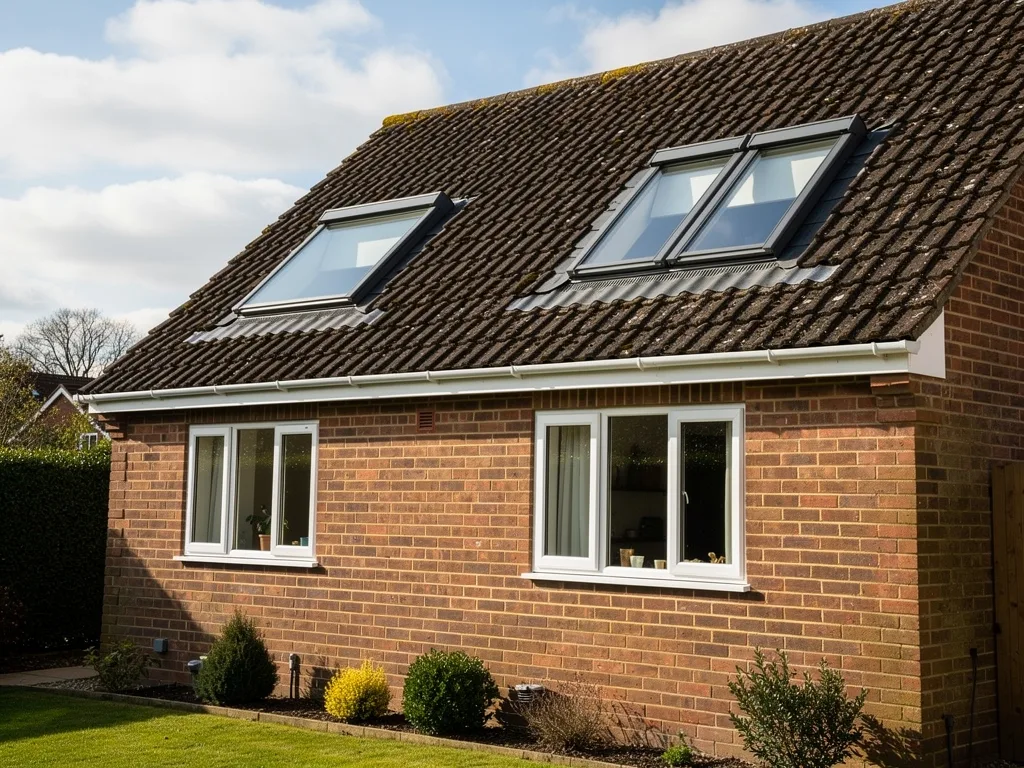
Inside, a CABRIO's opening is finished the same way any VELUX window is: an insulation collar around the frame, a vapour collar to stop moist room air reaching the cold roof timbers, and a lining kit closing off the reveal between frame and plasterboard. Our guide to VELUX installation collars and linings covers what each layer does, and a CABRIO simply asks for a taller version of the same kit, since the reveal runs the full stacked height of the two glazed sections rather than one.
Getting that lining right matters more here than on a shorter window, because the reveal is what the eye reads first from a bed or a chair below the sill, before the glass or the sky beyond it. A deep, poorly lined reveal narrows the view of the sky in exactly the way our sightline sketch is drawn to catch before the roof is opened, not after the plasterboard is closed up around it.
Manual by design
Every CABRIO on the market is opened by hand, both the everyday tilt of the upper pane and the occasional release of the lower section, rather than by the remote controls and rain sensors covered in our guide to VELUX INTEGRA: electric and solar opening explained. On a roof carrying a mix of windows, that is worth planning for early: a CABRIO fitted next to an electric INTEGRA unit will look consistent from outside, sharing the same cladding and glazing bar language, while operating on entirely different terms from inside the room.
That has a practical side too. A CABRIO's sill sits within easy reach specifically because someone has to open it by hand to use the balcony function at all, so sill height is set by that reach rather than by the ceiling line alone, in a way an electric window elsewhere on the same roof does not need to consider.
The platform is what planning looks at, not the glass
A standard roof window swap or a new rooflight usually falls under permitted development, but the rules covering loft conversions single out balconies, verandas and raised platforms and take them out of that allowance on purpose. A CABRIO is one of the few VELUX products that can trip this: put in a platform someone can stand on and look out from, and permission is very likely needed even though the opening itself is no larger than plenty of windows that never need an application at all. What Peterborough City Council actually weighs is how far that platform sits from a boundary and from a neighbour's own windows, so that distance gets checked against the specific address before a CABRIO is drawn into any plans, never after the application has gone in.
A rear roof slope, facing away from the street and away from a neighbour's garden, tends to be the easiest position to put one into, and it usually gives the broadest sweep of open sky besides. Put it instead on a side slope near a shared boundary, or on a front slope looking over the road, and the neighbour's outlook or the street frontage enters the conversation sooner, though neither rules the window out by itself.
Where it earns its place across a Peterborough roof
Think of the CABRIO as answering a question a particular room already asks, rather than a feature added to any loft conversion as a matter of course. A home office tucked under the ridge, a main bedroom where someone likes to sit close to the glass, the top of a new staircase where stepping outside for a few minutes on a mild evening genuinely appeals: these are the rooms where a platform earns its keep, chosen once for a space people actually use rather than fitted as standard across every similar loft on a street.
- Fletton-brick terraces: pitch often sits comfortably inside the CABRIO's 35 to 53 degree band.
- Newer township extensions in Bretton, Orton and Werrington: pitch worth checking before a CABRIO is specified, since these roofs often run shallower.
- Stone cottages around Stamford: pitch usually well within range, though a conservation area or listed status is checked for the address before a platform changing the roofline is designed in.
- A rear slope over the Fens' flat horizon: the widest, least interrupted run of sky, and the easiest position from a planning point of view.
Sizing still starts the way any VELUX choice does, against the rafters that are actually in the roof rather than a catalogue figure; our guide to VELUX window sizes: choosing the right one sets out how that ladder works before a CABRIO's own taller, wider opening is measured against it. On the home visit, we confirm pitch, rafter spacing and floor loading together, and bring back a sightline sketch showing both the closed view from your bed or chair and the open view from the sill, so the platform is planned around a room you already use rather than a feature added because the roof happens to allow it.
Before a CABRIO goes on your shortlist
Can any steep roof take a CABRIO?
Only within its pitch band, roughly 35 to 53 degrees. Steeper or shallower than that, the folding lower pane cannot clear the roof covering as it opens, and a standard roof window or a fixed unit is the better fit for the pitch that is actually there.
Does the balcony function need to be used to justify choosing a CABRIO?
No. Many owners choose one mainly for the tall run of glass and sky it gives a room, with the platform used only occasionally on a still evening. The upper pane tilts for everyday ventilation on its own, independent of the balcony function ever being released.
Is fitting a CABRIO notifiable to Building Control?
Yes. Cutting into rafters to make the opening and building the platform into the roof structure both count as notifiable building work, and that notification is arranged as part of the job.
Does a CABRIO carry the same guarantee as a standard VELUX window?
Yes, the same 10-year workmanship guarantee covers the fitting, the flashing and the seals around a CABRIO as it does any other VELUX roof window we install.
What happens if planning permission is refused for the platform?
A large fixed pane, set low enough in the pitch that the view still reaches down to standing height but with no lower section that opens, can sometimes give the same feeling of sky without a platform to trigger a planning application at all. Raising that option at the survey, before any application goes in, is far more useful than reaching for it after a refusal.
Read more about VELUX window installation in Peterborough, see what affects the cost of a rooflight, or find out more about the sightline sketch and how we plan the view before booking a home visit or messaging us on WhatsApp.
Keep reading
 GuideVELUX Installation Collars and LiningsThe insulation collar, vapour collar and lining kits that finish a VELUX window from inside the room.
 GuideVELUX Flat Roof Windows Against Other Flat RooflightsHow VELUX's boxed flat roof window compares with a made-to-measure flat rooflight, in size, frame, glass and view.
 GuideVELUX ACTIVE and Smart ControlVELUX ACTIVE adds an indoor sensor and app to an electric roof window and its blinds.
Book a home visit
Tell us which room
- No obligation
- Sightline sketch included
- 10-year guarantee
Or call 01733 736163