Question
Should a Skylight Go Over the Kitchen Sink?
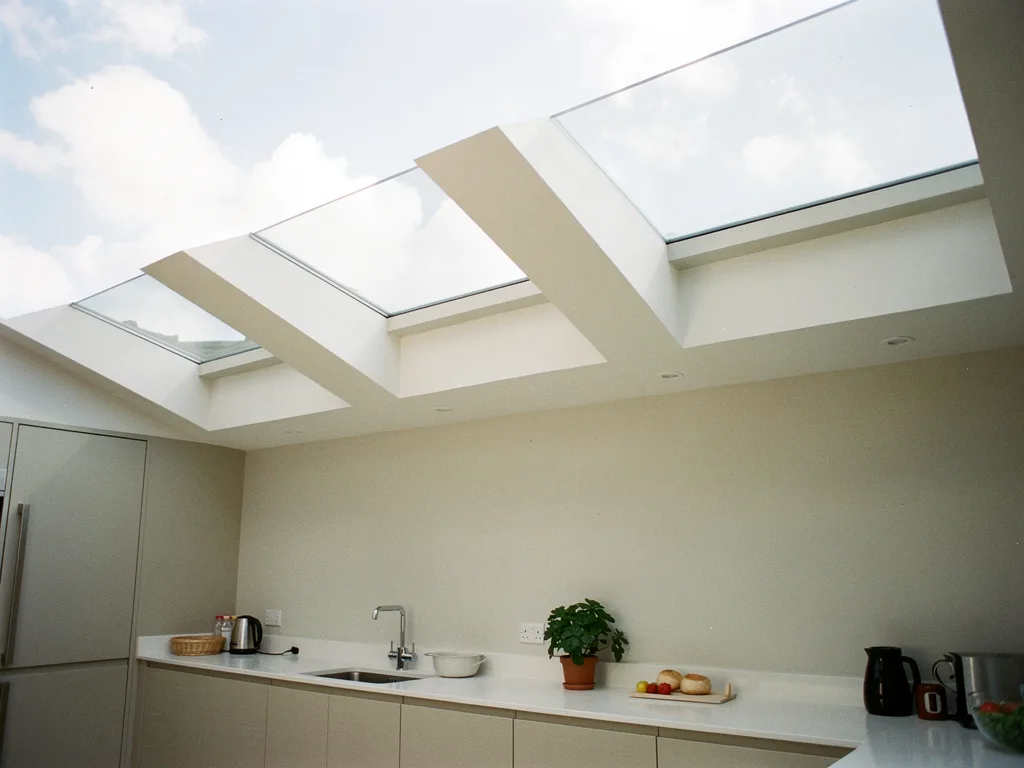
The one place in a kitchen where you actually stop and look up
Most of a kitchen is a room you pass through: from fridge to hob to worktop, eyes down on a knife or a pan. The sink is different. You stand still there for minutes at a time, hands wet, and your eyes are free to travel wherever the ceiling lets them. That is why a rooflight over the sink earns its place: it is the one fixed position in the room where a view of open sky actually gets used, rather than a rooflight fitted somewhere the room's traffic never pauses.
The test is the same one used over a bed or a sofa: stand where the person actually stands, not where the roof happens to have the most space, and look up from there. At a sink that means checking the view from a normal standing height, hands at the level of the bowl, not from the middle of the room. Move the glass a few hundred millimetres and the frame edge that was dead centre in the eyeline can disappear entirely. The same thinking runs through placing a rooflight over the bed for a view of the sky: it is eye position, not the size of the ceiling void, that decides whether the sky is framed or cut off.
Task light on the worktop, not just daylight in the room
A rooflight over the sink does a specific job that one set further into the kitchen does not: it puts daylight directly onto the surface where you need to see clearly, whether that is checking a glass is properly rinsed or reading the label on a jar. Daylight from directly above falls without the shadows a side window throws across a bowl or a draining board.
Sizing follows from that job. A single, well-placed rooflight over the sink and the run of worktop beside it can give better task light than a larger one set further into the room, because the light lands where the hands are working rather than spreading across cupboard doors and floor tiles that do not need it. Frame profiles and sightlines covers how frame depth and face width change how much of that light actually reaches the worktop.
Orientation and glare on a sunny slope
The direction a roof slope faces changes what standing at the sink is actually like. A rooflight on a south-facing pitch brings strong, low sun onto stainless steel and glossy worktops for parts of the day, and that glare is felt exactly where a person is standing, not somewhere they can step away from. A north-facing slope gives a steadier, softer light with none of that glare, at the cost of less warmth in winter. Orientation: north, south, east and west facing rooflights goes through how the direction changes the kind of sky on view across a whole roof, and the same reasoning applies directly over a sink.
Where a south or west-facing slope cannot be avoided, the glare is managed rather than simply accepted:
- A solar control coating that cuts brightness without turning the glass an obvious colour
- A blind fitted for the specific angle of low sun over that worktop, closed for the worst part of the day and open the rest of the time
- Positioning the glass slightly off the direct line to the lowest winter sun, where the roof shape allows it
Does tinted rooflight glass spoil the view? sets out how far a coating can go before it changes the colour of the sky, and skylight blinds that keep the view covers blind choices that control glare without sitting across the glass all day.
Steam, grease and keeping the glass clear
A kitchen puts more into the air around a rooflight than most other rooms: steam from pans and a kettle, and grease carried on the air near a hob. Over the sink specifically, the main load is steam and condensation rather than grease, since a sink is usually a step or two from the hob itself. Even so, the glass needs a specification that copes with a wetter atmosphere than a bedroom or landing sees.
An outer coating that sheds dirt in the rain keeps the outside clear with less attention, and a well-sealed unit resists the misting between panes that shows up as a permanent grey haze rather than something a cloth will shift. Keeping rooflight glass clear for years goes through edge seals, coatings and condensation control, and it is worth reading before settling on glass for a kitchen specifically rather than treating every room the same.
Where it sits against units, the extractor and the ceiling
The sink itself is usually fixed by the plumbing, so the rooflight has to fit around it rather than the other way round. A few things narrow the position.
| Constraint | What it means for placement |
|---|---|
| Extractor hood or fan duct | A duct run in the ceiling void can block the obvious spot; the glass may sit slightly to one side |
| Wall units above the worktop | Glass set directly above a run of wall cupboards gives no benefit at the sink itself |
| Roof structure | Rafters or trusses may push an opening a short distance from the ideal line |
None of these usually rule a sink rooflight out. They mean the final position is agreed on site, checked against where a person actually stands, rather than assumed from a plan alone.
Kitchen extensions with a flat roof
Kitchen extensions across Peterborough's new-town townships, in Bretton, Orton and Werrington, sit under a flat or low-pitched roof rather than a traditional pitch, and the sink often runs along the back wall under exactly that section of roof. A flat roof rooflight over the sink in an extension like this tends to have more room to move than one fitted into an existing pitched roof, since the void above is usually shallower and less broken up by rafters. The same glare and steam questions still apply: a flat roof facing south still needs the sun thought through, and a kitchen extension still puts steam into the air near the glass.
What a good answer over the sink looks like
Get the eye position right, choose a specification that copes with steam, and deal with glare where the slope demands it, and a rooflight over the sink turns a chore into the moment in the day when the sky is actually noticed. Every quote comes with a sightline sketch, a drawing of the view from where a person actually stands at that sink, so the position and the glass are agreed before the roof is opened rather than guessed at afterwards. See the full range of options in every type of rooflight and skylight compared, or start with skylight and rooflight installation in Peterborough for the whole picture.
Questions people also ask
Does a rooflight over the sink need to be openable?
Not for light and view alone. An opening rooflight adds ventilation, which clears steam faster than a fixed unit, but a fixed rooflight over the sink still does the main job of daylight and view. Whether to make it openable is a ventilation decision alongside any extractor fan, not something the sink position forces on its own.
Will a rooflight over the sink make the kitchen too bright to work in?
Daylight from directly overhead is generally easier on the eye than a low, sharp beam of direct sun hitting a glossy worktop, which is the specific glare a south-facing slope can bring. Managed with the right glass and a blind for the worst part of the day, a rooflight over the sink gives useful daylight rather than a source of glare to work around.
Can a rooflight go above the sink in a small kitchen?
Yes. In a small kitchen the sink is often close to an outside wall or under a return in the roof, and a single well-placed rooflight can do the work of the whole room rather than needing a second unit elsewhere. Do skylights make rooms feel bigger? looks at how a view of sky changes how a small room feels, which applies as much to a kitchen as to a bedroom.
Should the rooflight sit directly above the sink or slightly to one side?
Directly above the sink is usually the aim, but an extractor duct, the roof structure or a run of wall units can push it a short distance to one side. A small offset rarely matters for the view; what matters is checking the sightline from standing height at the sink itself, not assuming the centre of the ceiling is the centre of the useful view.
Book a home visit
Tell us which room
- No obligation
- Sightline sketch included
- 10-year guarantee
Or call 01733 736163