Guide
Keeping Skylight Glass Clear for Years
Edge seals, coatings, pitch and room humidity all decide whether the view through your rooflight stays clear for years, not just how often it is cleaned.
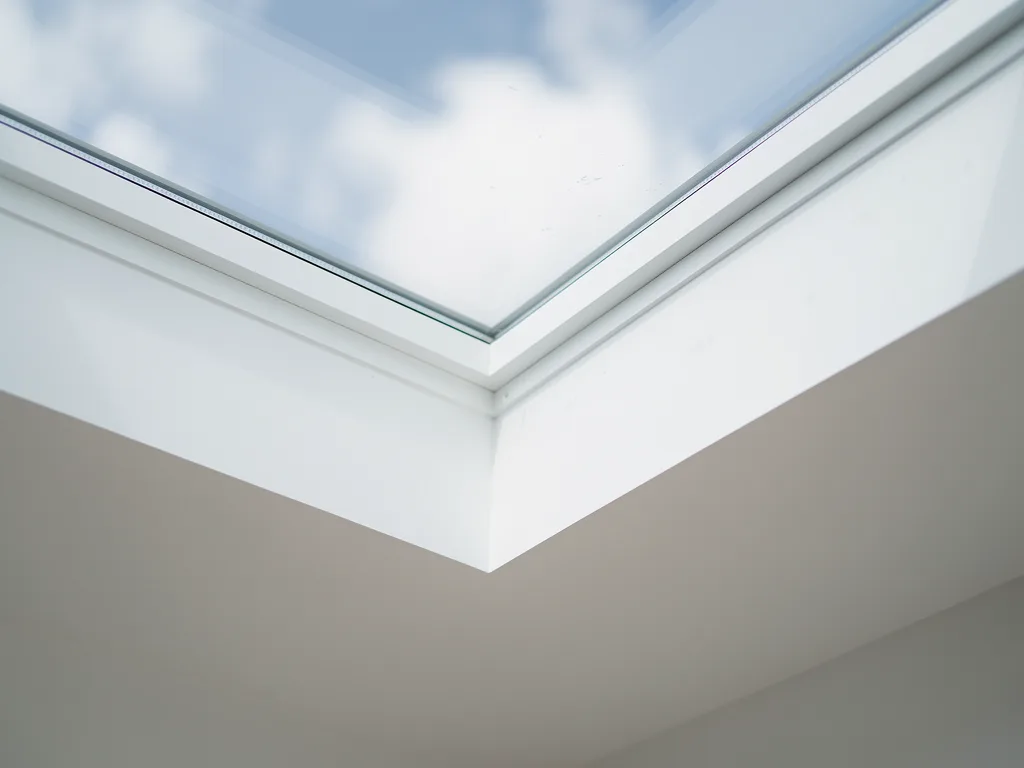
A new rooflight looks sharp the day it goes in: the sky sits close, the frame is thin, and the glass all but disappears. What decides whether it still looks that way in ten years is set mostly at the point of specification, not by how often anyone climbs a ladder with a cloth. Edge seals, coatings, the pitch of the glass and the air inside the room all pull in different directions, and knowing which one is doing the pulling is the difference between a two minute wipe and a call to replace the unit.
Four things decide whether the sky stays sharp
Almost every complaint about a cloudy rooflight traces back to one of four causes, and each has its own fix, or its own reason there is no fix at all.
- The edge seal fails and the gap between the panes clouds for good.
- Outside dirt builds up faster than rain and any coating can clear it.
- Moisture in the room lands on the glass before it ever reaches outside air.
- A coating wears or scratches, usually from the wrong cleaning method rather than age.
The first is a manufacturing and specification question. The other three are largely about how the rooflight is used and kept, and they are the ones a homeowner has some control over once the glass is in.
The edge seal: the line between clear and misted for good
Between the two or three panes of a sealed unit sits a spacer bar and a seal that keeps argon gas in and damp air out, and once that seal lets go, no amount of cleaning brings the view back.
A warm edge spacer, usually a composite rather than plain aluminium, is chosen to reduce the cold bridge at the very edge of the glass, where condensation is most likely to start. Behind it, a primary and secondary seal hold the whole unit airtight. While they hold, the gas fill stays where it should and the cavity stays dry. Once moisture gets past a failed seal, it has nowhere to go: the gap is sealed on both faces, so the mist sits inside the unit, permanently, and often thickens with each cold snap rather than clearing on a warm day.
This is the one form of clouding that installation quality and glass specification, not upkeep, decide. A well made unit with a good spacer and seal can hold clear for a long time; our answer on how many years a new rooflight will give you sets out realistic expectations for frames, glass and seals separately, since they do not all age at the same rate.

A self-cleaning coating only works if the pitch lets water sheet
A self-cleaning outer coating breaks down organic grime in sunlight and lets rain spread into a sheet rather than beads, so dirt rinses away instead of drying into streaks, and none of that works if the glass sits too flat for water to run off it.
The coating itself does two jobs. Ultraviolet light acts on a very thin surface layer and loosens the bond between the glass and general dirt, bird droppings and algae. Then the same layer turns hydrophilic, so instead of rain forming beads that dry into spots, it spreads into a thin film that carries the loosened dirt with it as it runs off. On a steep pitched roof window that process works well with very little help. On a flat rooflight, the glass has almost no run for the water to gather speed, and standing puddles dry to a haze however good the coating is underneath them.
That is why the fall built under a flat rooflight's upstand matters as much as the coating on top of the glass. A kerb set to a fall of at least 1:80 gives rainwater somewhere to go rather than sitting on the pane, and a self-cleaning coating on that glass will earn its keep. On a kerb set almost dead level, the same coated glass can still film over with dried mineral deposits from evaporating rainwater, because there is nowhere for the water to sheet to. Our guide to every type of rooflight and skylight compared covers how flat, pitched, lantern and tubular units differ in exactly this respect.
Dew on a cold morning is the glass working, not failing
Wake up to a rooflight silvered with droplets on a clear, cold morning and the natural reaction is to worry the unit has failed, but that film sitting on the outer pane is ordinary dew, and it says the glass is doing its job well.
On a still, cloudless night, the outer pane of a well insulated rooflight radiates heat to the sky and cools below the surrounding air temperature, sometimes below the dew point of the air sitting against it. Moisture in that air condenses on the glass exactly as it would on a car windscreen or a garden table. Counterintuitively, the better the glass is at holding heat inside the room, the more this happens: a poorly insulated older unit leaks enough warmth outward to keep its outer face a touch warmer, so external dew is often more common on newer, more efficient glass, not a sign that it is worse.
It clears within an hour or two of sunrise, needs no attention, and tells you nothing about the seal or the coating. The only useful check is whether it dries away completely once the sun is on it. If it does, move on.
Damp air indoors clouds the glass before the glass is at fault
Misting on the inside face of the glass is almost always the room telling you it is holding more moisture than the air can carry at that temperature, and the fix usually sits with ventilation rather than the rooflight itself.
A bathroom rooflight above a shower, or a kitchen unit near a hob, sits closest to the two rooms that generate the most water vapour in an ordinary house. Warm, moist air rises, meets the coolest surface in the room, which is often the glass or its reveal lining, and gives up its moisture there. A trickle vent left shut, an extractor fan that is undersized or switched off out of habit, or a loft conversion with poor background ventilation all raise the humidity the glass then has to cope with.
The reveal shape plays a part too. A deep, unlined or poorly insulated reveal creates its own cold surface close to the glass, and condensation can run down the lining as readily as it sits on the pane. Our answer on why a skylight can look dirty from inside separates ordinary dust from this kind of damp staining, since the two are often confused and need different fixes.

Cloud that never clears sits between the panes
A film on the outside dries by lunchtime and a film on the inside responds to an open window; a haze that sits between the panes and never moves at all is the one kind that no amount of ventilation or cleaning will touch.
| Where it sits | What it usually is | What to do |
|---|---|---|
| Outer face | Overnight dew or general dirt | Leave it, or clean the outside |
| Inner face | Room humidity or a cold reveal | Ventilate, ideally daily in wet rooms |
| Between the panes | A failed edge seal | Replace the sealed unit |
Between-pane misting tends to start small, often a faint cloudy spot in one corner that grows over weeks or months, and it comes back the moment it is wiped, because the moisture causing it is sealed inside the cavity, not sitting on a surface you can reach. It is one of the clearest signs a skylight is due for replacement, and it is worth acting on early: the seal will not recover, and glass with visible haze inside it only gets less clear from there. We handle the Building Control notification for that kind of replacement where the work is notifiable.
What sits behind the glass: coatings, gas fill and laminate
The build of the glass itself sets a ceiling on how clear the view can stay, long before pitch, weather or upkeep get a say.
Double glazed units remain the standard choice and give a good, clear view; triple glazed units add a third pane and a second gas filled cavity, mainly for warmth rather than clarity, since three panes of good glass still read as one clear sheet from below. A low-emissivity coating on one inner face reflects room heat back inside, which keeps that pane warmer and cuts down the internal condensation described above; it has a very slight tint when compared pane to pane, but it is not something a homeowner notices once the unit is fitted and glazed. Solar control coatings go further, filtering some of the sun's heat and glare, usually with a neutral or lightly tinted appearance; our answer on whether tinted rooflight glass spoils the view looks at how far different tints shift the colour of the sky you actually see. Laminated glass, with its interlayer between two panes, is chosen mainly for safety on walk-on and overhead glazing rather than for clarity, and does not affect how the unit resists misting.
For a straight comparison of toughened, laminated, self-cleaning and solar control options against clarity and safety, see our answer on the best glass for a skylight. For rooms where warmth matters as much as the view, our energy efficient rooflights service covers how coatings and gas fills are matched to a particular roof and room.
Frames, gaskets and the drainage that keeps them working
A clear pane sitting in a frame that has stopped doing its own job will still let water and dirt find their way to the glass, so the frame is worth a look alongside the glazing itself.
Aluminium frames, the usual choice for pitched roof windows and flat rooflight kerbs, need very little attention: no repainting, and the powder coated finish holds its colour for years. The rubber gaskets that seal the opening sash or the fixed glazing bead are the part that ages, slowly losing a little flexibility over time. Weep holes and drainage channels around the frame, designed to let any water that gets past the outer seal find its way out again, do their job only if they stay clear of moss, leaf litter and general grit. On a timber framed conservation rooflight, the timber itself needs an occasional repaint to keep it protecting the wood underneath, quite separate from anything happening to the glass.
None of this is frequent work, but a frame that is neglected for long enough, gaskets gone stiff, weep holes silted up, can let water sit where it should drain, and that standing water is what streaks and stains a pane that the glass specification alone cannot prevent.
Cleaning that keeps the coating instead of stripping it
The way glass is cleaned matters almost as much as how it is specified, because a self-cleaning or solar control coating sits in a layer thin enough to scratch.
Warm water, a soft cloth or a soft bristled brush on an extension pole, and a plain glass cleaner without added abrasives will keep any modern coated pane clear without touching the coating underneath. Scourers, wire wool, or any cleaning pad sold for scrubbing baked-on grime will mark a coated surface permanently, leaving faint scratches that catch dirt more readily afterwards rather than less. A self-cleaning coating still benefits from an occasional rinse in a dry spell, since it needs actual rainfall to carry loosened dirt away, and weeks without rain under a covered porch or a sheltered courtyard can leave it looking duller than the same glass in the open.
Reaching the outer face safely is its own question on many roofs, and our guide to replacing old rooflights touches on how access is planned at survey stage for exactly this reason: a unit that cannot be reached safely for the occasional rinse is one where the coating and the fall have to do more of the work alone.
Trees, orientation and roofs that stay grimy longer
Two rooflights of identical specification, fitted the same week, can look completely different after a year, because where they sit does as much to their clarity as what they are made of.
A north-facing slope stays damp for longer after rain and sees less direct sun, so algae and green staining establish there faster than on a south-facing pane that dries out quickly and gets the ultraviolet light a self-cleaning coating needs to work. Overhanging branches drop sap, pollen and leaf litter directly onto the glass and its surrounding gutter or weep holes, and a rooflight tucked under mature trees in a garden in Orton or Werrington will need the drainage checked more often than one on an open new-town roof with a clear run of sky above it. Out across the flatter ground toward the Fens, where roofs stand more exposed with fewer trees close by, wind-blown dust and field debris can settle instead, though it washes off far more readily than sap or moss ever does.
None of this changes the glass specification you would choose, but it does change how often a rinse is worth doing, and where the drainage deserves a closer look at survey stage.
When cleaning stops being the answer
A rooflight that still looks hazy straight after a good clean, in dry weather, with the sun on it, is telling you the problem has moved past the surface and into the unit or the frame itself.
A coating that has been scratched by the wrong cleaning method cannot be restored; it can only be replaced along with the glass it sits on. A seal that has failed and let mist into the cavity will not clear, however it is cleaned, and only gets worse. A timber frame that has swollen and lost its true shape can stop a sash closing squarely, which affects both the seal at the edge and how well the frame drains. None of these are jobs for a cloth and a bucket, and treating them as a cleaning problem for another season or two usually means a worse job, and a bigger hole in the roof, when the unit is eventually changed. Our guide to replacing old rooflights walks through what that involves, and a replacement is also the moment to upgrade the frame profile and glass specification rather than putting back what was already struggling to stay clear.
Every quote across our rooflight and skylight installation service in Peterborough comes with a sightline sketch, so you can see exactly what the new glass will look like from where you sit, and a 10-year workmanship guarantee on the fitting itself.
What homeowners ask about keeping the view clear
A few questions come up at nearly every survey once clarity is the subject on the table.
Can a misted rooflight be cleared without replacing it?
No. Once the seal between the panes has failed and let moisture into the cavity, that gap is closed on both sides and cannot be dried out or cleaned from outside. The only way to restore a clear view is to replace the sealed unit, and often the whole rooflight if the frame has aged alongside it.
Does a self-cleaning coating mean I never need to clean the glass?
It means far less cleaning, not none. The coating needs sunlight to break down dirt and rainfall to rinse it away, so a sheltered spot, a long dry spell, or too flat a pitch for water to sheet can all leave it duller than it should be. An occasional rinse keeps it working as intended.
Will tinted or solar control glass stay as clear as plain glass over time?
A quality solar control coating is baked into the glass itself and ages at the same rate as the rest of the unit, rather than fading or clouding unevenly. It does shift the colour of the sky you see very slightly, which our answer on whether tinted glass spoils the view sets out in plain terms.
How do I know if it is condensation or a failed seal?
Location is the tell. Dew on the outer face clears with the morning sun. Mist on the inner face responds to ventilation. A haze that sits between the panes, does not move, and returns as soon as it is wiped away is the seal, and that calls for a replacement, not a cloth.
Keep reading
 GuideRooflight Permitted Development and Planning PermissionA plain guide to when a new rooflight is permitted development, and when Peterborough City Council needs a planning application first.
 GuideSkylight Orientation: North, South, East and West-Facing RooflightsHow north, south, east and west-facing slopes change the light, glare and view through a rooflight.
 GuideWhat Happens on Rooflight Installation DayWhat actually happens, in order, on the day a rooflight or skylight is fitted or replaced.
Book a home visit
Tell us which room
- No obligation
- Sightline sketch included
- 10-year guarantee
Or call 01733 736163