Guide
Skylight Blinds That Keep the View
A blind should block glare and heat on demand, then disappear from the sightline the rest of the time. Here is how the main types differ, and why box depth and rail position matter more than fabric.
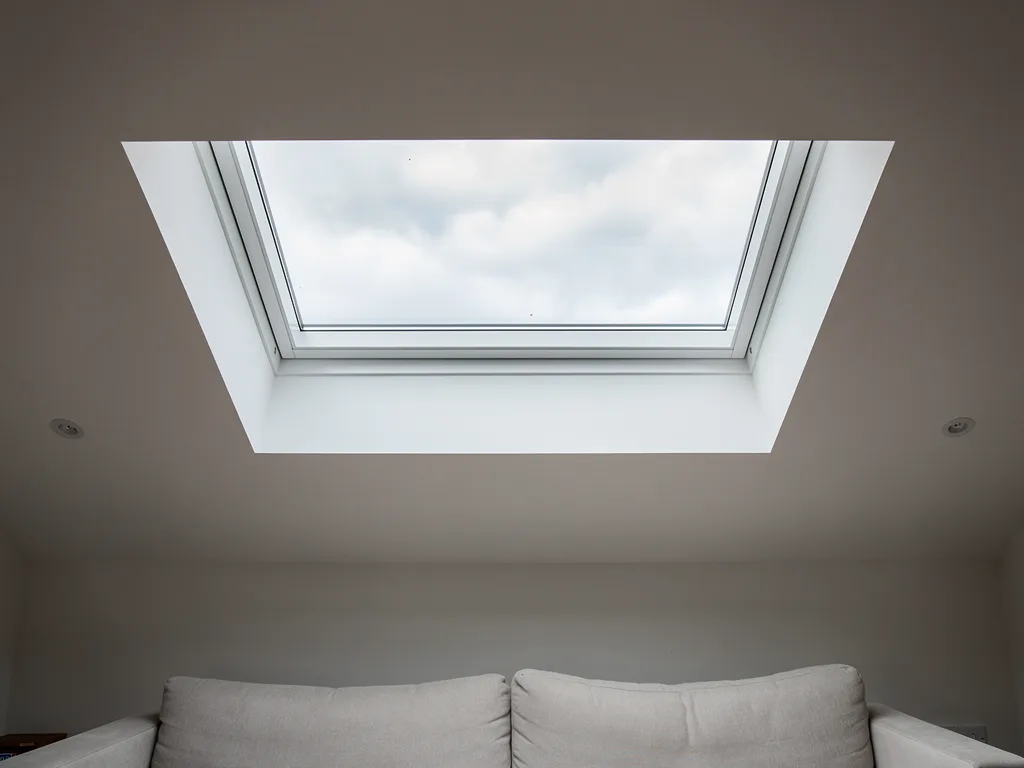
A blind changes what a rooflight does twice a day: it should shut out glare and heat when the sun is on that slope, and disappear completely the rest of the time, so the sky you paid for is still there to look at. Plenty of blinds do the first job well and fail the second, sitting in a box that eats into the reveal or running on rails that sit exactly where the pillow view crosses the glass. This guide goes through the main types, how each is controlled, and the details of box depth and rail position that decide whether a blind gets in the way of the view or simply vanishes when you do not need it.
A blind is part of the sightline, not an accessory bolted on afterwards
Choose a blind after the rooflight is fixed and the box, the rails and the fabric it carries have to fit whatever reveal and frame are already there, whether or not that reveal was ever meant to hide them.
A rooflight's frame already takes a slice out of the sky before a blind is even fitted, through face width, frame depth and, on a flat roof, the upstand the glass sits on. A blind adds a second layer to that same calculation: a headbox at the top of the reveal, side channels or wire guides running down each edge, and sometimes a bottom bar that sits proud of the glass line even when the blind is fully open. None of this is a reason to skip a blind. It is a reason to choose the type, and where it sits, with the same care given to the rooflight itself, rather than picking whatever the supplier lists as an optional extra.
The main types of skylight blind, by what each is built to do
Skylight blinds fall into a handful of families, and the differences between them matter more than the fabric pattern printed on the sample card.
| Type | What it does | Best suited to | Fully open |
|---|---|---|---|
| Pleated blackout | Blocks light completely | Bedrooms, night shifts | Folds to a slim stack |
| Pleated day/night | Dims without full dark | Landings, living rooms | Two fabrics, one track |
| Solar reflective roller | Cuts glare and heat | South or west slopes | Rolls into a headbox |
| External awning | Stops heat before glass | Kitchens, conservatories | Retracts onto the roof |
A pleated blind, the type pictured most often on a pitched roof window, runs on wire guides fixed close to the glass edge and folds down into a shallow stack rather than a bulky roll, which keeps the stack itself out of the sightline once it is drawn open. A blackout fabric blocks light front to back; a day and night version pairs a sheer fabric with a blackout one on the same pleats, so one blind can dim a room by day and darken it by night without swapping units. A solar reflective roller works differently again, usually mounted flat rooflights and lanterns where the glass area is bigger, using a metallised or light coloured fabric to bounce heat back out rather than blocking it after it has already warmed the room. An external awning sits above the glass altogether, outside on the roof, so it stops solar gain before it ever reaches the pane; it costs more in moving parts exposed to weather, but it is the only type that keeps heat off the glass rather than off the room.
Manual, corded or electric: how you operate it changes what sits in view
How a blind is opened and closed decides how much hardware has to sit somewhere near the glass, and that hardware is exactly what a careful sightline tries to avoid.
A manual pleated blind, pulled by a toggle or a pole, needs the least fixed equipment: a headbox, wire guides and a bottom bar, nothing more. A geared, crank operated blind trades a small amount of visible mechanism, usually a pole and a gearbox at one side, for control over a unit too high to reach by hand, common on a vaulted ceiling or a tall lantern. An electric blind, run from a wall switch or a remote, adds a motor inside the headbox and, if it is not battery or solar powered, a cable run back to a switch; the payoff is a blind that can be reached at all on a rooflight set into a high pitch, and one that can be timed to close before a room warms up rather than after.
- Bedroom over the bed: a remote or a switch by the bed avoids reaching up and across the glass, which matters more the higher the rooflight sits.
- Landing or stairwell: a fixed pole often beats electric wiring, since the unit is used rarely and a cable run is harder to hide.
- Kitchen extension: a switch by the door, or a timer, suits a room where hands are often full and the glass is often high above a worktop.
Blackout for sleep, without losing the sky by day
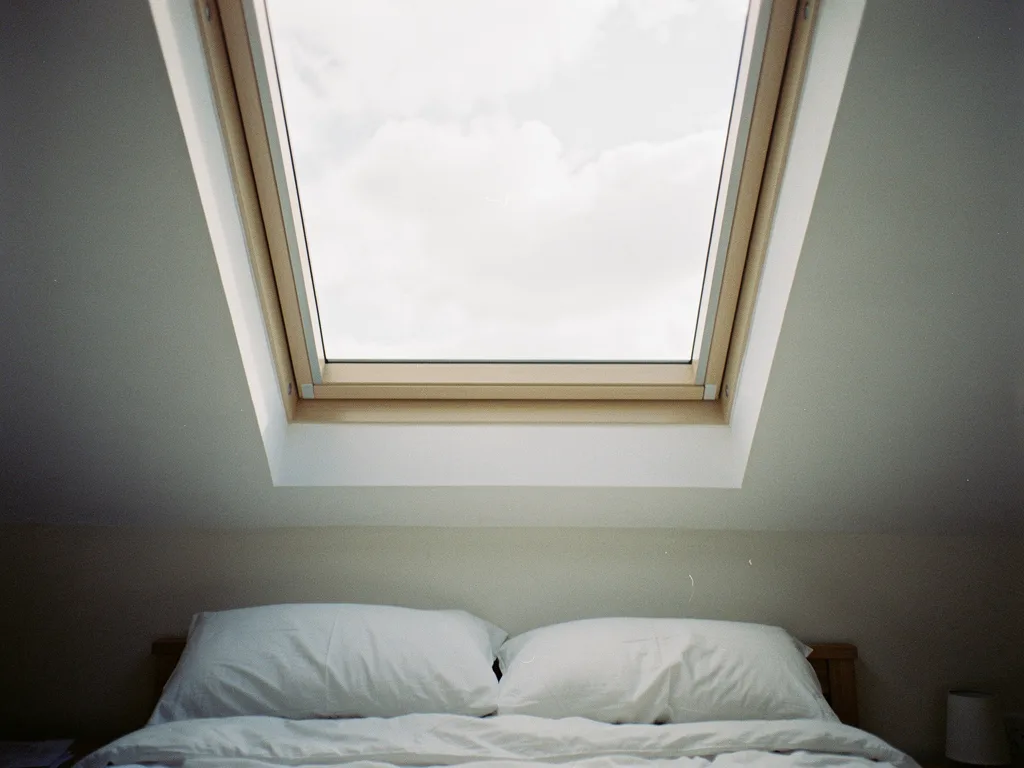
A bedroom rooflight is usually chosen for the view from the pillow, so the blind that darkens it for sleep has to leave that same view alone the rest of the time.
A blackout pleated blind, fully open, folds to a stack a few centimetres deep, usually sitting at the top of the reveal above the eye line from the bed, which is one reason it suits a rooflight placed carefully over where you actually lie rather than centred on the room. A roller blind stacks into a headbox in much the same way, though the box itself is usually deeper front to back, which can shorten the reveal slightly at the top edge. Wire guides down each side sit close to the glass and rarely intrude on a view taken from below rather than from the very edge of the room, but a bottom bar left resting a few centimetres down from the glass line, rather than tucked fully against the frame, is a common reason a supposedly open blind still shows in the top of the sightline from a low pillow. Where exactly the glass should sit relative to the bed, and how that interacts with a blind fitted afterwards, is worth settling at the same time; see where a skylight should go in a bedroom for that in full.
Glare and heat on a south or west facing slope
A rooflight facing south or west can turn a room hard to sit in on a bright afternoon, and a blind chosen for that alone should be judged on how much heat and glare it stops, not on how dark it can go.
Solar reflective fabrics, pale on the outer face and often backed with a metallised layer, are built to bounce a good share of incoming heat back through the glass rather than absorbing it into the room, which suits a south facing kitchen extension or a west facing loft bedroom that catches the evening sun. A close weave screen fabric, which looks almost sheer from below, cuts glare while still letting a soft, diffused view of the sky through, useful where blocking the outlook entirely feels like giving up the reason the rooflight was fitted. An external awning, mounted outside the glass, is the most effective option for heat specifically, because it stops solar gain reaching the pane at all rather than managing it once it is already inside the room. Which of these suits a given roof depends heavily on which way the slope faces; our guide to orientation for north, south, east and west facing rooflights sets out how much difference direction makes on its own, before a blind is even added.
Where the blind box sits, and what it costs the reveal
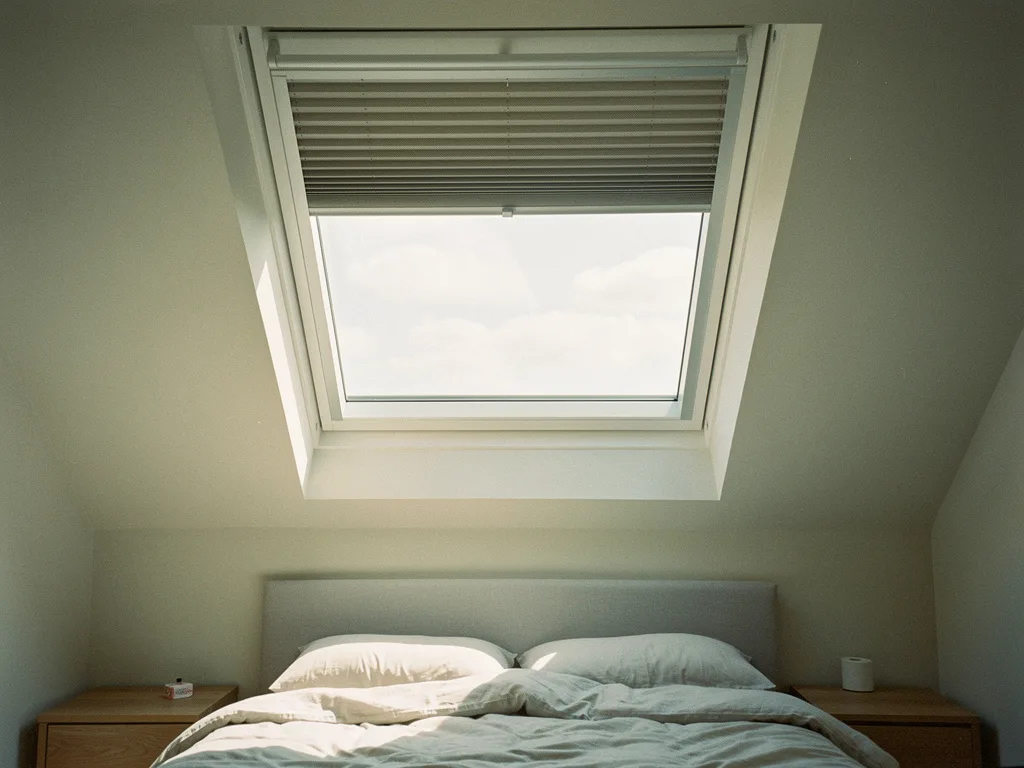
The single biggest factor in whether a blind vanishes from the sightline or lingers in it is not the fabric at all: it is where the headbox sits and how deep it runs into the reveal.
A recessed headbox, built into a pocket above the plaster line at the top of the reveal, keeps the mechanism entirely out of the room, so the stack is invisible whether the blind is open or closed. A surface mounted headbox, fixed to the face of the reveal rather than recessed into it, is simpler to fit, especially onto an existing rooflight where no pocket was ever built in, but it sits proud of the lining and takes a visible bite out of the reveal from certain angles, the same geometry covered in our guide to choosing a reveal shape. Side guides matter almost as much: a wire guide sits close against the glass and rarely shows, while a boxed side channel, common on some roller systems, adds a narrow strip of frame either side of the pane that behaves exactly like an extra glazing bar in the sightline, a point our guide to glazing bars and the view covers from the frame's own side. None of this shows up on a fabric sample or a brochure photo taken straight on from below; it only shows once you are sitting or lying at the actual angle the room is used from, which is exactly what a sightline sketch is drawn to check before anything is ordered.
Condensation, glass and a blind kept closed
A blind left closed against cold glass for long stretches can trap air between fabric and pane, and that trapped air is often more humid, and more static, than the room around it.
On a cold night, moisture in room air condenses on the coldest surface it reaches, usually the inner face of the glass near the edge seal. A blind pulled tight against the pane holds that moist air against the glass rather than letting the room's own air movement clear it, which is one reason a blind left down overnight on a bedroom rooflight can leave a damp line at the bottom edge by morning that a blind left open would not. This is not a fault in the blind; it is a reason to leave a small gap where the design allows it, or to lift the blind for a short spell most mornings, rather than treating "closed" as the default state for the glass. It is also a reminder that the glass unit itself does most of the real work here: coatings, spacer design and edge seals decide how much a pane resists condensation in the first place, covered fully in our guide to keeping rooflight glass clear for years, with a blind only ever managing what the glass and the room's ventilation do not.
Fitting a blind now, or building it in from the start
A blind can be added to a rooflight that already exists, or specified alongside a new one, and the two routes leave you with a noticeably different result at the reveal.
Fitted from new, a blind's headbox and guides can be built into the reveal as it is lined and plastered, recessed rather than surface mounted, with cabling for an electric unit run inside the lining before it is closed up. That is the neater outcome, and the one worth planning for whenever a rooflight is being replaced rather than kept; our guide to replacing old rooflights covers what a replacement involves and where a blind fits into that sequence. Fitted afterwards to glass already in place, a blind usually has to work with whatever reveal is already there, which more often means a surface mounted headbox and, for an electric unit, a cable run along the surface of the lining rather than hidden inside it. Neither route rules a blind out; it simply changes how much of it stays visible once it is drawn back, which is worth knowing before you commit to a particular type on an existing rooflight.
Keeping the blind itself working, not just the glass
A blind that has stopped running smoothly usually has a simpler cause than a broken mechanism, and most of it comes down to keeping the track clear rather than anything more involved.
- Dust in the guides: a pleated blind's wire guides collect dust from the room over time, which slows the pleats and can leave them sitting unevenly; a soft brush along the wire clears most of it.
- Fabric left compressed: a pleated blind left closed for long spells can take a while to spring back to a crisp stack; opening it fully every so often keeps the pleats from setting flat.
- A roller running off true: if a roller blind starts to sit crooked in its guides, the roller tube itself has usually shifted slightly at one bracket, which is a straightforward adjustment rather than a sign the fabric or motor has failed.
An electric blind adds a battery or a mains connection to keep an eye on, but otherwise wears in much the same way as a manual one: the fabric and the track, not the motor, are usually what needs attention first.
Blind decisions worth settling before you order
These are the questions that tend to come up once someone has chosen a rooflight and started thinking about what sits over it.
Does a blind reduce how much sky I can see, even when it is open?
It can, depending on the headbox and guide type. A recessed headbox and wire guides add almost nothing to the sightline once the blind is drawn back. A surface mounted headbox or a boxed side channel can take a visible strip out of the top or the sides of the reveal, which is worth checking against the actual eye position in the room rather than judging from a straight-on photo.
Can one blind both black out a room and cut glare on a bright day?
A day and night pleated blind, with a sheer fabric and a blackout fabric on the same pleats, comes closest, letting you choose dim daylight or full dark from the same unit. A single blackout fabric alone will do one or the other well but not both equally.
Is an electric blind worth it on a rooflight I can reach by hand?
Not always. Electric operation earns its keep on a high pitch, a vaulted ceiling or a lantern out of easy reach, or where a blind needs to close on a timer before a room heats up. On a low pitched roof window within arm's reach, a manual pull is simpler and has less to go wrong.
Should the blind be chosen before or after the rooflight itself?
Together, ideally. Choosing the rooflight first and the blind as an afterthought is how a headbox ends up surface mounted where it could have been recessed, or a side guide ends up sitting exactly where a bar in the sightline would have been avoided. We draw a sightline sketch for the glass itself; the same eye position is worth applying to where a blind's box and guides will sit. Book a home visit or message us on WhatsApp, and see our full rooflight and skylight service across Peterborough for the products a blind gets fitted to.
Keep reading
 GuideSkylight Orientation: North, South, East and West-Facing RooflightsHow north, south, east and west-facing slopes change the light, glare and view through a rooflight.
 GuideWhat Happens on Rooflight Installation DayWhat actually happens, in order, on the day a rooflight or skylight is fitted or replaced.
 GuideMaking Good Inside After a Rooflight Is ReplacedWhat making good involves after a rooflight is replaced, from the plastered reveal to a ceiling ready for decorating.
Book a home visit
Tell us which room
- No obligation
- Sightline sketch included
- 10-year guarantee
Or call 01733 736163