Question · Misted and failed rooflight replacement
Why is there black mould around my skylight?
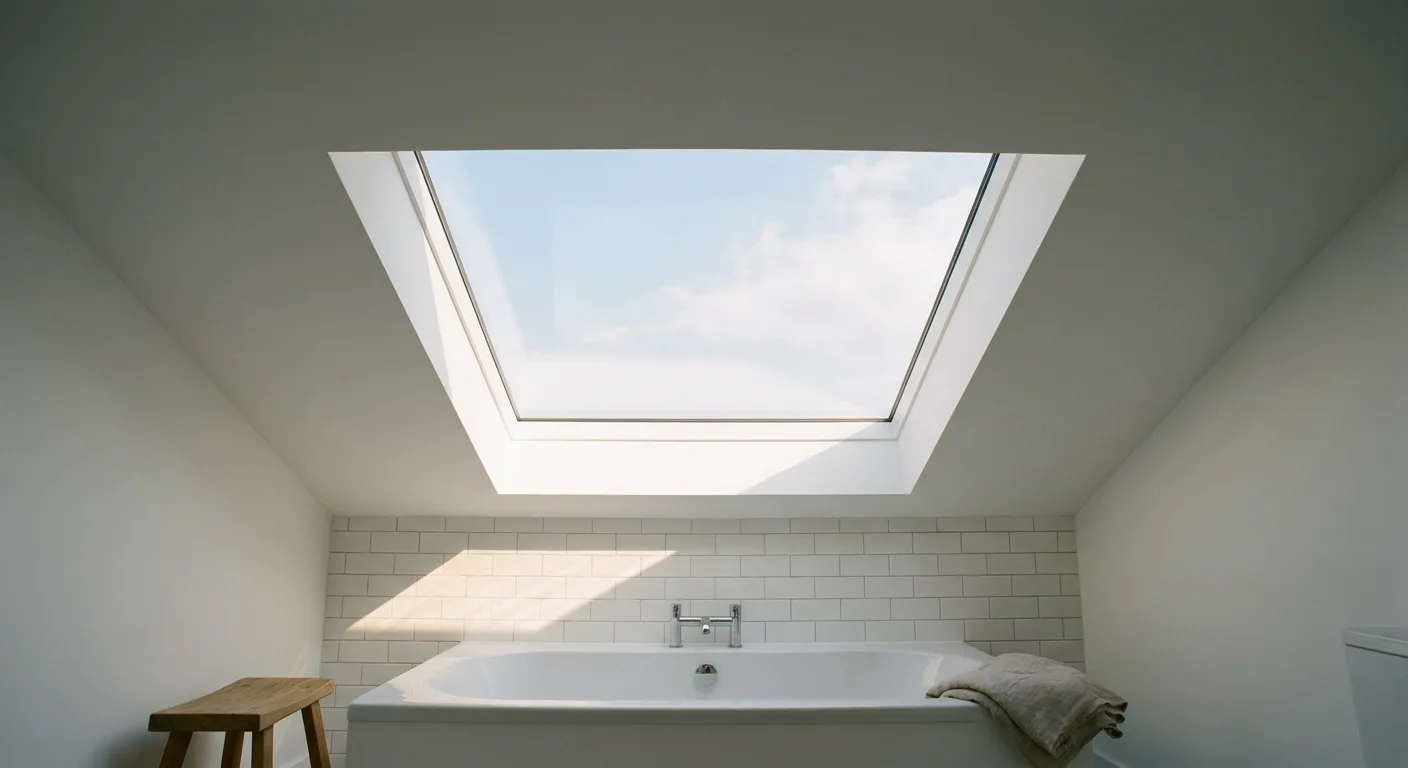
The coldest point in the room
Heat leaves a roof glazing unit fastest at its edges, not through the middle of the glass. The frame, the kerb or upstand beneath it and the last few centimetres of plaster lining all sit closer to the outside air than the rest of the ceiling, so on a cold night they are the first surfaces to fall below the temperature of the air in the room. That corner, where the plaster meets the frame, is usually the coldest patch a hand can find anywhere near the opening.
In Peterborough's new-town streets around Bretton, Orton and Werrington, a lot of roof glazing sits in flat-roofed kitchen extensions and loft conversions built decades apart, each with its own standard of insulation around the opening. An older kerb with a thin skin of insulation, or a frame bedded straight onto masonry with no thermal break, gives the cold a direct path inward, and the plaster around it never really warms up.
How the moisture actually gets there
Every room carries water vapour in its air: from breathing, cooking, showers, drying washing and simply being lived in. That air holds the moisture invisibly until it meets a surface cold enough to bring it back to liquid, the same way a cold glass sweats on a warm day. Bedrooms overnight and bathrooms after a shower push the most moisture upward, and warm air naturally rises to the ceiling, which is exactly where a skylight sits. Where the glass or frame is at or below the temperature of that damp air, the water condenses out onto it rather than staying in the room.
A film of condensation on its own is not mould. Mould needs the surface to stay wet for long enough, repeatedly, for spores already present in ordinary house dust to establish themselves. A frame or reveal that dries out between one damp night and the next rarely grows anything. One that stays damp because the cold bridge never lets it warm through is where the black spotting sets in, usually starting in the corners first.
What tends to make it worse
- An older single-glazed or poorly specified unit. Colder glass and a colder frame edge give condensation more surface to form on and more time to sit there.
- A deep reveal with no insulation behind the plaster. The lining itself becomes the cold surface, rather than just the frame.
- Curtains, blinds or a boxed-in reveal that traps air against the glass overnight. Still air against a cold surface condenses faster than air that can circulate.
- Little or no background ventilation in the room. Moisture has nowhere to go except onto the coldest surface available.
Reading where it sits
Where the mould actually appears is a fair guide to what is happening behind it, before anyone opens the reveal up.
| Where it appears | What is usually happening |
|---|---|
| Along the frame edge only | The frame or its thermal break is the cold bridge |
| In the plaster corners of the reveal | The kerb or upstand behind the lining is poorly insulated |
| Spreading down the full depth of the reveal | Little or no insulation behind the plaster at all |
| On the glass itself, not the frame | Ordinary surface condensation, not a build fault |
Why wiping it away does not end the story
Cleaning off the black spotting deals with what has already grown, not with the cold surface that let it grow. If the frame edge or reveal is still the coldest point in the room on the next cold night, the same corner meets the same damp air and the mould returns, often within weeks. That is the pattern that points to the opening itself, rather than the room's cleaning routine, as the thing worth looking at.
Is a misted rooflight a sign of a bigger problem? covers a related pattern, where moisture around an opening points past the glass itself to the frame or the roof detail around it.
What changes when the unit is replaced
A current rooflight is built to keep the coldest part of the assembly much closer to room temperature than an older one. A warm-edge spacer bar between the panes, rather than the old metal spacer that used to carry cold straight to the frame, raises the temperature of the glass edge. Choosing glass for a replacement unit sets out what a warm edge and a low-E coating do for that edge temperature specifically.
The frame matters just as much as the glass. Choosing slimmer frames when you replace explains how a modern, thermally broken frame reduces the area of cold surface in the room in the first place, alongside the clearer view it gives from underneath. Where the kerb or upstand itself is old, thin-walled or was never insulated to today's standard, when a failed frame means full replacement covers the point at which the frame and kerb are renewed together rather than the glass on its own, so the insulation runs continuously from roof to reveal.
Before any glass is ordered
A survey looks at the frame, the kerb and the reveal together, not just the pane, because the mould is telling you about all three. Does a misted skylight lose heat? covers the related question of how a cold edge affects the room's heat loss generally, which the same visit takes into account. Every quote from that survey comes with a sightline sketch, a drawing of the view from where you actually sit or lie in the room, so you can see what the replacement will look like from underneath before anything is cut. The sightline sketch explains how that drawing is put together, and what affects the cost of a rooflight covers the things that move a replacement job up or down in price.
For the fuller picture on failed and misted glazing across a roof, see misted and failed rooflight replacement in Peterborough, or book a home visit to have the frame, kerb and reveal looked at together.
Questions people also ask
Is black mould around a skylight dangerous?
It is a sign of a persistently damp surface rather than a structural fault on its own, but it is worth addressing because the moisture behind it can, over time, affect the plaster and any timber lining nearby. The cause is worth finding rather than only cleaning the surface each time it returns.
Does a new rooflight need more ventilation to stop it coming back?
Background ventilation in the room helps, because it gives moisture a route out other than the coldest surface it can find. A replacement unit reduces how cold that surface gets in the first place, which is the part a survey looks at alongside the glass.
Can mould around the frame mean the sealed unit has failed?
Not usually. A failed sealed unit shows as fog trapped between the panes rather than mould on the frame or plaster. Condensation or misting: telling the two apart sets out how to tell which one is happening from the room side.
Will mould keep coming back if only the glass is replaced?
If the frame edge or the reveal behind the plaster is the cold surface, glass alone will not stop it. That is why a survey checks the frame and kerb, not just the pane, before deciding what actually needs to change.
Book a home visit
Tell us which room
- No obligation
- Sightline sketch included
- 10-year guarantee
Or call 01733 736163