Question · Misted and failed rooflight replacement
Does a Misted Skylight Lose Heat?
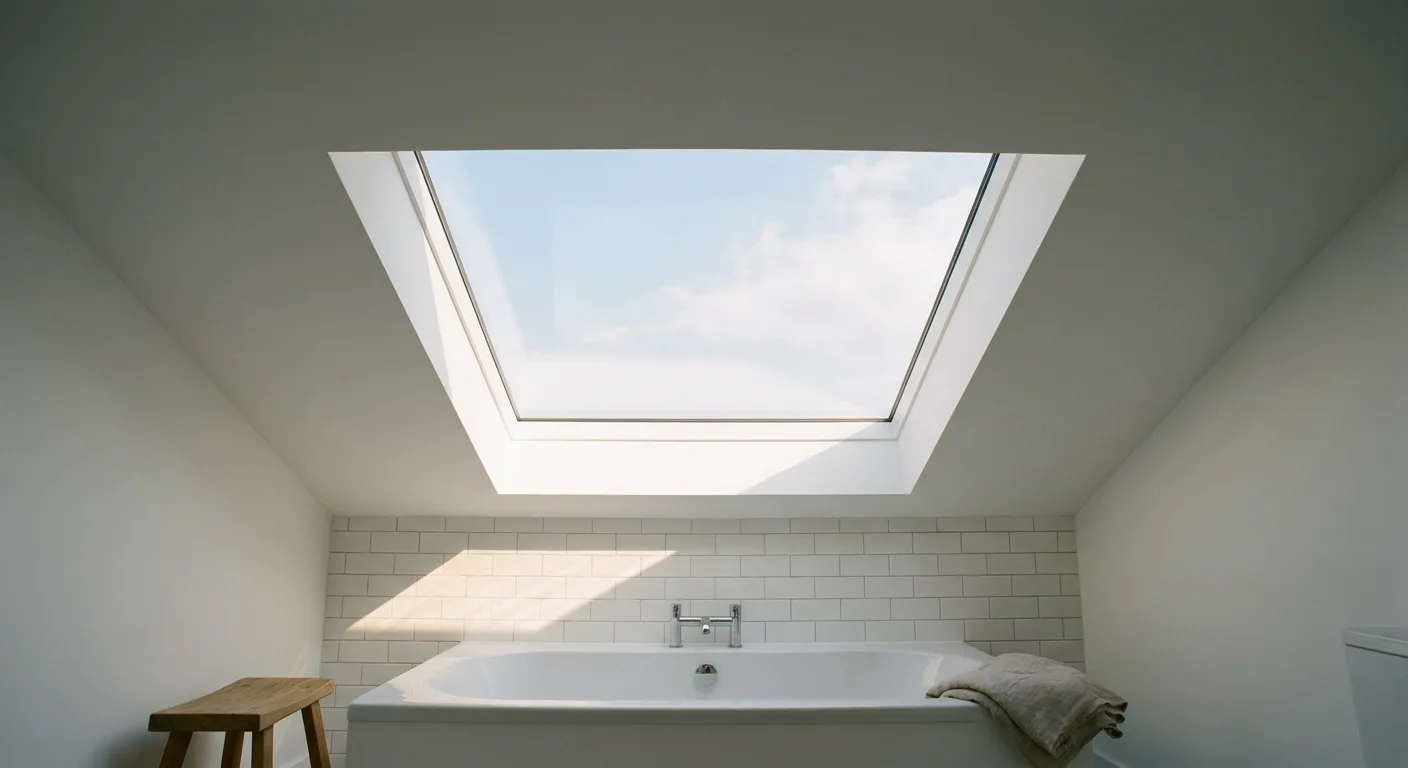
What the sealed unit is doing before anything goes wrong
A rooflight's double or triple unit earns most of its performance from what sits between the panes, not from the glass itself. The cavity is filled with argon or another inert gas at the factory, held there by the edge seal, and one of the inner faces carries a low-E coating that reflects heat back into the room rather than letting it pass straight through. Take those two things away and you are left with plain glass, which on its own insulates poorly whatever thickness it is cut to.
That is why the U-value quoted for a rooflight belongs to the whole sealed unit, gas and coating included, and not to the glass alone. A new rooflight installed to current Building Regulations is only meeting that figure because the cavity is doing the job it was built to do.
What happens to the gas once the seal lets go
A failing edge seal does not empty the cavity in one go. Moist air works its way in first, along whatever gap has opened in the seal, and that trapped vapour is the mist you see on a cold morning. The same gap that lets air in also lets the argon out, slowly, over months rather than days. As the inert fill leaches away it is replaced by ordinary air, which carries heat across the gap far more readily than argon does.
The performance of the unit does not drop in a single step. It drifts, pane by pane, as the gas escapes, and the drift is usually well under way before the mist is dense enough to notice from the bed or the sofa below. A skylight can be losing more heat than it should for a season or two before anyone in the room has a reason to look up and see why.
Why the cold shows up before the mist does
Stand under a misting rooflight on a frosty morning and the first thing you usually feel is not the haze on the glass, it is the air near it. A pane running colder than it should pulls heat from the room by radiation and sets up a slow fall of cooled air down off the glass, something that can feel like a draught even with a sound frame and no gap anywhere in sight.
That cold-air fall happens to some degree under any glazing, sealed or not. What changes once a unit's gas fill is gone is how cold the inner glass surface gets, and a colder surface makes a stronger, more noticeable fall of air. People living under a failed rooflight often mention the cold spot on the sofa or by the bed well before they mention the mist, because the two effects do not appear on the same schedule.
How much difference a failed seal actually makes
There is no single figure that applies to every rooflight, because a small conservation-profile unit loses less heat in absolute terms than a large flat rooflight over an extension, whatever state its seal is in. What holds across sizes is the direction of travel: a sound unit performs to the standard it was specified for, and a unit with a failed seal is working closer to the performance of an old single-glazed pane, sometimes worse, because a cavity that is part gas and part ordinary air can behave less predictably than one that never had a fill at all.
| Stage | Gas fill | Coating | View |
|---|---|---|---|
| Sealed and sound | Full argon fill | Reflects heat inward | Clear sky, no haze |
| Seal recently failed | Leaching slowly | Still mostly intact | Faint haze at the edges |
| Long failed | Mostly ordinary air | Marked by moisture | Persistent mist, blurred sky |
The middle row is the one worth acting on. A unit there is still doing most of its job on the view, which is exactly why it gets left alone, and it is also the point at which the heat loss is climbing fastest as the gas continues to escape.
Signs the problem is more than the haze on the glass
A misted pane on its own tells you the seal has gone. A few other signs point to something worth checking sooner rather than later:
- Water sitting at the bottom edge of the unit, inside the cavity, rather than a general haze across the pane.
- A frame that feels cold or slightly damp to the touch even where the glass itself still looks clear.
- Mist that clears in warm weather and returns every autumn, which points to a seal still in the process of failing rather than one that has already given way completely.
None of these on their own means the frame has failed, only the glass unit sitting inside it. Mist between the panes: how a rooflight unit fails sets out the seal mechanics in full, and is a misted rooflight a sign of a bigger problem? covers when it is the frame, not just the glass, that needs attention.
Replacing the unit restores the performance and the view together
Because heat loss and mist come from the same failed seal, replacing the glass unit deals with both at once. We specify the replacement to current Building Regulations, so the new unit is rated to the standard the roof needs today rather than the standard the original unit met on the day it was fitted years ago. Replacing the glass unit or the whole rooflight covers when the frame can stay and only the glass changes, and choosing glass for a replacement unit goes through the coating and gas-fill options in more detail.
Because the old unit has to come out either way, it is also a natural point to reconsider the frame profile itself. Where the existing frame is bulkier than it needs to be, choosing slimmer frames when you replace sets out how a like-for-like glass swap compares with a frame that gives back some of the sky the old one was taking up. Every quote includes a sightline sketch, a drawing of the view from the bed, the sofa or wherever the room is used, so you can see what the new unit will actually look like from below before any decision is made; the sightline sketch: how we plan the view explains how that drawing is put together, and what affects the cost of a rooflight sets out the factors that decide what a job like this involves.
For the full picture on why units fail and what replacing one involves from survey to fitting, misted and failed rooflight replacement in Peterborough covers the whole service, and how long does a rooflight sealed unit last? sets out what tends to shorten or extend a unit's working life.
Questions people also ask
Does misting mean the whole rooflight has failed, not just the glass?
Not usually. In most cases it is the sealed glass unit that has failed, and the frame around it is still sound and can stay in place while the unit is replaced. The frame only needs attention where it has its own separate faults, such as corrosion or movement in the fixings, which is a different problem from a misted pane.
Will one misted skylight make a noticeable difference to a heating bill?
A single failed unit affects the heat lost through that one pane, and the effect is strongest right around it, as a cold spot in the room rather than a change you would necessarily read off a bill. Several units failing at once in the same roof, or one large flat rooflight over an open-plan space, will make more of a difference than a single small pane in a landing.
Can the low-E coating fail without any visible mist?
The coating sits on one of the inner glass faces and is protected from the room and the weather as long as the seal holds, so it is not something that fails on its own while the unit is still sealed. Once moisture reaches it through a failed seal, though, it can mark or degrade at the same time as the mist appears, which is one more reason a hazy pane is treated as a full unit problem rather than a surface one.
Does a failed rooflight lose heat through the frame as well as the glass?
The frame and the glass are separate parts and fail for separate reasons. A frame in good condition, correctly sealed into the roof, does not lose extra heat just because the glass unit inside it has misted. Where a frame has its own problems, such as a perished gasket or movement in the roof structure around it, that is worth raising alongside the glass rather than assuming the mist explains it.
Book a home visit
Tell us which room
- No obligation
- Sightline sketch included
- 10-year guarantee
Or call 01733 736163