Guide · Misted and failed rooflight replacement
Condensation or Misting: Telling the Two Apart
Condensation comes and goes with the room; a failed sealed unit does not. This guide shows you where the moisture is sitting, what each cause means, and when the glass itself needs replacing.
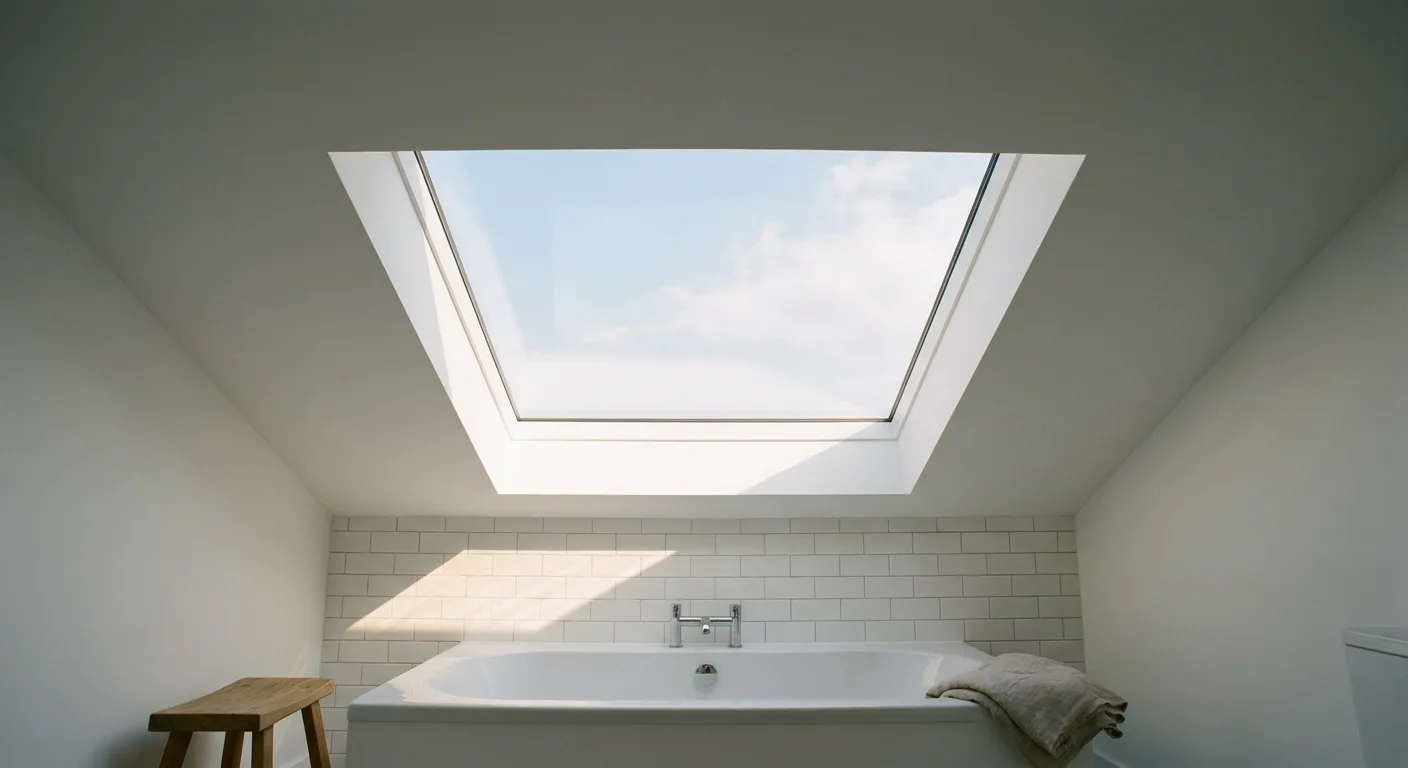
Three places moisture can sit, and only one of them means trouble
A rooflight that looks "misted" can be damp in three different places, and only one of them means the glass itself has failed. Work out which face the moisture is on before you decide anything, because the fix for each is completely different.
Stand under the rooflight and look along the pane rather than straight up through it. Condensation on the room side sits on the inner face of the glass, the one closest to you. Condensation on the outside sits on the outer face, out in the weather. Misting from a failed unit sits between the panes, in the gap that is built to stay sealed and dry for the life of the unit. That third one is the only kind you can never reach to wipe, and it is the only one that means the rooflight needs new glass.
The other two look alarming the first time you see them, especially on a flat-roofed extension or a loft conversion where the rooflight sits low over a bed or a desk. They are not a sign that anything has gone wrong with the unit.
Why a deep reveal makes the moisture more obvious
The lining around the glass changes how noticeable any of this is, which is one reason two rooflights in the same house can seem to behave completely differently. A shallow, splayed reveal lets a shower of dust and a puff of warm air move across the glass fairly freely, so light condensation dries off quickly. A deep, square-cut reveal, common where a rooflight sits in a thick roof build-up on an extension, traps still air against the pane, so any condensation lingers longer and can run down and pool on the sill or the top of the lining.
None of that changes which of the three causes is at work, but it does explain why the same amount of moisture looks worse in one room than another, and why the sill under a rooflight in a box-section extension roof is often where people first notice a problem, well before they notice the glass itself.
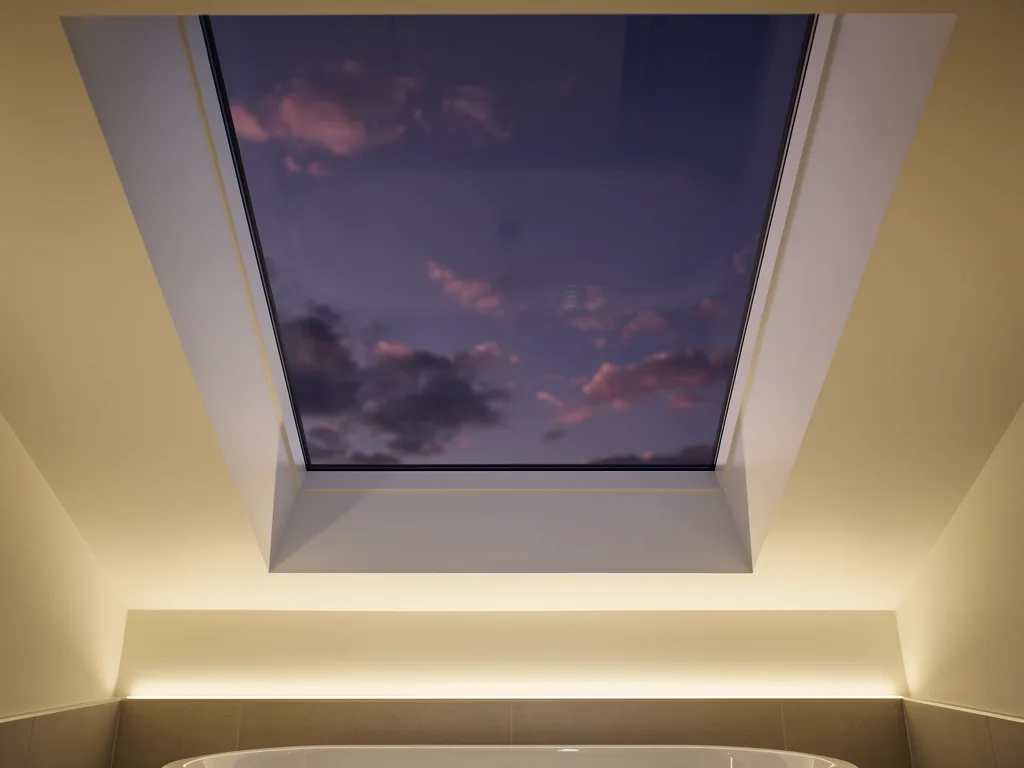
Condensation on the room side: a ventilation problem, not a glass problem
This is the most common of the three, and the easiest to fix. It has nothing to do with the rooflight's construction and everything to do with the air in the room underneath it.
Warm air holds more moisture than cold air. A bedroom fills with it overnight from breathing alone; a kitchen or bathroom fills with it in minutes from cooking, a kettle or a shower. When that warm, damp air meets the coldest surface in the room, usually the rooflight glass on a cold morning, the moisture drops out of it and sits on the pane as fine droplets. It is the same thing that happens on a bathroom mirror.
You will usually see it:
- first thing on a cold, still morning, and gone within an hour of the heating coming on;
- worse in a loft bedroom in a Fletton brick terrace that has been boarded out without adding a trickle vent or extractor;
- worse over a bed or sofa where a person spends several hours breathing under the glass;
- gone completely on a mild, breezy day, even without touching the glass.
It wipes away with a dry cloth, and it comes back only if the room stays warm and damp with nowhere for the air to go. The fix sits with ventilation, not the rooflight: a trickle vent left open rather than taped shut for winter, an extractor fan actually switched on and left running for a few minutes after a shower, or simply opening a rooflight itself for ten minutes on a dry morning. Left unaddressed for long enough, this kind of condensation can turn into mould around the frame, but the rooflight glass itself is not at fault and does not need replacing.
Condensation on the outside face: dew, not a fault
This one confuses people the most, because it can look identical to a failed unit from below: a hazy, even film across the whole pane. The difference is that this haze is sitting on top of the glass, on the outside, not sealed inside it.
On a clear, still night, a roof loses heat upward to the open sky faster than the surrounding air cools. By early morning the outer face of the glass can be colder than the air around it, and any moisture in that air condenses straight onto it, exactly like dew on a car windscreen or a lawn. A rooflight with a good low-emissivity coating, the kind that keeps heat inside the room rather than letting it leak out through the glass, is more prone to this than an older, leakier unit, simply because less warmth escapes from inside to keep the outer pane above dew point.
Seen this way, outside condensation is closer to a compliment than a complaint: it is a sign the glass is holding your heat where it belongs. It clears on its own once the sun gets on the roof or the air outside warms a degree or two, and needs no attention from anyone.
Misting between the panes: the sign a unit has failed
A modern rooflight pane is not one sheet of glass but two or three, held apart by a spacer bar and sealed at the edge, with a barrier of dry gas trapped in the gap between them. That seal is what keeps the space dry for years. When it lets go, moist air works its way in, meets the cold air trapped in the gap, and condenses inside it, exactly like the room-side condensation described above, except this time there is no cloth that can reach it.
The tell is persistence. Room-side and outside condensation both clear within a few hours as conditions change. Misting between the panes does not: it can be there at ten in the morning on a dry, sunny day just as much as at dawn, because nothing about the room or the weather affects a gap that has already flooded with damp air. Some units show it as an even fog across the whole pane; others show it as streaks, a patch in one corner near the spacer, or a faint rainbow sheen where moisture has started to interact with coatings on the inner glass surfaces. Whatever the pattern, once it is inside the sealed unit it does not go away on its own, and in most cases it gradually spreads rather than staying still.
The trade calls a unit in this state "blown", and it happens for the same reason in a VELUX roof window, a flat rooflight on a kerb, or a pane in a lantern roof: the edge seal has failed, usually after years of the frame expanding and contracting with the weather. Our guide to how a sealed unit fails covers that mechanism in more depth, and what "blown" actually means if you have heard the term and want it explained plainly.

A short test you can run from inside the room
You do not need a survey to make a reasonable first diagnosis. Over a day or two, note where the haze is and how it behaves against these three checks.
| Where it sits | Best time to look | Does it wipe off? | What it points to |
|---|---|---|---|
| Inner face, closest to the room | First thing on a cold morning | Yes, with a dry cloth | Room humidity; open a vent |
| Outer face, out in the weather | Before sunrise, clear still night | Clears as the day warms | Overnight dew; no fault |
| Between the panes, unreachable | Any time; unchanged all day | Never wipes away | Failed seal; unit needs replacing |
The middle column matters more than people expect. If a supposedly "misted" rooflight is perfectly clear by mid-afternoon on a dry day, whatever you saw that morning was on one of the outer faces, not inside the unit. If it is still there, unchanged, at four in the afternoon on a warm, dry day with the heating off, that is the strongest sign you are looking at a failed seal rather than ordinary condensation.
Worth doing this over two separate mornings rather than one, ideally with different weather: a cold, still, clear night followed by a cloudy, breezy one. Room-side and outside condensation should each behave differently between the two, clearing faster or barely appearing at all when the weather changes. A failed unit gives you the same, unmoving haze regardless of what the night was like, which is the clearest single sign that the problem sits inside the glass rather than around it.
Why it is worth getting the diagnosis right
Treating one problem as the other wastes effort in both directions. Fitting extra ventilation will not touch misting that is sealed between the panes; it will still be there next winter, because the room's humidity was never the cause. Going the other way and replacing glass that is only suffering from room-side condensation is glass that did not need to come out at all.
A genuinely failed unit is worth sorting rather than living with, for two reasons beyond the view itself. First, a broken seal usually means the gas or air gap inside is no longer doing its job, so the unit is losing some of its insulating value as well as its clarity. Second, moisture sitting permanently against the inner coatings and spacer bar tends to get worse rather than settle, so the sooner it is confirmed, the fewer options narrow. Depending on the rooflight, the fix might be a new glass unit in the existing frame, or, where the frame itself has also suffered, the whole rooflight. Swapping just the glass on most rooflight types is not notifiable work, though it is always worth checking for your specific job, and we handle the Building Control notification ourselves on any job where it is required.
When it is worth a second opinion
If the test above still leaves you unsure, or the rooflight is somewhere awkward to view closely, such as over a stairwell or high in a lantern roof, a short visit settles it properly. We look at the pane from both sides where access allows, check the spacer and edge seal for the fine signs of failure, and confirm whether the frame around the glass is still sound.
Every quote we give includes a sightline sketch, a drawing of the view from where you actually sit or lie under that rooflight, so you can see what a replacement pane changes for the room, not just what it costs. If you would rather understand the general range of options first, our page on what affects the cost of a rooflight sets that out, and our misted and failed rooflight replacement page covers the whole service from first look to finished job.
If you are ready, you can book a home visit, or send us a photo of the pane on WhatsApp and we will tell you, from that alone, which of the three you are most likely looking at.
This matters as much on a slim conservation rooflight over a Collyweston stone slate roof near Stamford as it does on a large flat rooflight over a kitchen extension in one of Peterborough's new-town townships. The glass, spacer and seal behave the same way whatever sits around them; only the frame and the reveal differ, and those are exactly the things a home visit is there to check alongside the pane itself.
A few things that come up once you have made the call
What if it is misty on the outside and there is also haze between the panes?
It happens, particularly on an older unit. Outside dew clears within a couple of hours regardless of what is happening inside the glass, so run the same test: check again once the day has warmed up. If the haze underneath the dew is still there, unchanged, the unit itself has failed and the outside condensation was simply masking it that morning.
Does wiping the glass tell you anything on its own?
Only that the moisture was reachable, which rules out a failed unit but does not confirm which of the other two causes you have. A cloth test paired with the time-of-day check above gives a much clearer answer than either alone.
Can this be confirmed without anyone coming inside the loft or up a ladder?
Often, yes, at least well enough to plan a visit. A couple of clear photos, one from directly under the rooflight and one taken along the length of the pane, plus a note of the time of day and whether the room had been heated, usually tells us which of the three we are dealing with before we arrive.
Keep reading
 GuideDiscoloured and Yellowed Plastic SkylightsWhy plastic domes and sheets yellow with age, and how swapping to glass restores a clear view of the sky.
 GuideChoosing a Slimmer Frame When You Replace a RooflightA failed rooflight is the moment to choose a slimmer frame, fewer bars and a wider view of the sky.
 GuideMisted Flat RooflightsWhy a flat rooflight's low pitch and sun exposure mist the seal faster, and how the glass is replaced on the kerb.
Book a home visit
Tell us which room
- No obligation
- Sightline sketch included
- 10-year guarantee
Or call 01733 736163