Question · Misted and failed rooflight replacement
Is a misted skylight dangerous?
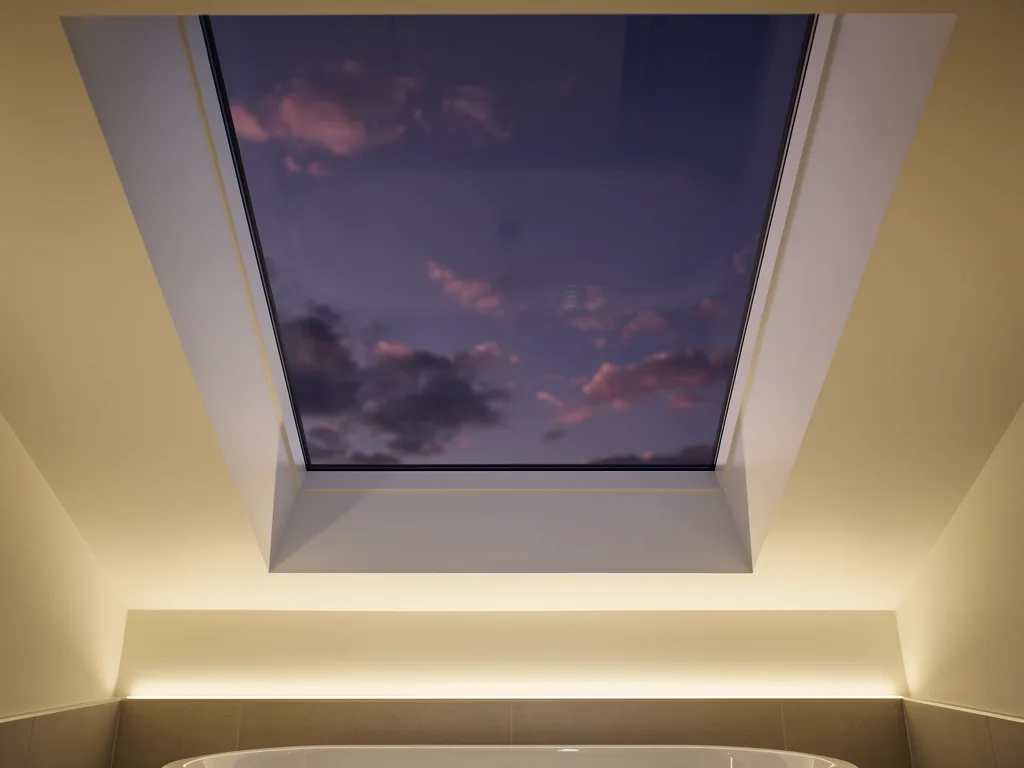
What the mist is, and why it is not a structural fault
A modern rooflight is glazed as a sealed unit: two or three panes with a spacer bar between them, the gap filled with dry air or argon and closed with an edge seal. That seal is what keeps the view clear. Once it fails, damp air is drawn into the gap and settles on the inner faces of the glass, where nobody can wipe it away because it is on the wrong side of the pane.
That failure is in the seal and the gas fill, not in the roof structure around it. The rafters, the frame fixings, the flashing and the kerb are a separate job from the glass unit sitting inside them, and misting between the panes does not by itself mean any of those are compromised. It is a cosmetic and thermal problem: you lose the clean sightline up to the sky, and the unit no longer insulates as well as it did, because the trapped gas that did the work has gone. Our guide to how a rooflight unit fails sets out why the pane clouds and why it cannot be cleaned from inside.
Where misting does point to a genuine risk
The mist itself is not the danger. What matters is what else is happening around it. A handful of situations turn a cosmetic problem into one worth treating as a priority:
- The glass is cracked as well as misted, which is a safety issue with the pane itself, not just its clarity.
- Water is tracking down the inside of the reveal or dripping onto the sill or the floor below.
- An opening rooflight's vent or catch has stopped working properly, so it no longer closes flush.
- Black spotting or a musty smell has started in the plaster lining around the unit.
- The frame has begun to soften, discolour or move at a joint.
Any of those alongside misting is worth a look sooner rather than later. Our guide on whether a misted rooflight is a sign of a bigger problem goes through how to tell the difference, and our guide to what causes rooflight glass to crack covers the glass safety side on its own.
How the risk usually stacks up
Most misted units sit at the low-risk end for a long time before anyone gets around to replacing them, and that is a reasonable choice. The table below is a rough guide to where the line sits, not a rule for every roof.
| What you are seeing | What it usually means |
|---|---|
| Misting only, view unchanged otherwise | Seal has failed. Schedule a replacement when it suits you. |
| Misting plus dripping water | Water is finding a way past the frame. Get it looked at soon. |
| Misting plus a cracked pane | Glass safety issue. Treat as a priority. |
| Black staining in the lining | Moisture is sitting rather than drying out. Check the unit and the ventilation. |
Our guide to whether a misted rooflight can get worse covers how misting progresses on its own, without any of those other signs joining it.
What replacing a misted unit involves
In most cases, the frame stays put and only the glass unit changes: the old, misted sealed unit is lifted out and a new one goes in on the same beads or gaskets. That keeps the job quick and the disruption to a single visit in most cases. Where the frame itself has swollen, rotted or lost its shape, the whole rooflight comes out and a new one is fitted, which is a bigger job with more making good around it. Our guide to replacing the glass unit or the whole rooflight explains how that decision is made, and when a failed frame means full replacement sets out the signs that push it that way. We plan the replacement around the same sightline you have now, or a clearer one where a slimmer frame allows it, and every quote comes with a sightline sketch of the view from where you actually sit or lie.
We install to current Building Regulations and handle the Building Control notification where the work is notifiable, and every replacement carries a 10-year workmanship guarantee. Timescales depend on the unit and whether it is a standard size or made to measure; our guide to how quickly a failed rooflight can be replaced covers what affects the wait.
Living with it while you decide
There is no reason to rush a straightforward misted unit into an urgent slot, and no reason to leave it indefinitely either. The heat loss is real, if modest, and a clouded pane in a bedroom or landing is one more thing standing between you and open sky every time you look up. Both are good reasons to book a survey when it suits you, rather than to treat it as a crisis.
For background on the thermal side, our guide on whether a misted skylight loses heat explains what the failed seal actually does to the unit's performance, and why it is worth weighing alongside the loss of the view when you decide how soon to act.
Questions people also ask
Can a misted skylight make a room unsafe to use?
Not on its own. Misting between the panes affects the view and the unit's insulation, not the strength of the glass or the fixing of the frame. The room stays safe to use as normal; what changes is what you see when you look up, and how well the unit holds heat.
Does misting mean water is getting into the roof?
Not usually. The moisture causing the cloudiness is sealed inside the unit itself, between the panes, and has nothing to do with the weatherproofing around the frame. Water reaching the room below points to a separate problem with the frame, flashing or kerb, and is worth investigating on its own terms.
Is it safe to leave a misted rooflight until a convenient time?
In most cases, yes. A unit that is misted and nothing else can usually wait for a survey and a scheduled replacement without any risk building up. That changes if the glass is also cracked, if water is tracking through, or if mould has started in the lining, all of which are worth treating sooner.
Should children's bedrooms with a misted skylight be treated differently?
The mist itself needs no special treatment for any room. What is worth checking in any bedroom, children's or otherwise, is whether the unit still opens and closes properly if it is a venting rooflight, since that affects ventilation and, on some models, whether it can be used as an escape route, unrelated to the glass. A misted pane with a working, secure frame is a cosmetic issue, not a safety one.
Book a home visit
Tell us which room
- No obligation
- Sightline sketch included
- 10-year guarantee
Or call 01733 736163