Question · Misted and failed rooflight replacement
Why Does My Skylight Have White Streaks?
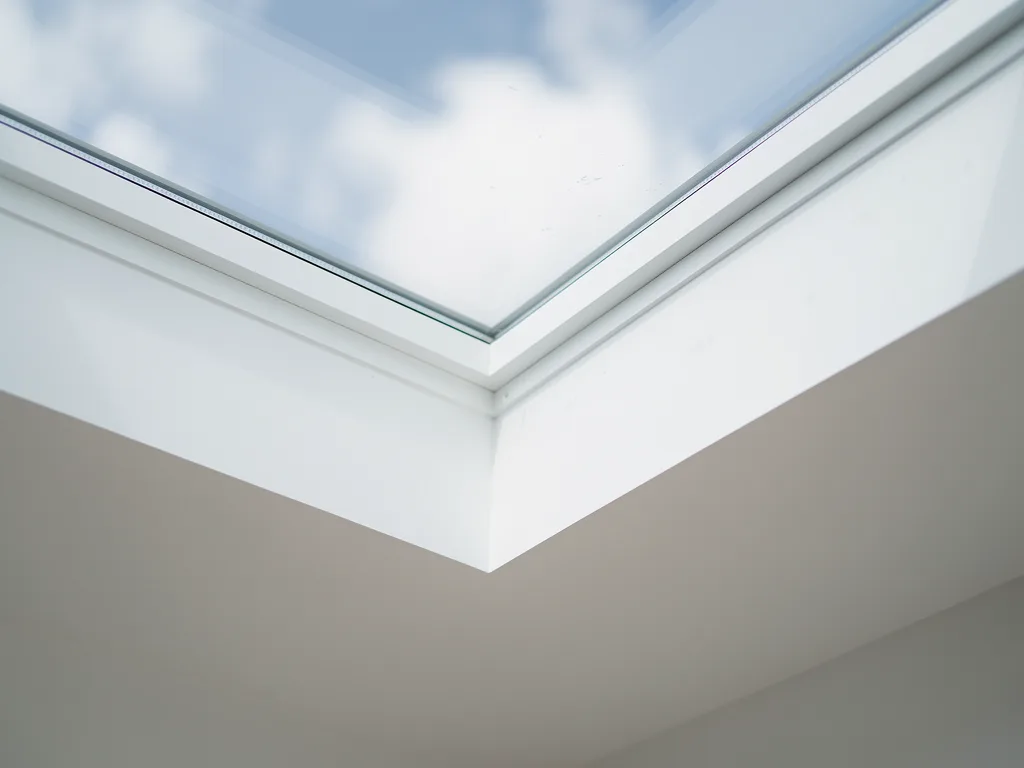
Rainwater residue is the most common cause
Most white streaks come from ordinary rain, not a fault in the unit. Rain carries dissolved minerals, and wherever it dries on the glass rather than draining straight off, it leaves a trace of them behind.
On a steeply pitched roof window the water runs off before it has much chance to dry on the pane. On a flat or low-pitch rooflight, common on extensions and on the flat-roofed additions found across Bretton, Orton and Werrington, water can sit at the glass edge or pool very slightly before it evaporates. The same path dries in the same place each time it rains, so the mineral trace builds along that line rather than spreading evenly. After a few seasons it reads as a pale, chalky streak that a damp cloth alone will not shift.
Seen from inside, on a grey day, that streaking can look a little like a misted pane. The two are not the same: genuine misting sits between the panes and looks like an even fog that does not move or follow any obvious path, while rainwater residue sits on the outer face, follows the line the water actually took, and is patchier at the edges than in the middle. If you are not sure which you are looking at, Condensation or Misting: Telling the Two Apart covers the inside-the-room signs of a failed sealed unit.
Four things that leave a mark on the glass
Streaking is not always the same problem twice, and knowing which of these is on the glass decides what to do about it.
- Mineral residue from rainwater, drying along the same path each time and building up as a chalky line, usually along the lower edge or wherever water gathers before it drains.
- Cement or mortar splash, thrown up during roofing, rendering or scaffolding work nearby, which reacts with the glass surface and cannot be wiped off once it has dried.
- A self-cleaning coating that has stopped working in one spot, where residue has sat long enough to wear the coating rather than being carried away by it.
- Bird fouling or garden debris, which dries pale and chalky in its own right and is often mistaken for mineral residue until it is looked at closely.
Telling a surface mark from permanent damage
The question that matters is whether the mark will come off, because that decides between cleaning and replacing the glass.
| Mark | Likely cause | Comes off? |
|---|---|---|
| Chalky line, follows a path | Mineral residue from rainwater | Usually, with the right method |
| Hazy patch, gritty to touch | Cement or mortar splash | No, the glass is etched |
| Dull bloom in one area | Coating worn under old residue | Partly, coating will not return |
| Even fog, both panes affected | Failed sealed unit | No, the unit needs replacing |
A gritty or slightly abrasive feel under a fingernail is the clearest sign of etching rather than residue. Etched glass has had its surface chemically altered, so no amount of cleaning restores the clear view; only a new pane or a new unit does that.
Self-cleaning coatings and why they do not always keep up
Many modern rooflights carry a self-cleaning coating on the outer pane, designed to break down organic grime under UV light and let rain sheet off evenly. Where it is working well, it is the biggest reason a rooflight stays streak-free between visits from a window cleaner.
The coating is thin and sits on the very outer surface of the glass, so anything left sitting on top of it for long enough, hard mineral residue included, can wear it locally rather than everywhere at once. That is why streaking often shows as a patch or a line rather than across the whole pane: the coating is still doing its job everywhere except where something has been left to dry on it repeatedly. Once that happens in one spot, residue collects there faster next time, and the mark becomes more visible with each dry spell rather than less. Choosing Glass for a Replacement Unit covers the coatings worth specifying if a unit is being replaced anyway.
Cement and mortar splash is damage, not dirt
Building work near a rooflight is the other common cause of white marks, and it is worth knowing about before any scaffolding goes up.
Fresh cement, mortar and render are strongly alkaline, and a splash of any of them on glass starts etching the surface within hours if it is not washed off straightaway. Once it has dried and been left, the alteration is in the glass itself rather than on it, and cleaning products make no difference.
Timing matters more here than with any other cause. Rinsed off with plain water the same day, a splash usually leaves nothing behind; left through a weekend on site, it is very often permanent.
A flat or low-pitch rooflight holds water longer
Pitch decides how long water sits on a pane, and that is a large part of why streaking shows up more on flat roofs than pitched ones.
Current guidance for flat rooflights calls for a minimum fall, typically around 1:80, so that standing water drains rather than lying on the glass. A unit fitted close to that minimum, or on an older flat roof where the fall has settled over time, holds water for longer after rain than one with a steeper fall built in.
The extra time the water spends on the glass is exactly the time it needs to leave mineral residue behind as it dries. It is one reason a replacement on a flat roof is a chance to check the fall as well as the glass: a slightly steeper fall built into the new kerb, alongside a fresh self-cleaning coating, does more to prevent the same streak reappearing than cleaning the old pane ever will.
When cleaning is enough, and when the glass is worth replacing
Mineral residue can usually be cleaned away; etching and a genuinely failed unit cannot, and knowing which is which saves wasted effort.
A specialist glass cleaner, plenty of water and a soft applicator, worked in the direction the streak runs rather than across it, lifts most rainwater deposits that have not been left for years. A pressure washer or an abrasive pad is the wrong tool for either job; both can scratch the glass or strip a self-cleaning coating that was otherwise still working.
Etching from mortar or cement is permanent, and no amount of cleaning brings the clear view back. The same is true of a unit that is genuinely misted between the panes rather than streaked on the surface. In either case the practical answer is new glass rather than repeated attempts to clean glass that cannot be restored. Replacing the Glass Unit or the Whole Rooflight sets out when a new pane is enough and when the frame needs attention too, and Misted and Failed Rooflight Replacement in Peterborough covers the wider range of glass problems, from etching and residue through to a fully failed sealed unit.
Where glass is being replaced anyway, whether for etching, a worn coating or simply to gain a clearer, slimmer frame, every quote includes a sightline sketch showing the view the new unit will actually give from the room below. The Sightline Sketch: How We Plan the View explains how that drawing is put together, and What Affects the Cost of a Rooflight sets out the factors that affect price, including glass specification and coatings.
Questions people also ask
Can I clean white streaks off a skylight myself?
Mineral residue often comes off with a dedicated glass cleaner, clean water and a soft applicator worked along the line the streak follows. Avoid pressure washers and abrasive pads, since both can scratch the glass or damage a self-cleaning coating. If the mark is gritty to the touch and does not lift, it is more likely etching than residue, and cleaning will not remove it.
Will a new self-cleaning coating stop streaks coming back?
A working self-cleaning coating reduces streaking a good deal by letting rain sheet off evenly, but it will not prevent every mark, particularly where water genuinely pools rather than running off. On a flat or low-pitch rooflight, improving the fall at the same time as fitting new glass makes more difference than the coating on its own.
Are white streaks a sign the rooflight has failed?
Not on their own. Streaking is a surface effect and does not mean the sealed unit has failed. A failed unit shows as an even, persistent fog between the panes rather than a line or patch on the outer face. Why Is My Skylight Glass Cloudy? separates the two in more detail.
Does building work always mark nearby glass?
No, but it is a real risk. Fresh cement, mortar and render are alkaline and can etch glass within hours if a splash is left to dry. Rinsed off promptly with water, most splashes leave no lasting mark; sheeting the glass before work starts avoids the risk altogether.
Book a home visit
Tell us which room
- No obligation
- Sightline sketch included
- 10-year guarantee
Or call 01733 736163