Question · Misted and failed rooflight replacement
Why is my skylight glass cloudy?
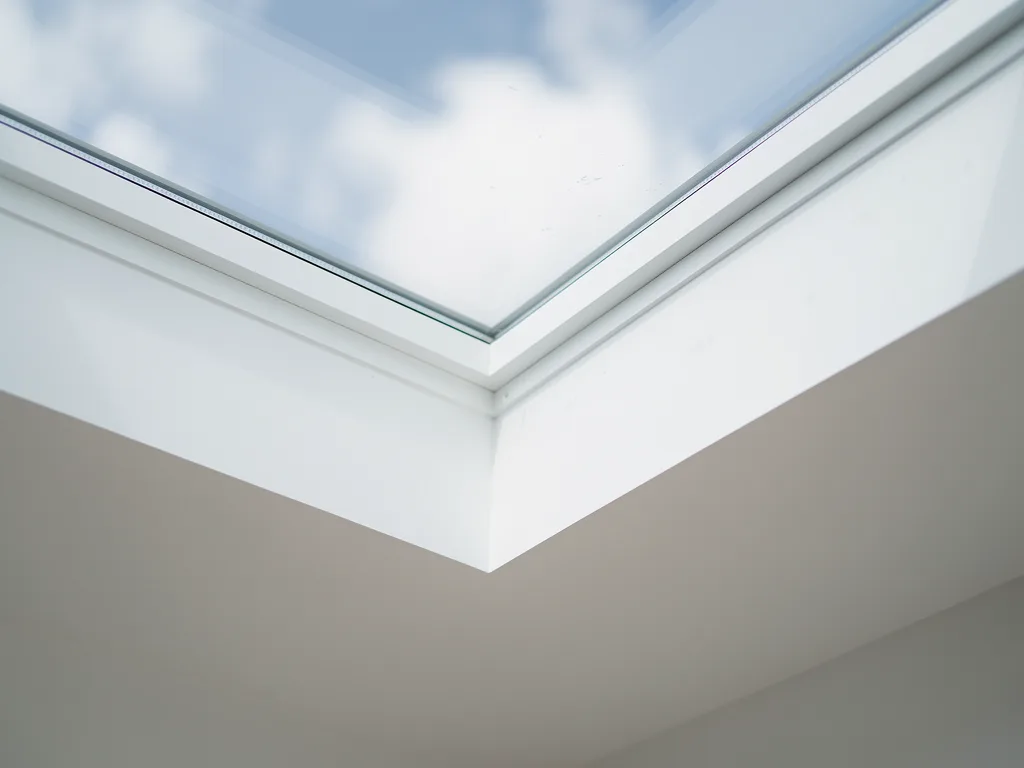
One word, two different faults
"Cloudy" covers two problems that look similar from the sofa but have almost nothing in common once you know where each one sits. One lives on a surface, so a cloth, some rain or the sun sorts it out. The other lives inside the sealed unit itself, in a gap that nothing you do from the room can reach.
Peterborough's rooflights sit under some of the flattest, most open skies in the country out towards the Fens, so any haze across the glass shows up fast against a plain grey or blue sky. Working out which of the two problems it is comes before any talk of replacement.
Haze that sits on the surface
Surface haze sits on the glass itself: the outer face, the inner face, or a coating on either. Every version of it can be explained without opening the sealed unit at all.
On the outer face, low-pitched glass collects dust, pollen and dried rain residue that builds into a fine mineral film, and this shows worst directly under the glass rather than at an angle from the garden. Flat-roofed kitchen extensions across Bretton, Orton and Werrington often carry a rooflight on a low fall, and it is that shallow pitch that collects the most film, since there is less slope for rain to run off with. A self-cleaning outer coating breaks this film down in sunlight and rinses it away in rain, though the coating itself can look faintly milky in patches before it has had a proper wash.
On the inner face, condensation forms on cold mornings when warm, moist room air meets glass colder than the room, the same way it does on any cold single-glazed window. It clears within an hour or two once the room warms or the air moves. Neither of these needs a new glass unit; see Condensation or Misting: Telling the Two Apart for the fuller picture.
Faint rainbow bands across the glass in direct sun are also a surface effect, not a fault: see why rooflight glass sometimes looks rainbow-coloured. Fine white streaks that follow the line of the fall are usually mineral residue too; Why Does My Skylight Have White Streaks? sets out what causes them.
Clouding that lives inside the unit
Internal clouding sits between the panes, inside the sealed unit, where two or three sheets of glass are held apart by a spacer bar and a gas-filled gap.
The spacer bar carries an edge seal running the full perimeter of the unit, keeping the gap filled with an inert gas and keeping moisture out. Once that seal fails, damp air works its way in through the smallest gap. A strip of desiccant packed inside the spacer bar soaks up the first traces, so for a while nothing shows at all. Once the desiccant is saturated, moisture starts to condense on the inside faces of the two panes, in the one place no cloth will ever reach, coming and going with temperature at first before it settles into a permanent haze or streaking that never clears again.
For how that failure starts and spreads, see Mist Between the Panes: How a Rooflight Unit Fails. Seals often show smaller signs before the glass clouds properly, covered in Failed Edge Seals: How to Spot Them Early.
Reading it from the room
A short look from where you actually sit, stand or lie tells you most of what a survey later confirms.
| Sign | Surface haze | Internal clouding |
|---|---|---|
| Timing | Comes and goes with weather or the hour | Stays, and slowly worsens over weeks |
| Location | Wipes off, or sits on the outer face only | Sits between the panes, out of reach |
| Pattern | Even film, or streaks following the fall line | Patchy cloud, sometimes with an edge tint |
What a failed unit means for the fix
Once moisture is confirmed inside the sealed unit, the glass has to come out, and the real decision is how much of the rooflight goes with it.
A straightforward flat rooflight or roof window with a sound frame usually only needs the glass unit replacing within the same frame; a tired or damaged frame, or a bar profile you would rather not keep, points to replacing the whole rooflight instead. Replacing the Glass Unit or the Whole Rooflight sets out how that decision gets made.
A replacement is also a natural point to choose a slimmer frame or a different glass specification, since the unit is coming out either way. Every quote includes a sightline sketch showing what the new glass will look like from where you actually spend time in the room, and the work is carried out to current Building Regulations, with the Building Control notification handled where the job is notifiable. What any of this costs depends on the rooflight and the access; our costs page sets out the general ranges.
Questions people also ask
Does cleaning ever fix cloudy skylight glass?
It fixes the surface kind. A soft cloth, or rain and sun working on a self-cleaning coating, removes dust and mineral film from the outer face and clears condensation from the inner face. It does nothing for clouding between the panes, because that gap sits sealed on both sides.
Can just one pane of a rooflight look cloudy while the rest of the roof stays clear?
Yes. Each sealed unit has its own edge seal, and seals do not all fail on the same day, even on units fitted at the same time. One rooflight clouding while its neighbours stay clear points to that unit's seal, not to the roof as a whole.
Does triple glazing cloud in the same way as double glazing?
The mechanism is the same, but a triple unit has two gaps instead of one, each with its own edge seal. Either gap can fail independently, so a triple-glazed rooflight can show clouding in just one layer while the other stays clear.
Does cloudy glass cut the light in a room, or only spoil the view?
Both. A hazy or clouded pane scatters light rather than passing it through cleanly, so the room reads dimmer and greyer even before you notice the view has gone. The sky above turns from something you can look up into to a flat grey patch overhead.
Book a home visit
Tell us which room
- No obligation
- Sightline sketch included
- 10-year guarantee
Or call 01733 736163