Question · Misted and failed rooflight replacement
Why Is There Water Between My Skylight Panes?
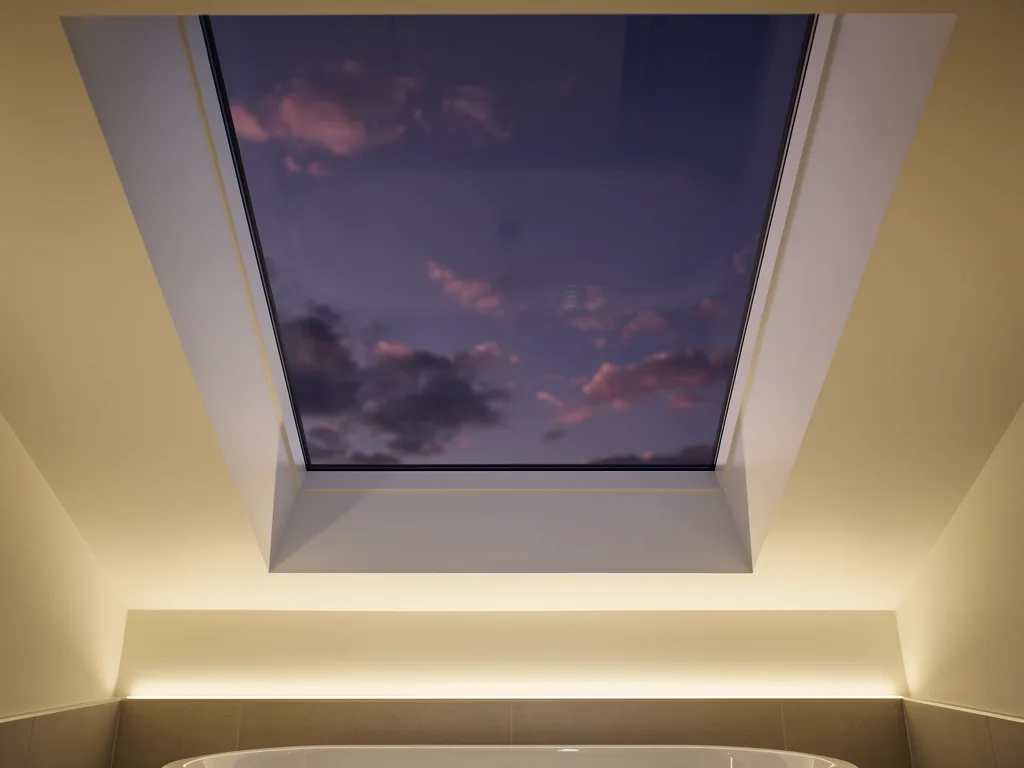
Not haze, and not condensation on the glass
Standing water inside a rooflight pane is a stage further on than the grey haze that usually comes to mind when someone says "misted glass", and it is a different thing again from condensation that sits on the room-side surface. Surface condensation is warm, damp room air meeting a cold pane on a winter morning, and it wipes off with a cloth because it is sitting on the glass, not inside it. What you are describing does not wipe off, because the moisture is trapped in the sealed gap between two sheets of glass, and neither surface you can reach has anything on it at all.
That distinction matters because the two look similar from a few feet away, especially through a loft hatch or from a bed looking straight up. Condensation or Misting: Telling the Two Apart sets out a short test for working out which one you are looking at before assuming the worst, though droplets that sit in exactly the same place every morning, rather than clearing as the room warms, are already a strong sign that this is the sealed unit itself, not the room.
Where the desiccant runs out
Every sealed rooflight pane is built with a strip of desiccant packed into the aluminium or foam spacer bar that holds the two sheets of glass apart. While the seal around that spacer is intact, no moisture reaches it and the gap stays dry. Once the seal starts to let vapour through, as covered in Mist Between the Panes: How a Rooflight Unit Fails, the desiccant absorbs what gets in for a long time before there is any visible sign at all, which is why a unit can look fine for years and then change quickly.
Water appearing rather than haze is what it looks like once that capacity is used up. Failed Edge Seals: How to Spot Them Early describes the stage before this, a line of tiny beads forming along the spacer on cold mornings, which is the desiccant losing its grip rather than losing it entirely. Once it stops absorbing altogether, moisture vapour that gets past the failed seal has nowhere left to go, so instead of being mopped up overnight it condenses straight onto the coldest surface inside the gap as liquid water.
What the water actually does inside the gap
From the room, this stage tends to show in one of a few ways rather than as an even film across the whole pane.
- Droplets or beads strung along the spacer bar, usually thickest in one corner rather than spread evenly.
- A streak or tide line running down the inner face of the glass, where water that has condensed higher up has run and dried repeatedly.
- On a low-pitched rooflight, a pool or a persistently wet-looking band sitting at the lowest corner of the unit's fall, since any moisture inside the gap tends to gather where the glass itself sits lowest.
None of it clears by wiping the inside face, and none of it clears once the sun is on the glass, which is the clearest sign that it is inside the unit and not on it. A pane at this stage can still look almost clear from across the room in flat light and show the water plainly the moment low morning or evening sun catches it at an angle.
Whether it means more than the glass
Water sitting inside the unit for any length of time is not, on its own, a sign that the roof is leaking. A sealed-unit failure and a leak at the frame or the flashing around it are separate faults, and one does not prove the other. Is a misted rooflight a sign of a bigger problem? goes into how a survey checks both rather than assuming the glass explains everything.
What is worth acting on is how long the unit has been left in this state. Water that has been sitting against the inner edge of the glass for a long period can eventually find its way past the spacer into the rebate where the unit sits in its frame, and sustained damp there can swell a timber frame or start corrosion at metal fixing points. When a Failed Frame Means Full Replacement sets out the signs that this has already started, since it changes a straightforward glass swap into a job that replaces the frame as well.
Nothing that dries it out from where you are standing
A sealed unit has no vent and no drain by design, because the gap between the panes is meant to stay closed for the working life of the glass. Once water is sitting inside that gap, there is no route for it to evaporate away for good, whatever is done in the room below. A dehumidifier, extra ventilation or a heater running longer all work on the room side of the glass, and the fault is sealed on the far side of it. Is there any way to clear a misted rooflight pane? covers why none of the usual household fixes reach a fault that has moved this far.
The water may look better on a warm afternoon than a cold morning, since some of it can shift around inside the gap as the glass warms and cools, but that is movement, not clearing. The only way to remove water that is already inside a sealed unit is to replace the unit itself.
What happens at survey
A survey confirms whether the glass alone can be lifted out and a new sealed unit fitted in the existing frame, or whether the frame has been affected for long enough that the whole rooflight needs replacing, a decision covered fully in Replacing the Glass Unit or the Whole Rooflight. Either way, the new glass is specified and placed with the same care as a first-time fitting rather than treated as a like-for-like swap, and every quote comes with a sightline sketch showing the view the new unit will give from the bed, the sofa or the sink in that room.
Where the job involves replacing the whole rooflight rather than just the glazed pane, it is installed to current Building Regulations, and the Building Control notification is handled where the work is notifiable. Every installation carries a 10-year workmanship guarantee. What affects the cost of a rooflight sets out how glass-only and full-frame jobs differ in scope, and the Misted and Failed Rooflight Replacement page covers the wider service if more than one rooflight in the house is showing signs of failing. Book a home visit and a survey settles which route applies to yours.
Questions people also ask
Does water between the panes mean the rooflight is leaking?
Not on its own. A failed sealed unit and a leak at the frame or flashing are separate faults, and one does not prove the other. A survey checks both rather than assuming the glass accounts for everything.
How long can a rooflight be left once water appears between the panes?
There is no fixed limit, but the longer moisture sits against the inner edge of the glass, the greater the chance it reaches the frame rebate and affects the frame itself, turning a glass-only job into a full rooflight replacement. Booking a survey sooner keeps more of that choice open.
Can the water just be drained out of the unit?
No. A sealed unit has no vent or drain, and there is no way to remove water once it is inside the gap without replacing the unit that holds it.
Will the replacement glass mist in the same way?
Not for the same reason, provided it is manufactured and fitted correctly. Every sealed unit eventually reaches the end of its working life, but a properly fitted replacement should give many years of clear glass before it is anywhere near that point.
Book a home visit
Tell us which room
- No obligation
- Sightline sketch included
- 10-year guarantee
Or call 01733 736163