Question
Will I hear the rain on a skylight?
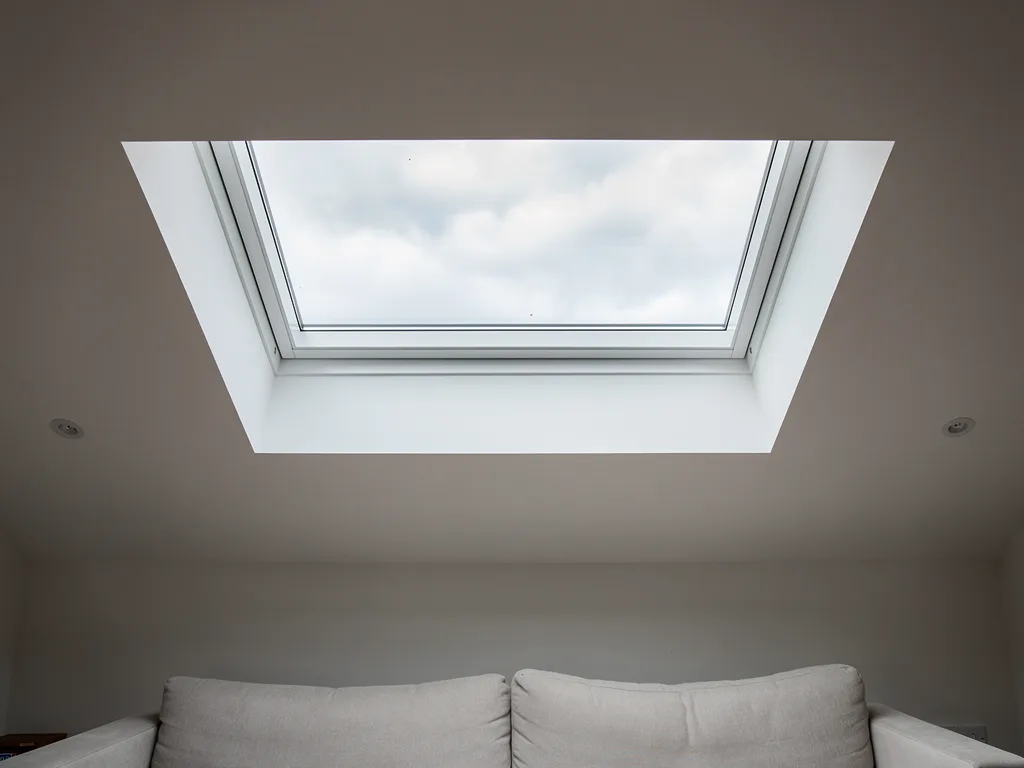
What actually turns rain into sound
Rain does not make noise on its own; it makes noise when it strikes a surface that can vibrate, and the roof around your rooflight decides how much of that vibration reaches your ears. A pane of glass held in a frame behaves a little like a drum skin: strike it with thousands of small drops a second and it moves, however slightly, and that movement pushes sound into the air on the other side. How much movement, and how much of it you hear, comes down to the mass and stiffness of what the rain hits, the air space behind it, and how firmly the whole assembly is fixed.
This is why two rooflights on the same street, in similar houses, can sound completely different in a downpour. One was specified with rain noise in mind, whether by accident or design, and the other was not.
Flat and low-pitch roofs carry more of the sound
A flat or very low-pitch rooflight sits closer to horizontal than a steep roof window, so rain strikes it more directly and at a steeper angle of impact, rather than glancing off a slope. Underneath, a flat roof build-up often has a shallower void between the roof deck and the ceiling below than a loft space does, and less air and insulation between the two means less is absorbed before the sound reaches the room. A single-ply membrane roof with a rooflight set into a small upstand can transmit a steady drumming in heavy rain that the same downpour, falling on a steep slated or tiled pitch above a full loft, would barely register indoors.
None of this rules out a flat roof rooflight; it changes what needs specifying. Our page on flat roof rooflight installation covers how these units are built up, and roof window installation sets out the pitched alternative, where the roof structure itself already does some of the quietening work before the glass is even considered.
The glass build does most of what is left
Once the roof structure is fixed, the glazing unit is where the remaining noise is won or lost. A basic double-glazed unit with two panes of equal thickness has a natural point where sound passes through both panes almost as one, and rain noise sits close to that point. Using two panes of different thickness, or building the unit with a laminated inner pane, breaks up that matching and cuts the sound that gets through, because a laminated pane carries an interlayer between two sheets of glass that damps vibration rather than passing it straight on.
- A laminated inner pane damps vibration through its interlayer, quietening rain and most other impact noise
- Panes of unequal thickness in the same unit avoid the resonance point that matched panes share
- Triple glazing adds mass and an extra air gap, which generally helps, though the improvement over a well-specified double unit is smaller than the jump from single to double glazing
Our guide to the best glass for a skylight weighs these builds against clarity and safety as well as noise, since the same laminated pane that quietens rain is also the one used for safety glazing above a bed or a stair. Keeping rooflight glass clear for years covers the edge seal and coating side of the same unit.
A large pane can drum where a divided one does not
Size plays its own part. A wide, unsupported pane of glass has more surface free to flex than a smaller one held at more edges, and a large single sheet across a wide flat rooflight can pick up a resonance that a similar area split into two or three stiffer sections avoids. This is one of the few places where a glazing bar earns its place on functional grounds rather than looks, since a bar stiffens the glass either side of it as well as dividing the view. Our page on glazing bars and the view looks at the same trade-off from the sightline side, since a bar that quietens a large flat rooflight also sits across the sky from the room below.
What sits below the glass changes what you hear
Sound that gets past the roof and the glazing unit still has to cross the reveal, the lined and plastered opening between the glass and the ceiling below, before it reaches the room. A deep reveal, lined with insulation rather than a thin skim over bare plasterboard, absorbs more of that remaining sound than a shallow one does, in the same way a deep window reveal softens traffic noise more than a flush one. This sits alongside the view the reveal gives you: a deeper, splayed reveal generally opens a wider slice of sky as well as quietening the room, though the two are decided by different parts of the build and are worth discussing together at survey stage.
Our page on choosing a reveal shape goes through splayed, square and deep options for the view; the same choices affect how much rain noise reaches the room, even though that is not its main subject.
Replacing an old unit usually quietens the room, not just the view
An older rooflight, fitted before laminated and acoustic glass builds were common, was often glazed with a basic double unit chosen for cost rather than sound. Whether it is worth replacing old skylights weighs comfort and condensation against keeping a unit going, and rain noise sits alongside those reasons rather than apart from them. Upgrading to a modern sealed unit with a laminated pane, in a reveal lined properly at the same time, tends to bring down both the drumming in heavy rain and the misting that makes an old skylight look dirty from inside, since both come from the same tired glazing unit rather than separate faults.
| Feature | Effect on rain noise |
|---|---|
| Flat or low-pitch roof, shallow void | Carries more of the sound through |
| Steep pitched roof over a full loft | Absorbs most of the sound before it reaches the ceiling |
| Laminated inner pane | Damps vibration and quietens rain noticeably |
| Deep, insulated reveal | Absorbs what little sound gets through the glass |
Where it matters most
Rain noise is rarely a problem worth solving on its own; it matters because of the room underneath. A rooflight over a landing or a bathroom, used briefly and rarely for sleep, can be specified purely for the view and the light without much thought for a downpour. Over a bed, on the other hand, or above a desk used for calls, the glass build and the roof structure around it are worth getting right from the start, since changing them later means opening the roof again rather than a small adjustment. Placing a rooflight over the bed covers the sightline side of that same decision.
We plan every quote around the glass, the roof build and the reveal together, and the sightline sketch that comes with each one shows what you will see from the position that matters, alongside the specification that decides what you will hear. You can start with a home visit for skylight and rooflight work across Peterborough, or see what a full quote sets out on our page about what a skylight quote should include.
Questions people also ask
Does a bigger skylight mean more rain noise?
Usually yes, if it stays as one unsupported pane, since a larger sheet of glass has more surface free to flex. Splitting a large opening into two or three panes, or adding a stiffening bar, generally keeps the noise down without losing much of the total glass area.
Do flat roof rooflights always sound louder than pitched roof windows?
Not always, but they start from a harder position, since the roof structure around a pitched window already absorbs some sound before the glass is even considered. A well-specified flat roof unit, with a laminated pane and a properly built-up roof deck, can be quieter than a poorly specified pitched one.
Does an opening rooflight let in more rain noise than a fixed one?
Closed and sealed, an opening rooflight performs much like a fixed unit of the same glass build, since the vent mechanism sits within the same frame. Left open in the rain, any rooflight lets the sound of rain into the room directly, which is one reason an automatic closer is worth having on an electric unit.
Can a noisy skylight be quietened without replacing the glass?
Not reliably. The things that cut rain noise, the pane build, the roof structure and the reveal lining, are all set when the unit goes in, so a noticeable improvement generally means renewing the glazing unit rather than adding something afterward.
Book a home visit
Tell us which room
- No obligation
- Sightline sketch included
- 10-year guarantee
Or call 01733 736163